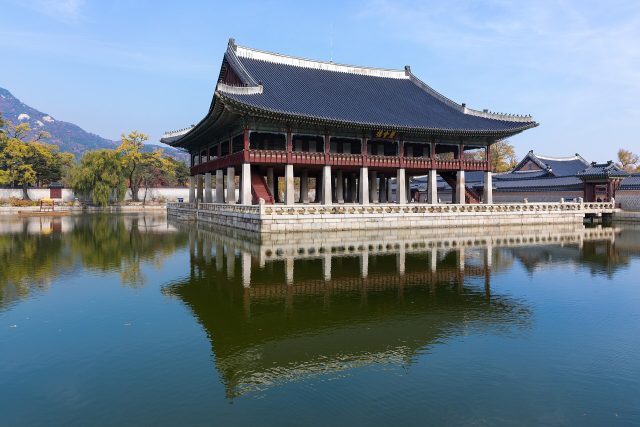
Hwaseong Fortress stands as one of the most ambitious architectural projects of Korea’s late Joseon period, built between 1794 and 1796 under the orders of King Jeongjo. The king had moved his father’s tomb to Suwon, a city about an hour south of Seoul, and envisioned transforming it into a new political and cultural center. What makes Hwaseong remarkable isn’t just its scale—a nearly five-and-a-half-kilometer wall encircling the old city core—but the speed of its construction. Most fortifications of this size took decades to complete, yet this one rose in just two and a half years, a testament to both the king’s determination and the ingenuity of its designers.
The fortress was the work of Jeong Yak-yong, a young scholar who blended traditional Korean techniques with ideas drawn from Chinese and Western texts. He introduced innovations like pulley systems to lift heavy stones, a mix of brick and stone masonry, and carefully calculated angles for defense. Every detail of the construction was meticulously recorded in the *Hwaseong Seongyeok Uigwe*, a comprehensive manual that included blueprints, budgets, and labor logs. This documentation proved invaluable when the fortress was restored in the late 20th century after suffering damage during the Korean War and subsequent urban development.
Walking the fortress walls today feels like stepping into a living diagram of 18th-century military engineering. The perimeter is punctuated by four main gates, each serving a distinct purpose. Paldalmun, the southern gate, was the ceremonial entrance, while Hwaseongmun to the north functioned as a military checkpoint. Along the way, you’ll pass command posts, bastions, and even a set of water gates—an arched structure spanning a stream that once controlled the flow of water into the city. The path along the top of the wall is uneven, rising and falling with the terrain, and a full circuit takes about three hours. The views shift constantly, from the dense urban sprawl of modern Suwon to the quiet, tree-lined streets of the old quarter below.
At the heart of the fortress lies Hwaseong Haenggung, a palace complex where King Jeongjo stayed during his visits to his father’s tomb. Unlike the grand, sprawling palaces of Seoul, this one is more intimate, designed for temporary residence rather than permanent rule. The buildings are modest in scale but rich in detail, with wooden eaves and painted screens that hint at the king’s dual role as both a ruler and a devoted son. Nearby, the fortress walls enclose a neighborhood that has retained its everyday rhythm. A small market bustles with vendors selling street food and souvenirs, while locals go about their routines in the shadow of the historic walls.
Hwaseong’s inclusion on the UNESCO World Heritage list in 1997 recognized its significance as a rare example of late Joseon-era military architecture. Unlike many fortresses, which were built purely for defense, Hwaseong was also a statement of political ambition and filial piety. The king’s vision extended beyond mere fortifications; he wanted to create a self-sustaining city that could rival Seoul. While that dream never fully materialized, the fortress remains a tangible link to a pivotal moment in Korean history.
Visiting Hwaseong is a mix of exploration and reflection. The entrance fee is modest, and while some sections of the wall are free to access, the main gates and palace require a ticket. The best time to walk the walls is early morning or late afternoon, especially in summer, when the sun beats down on the exposed stone. For those who find the uphill stretches challenging, a small tourist train runs along part of the route, offering a breezy alternative. Near the northern gate, visitors can try their hand at traditional archery or take a tethered balloon ride for a bird’s-eye view of the fortress and the city beyond.
What makes Hwaseong particularly engaging is its blend of history and everyday life. The fortress isn’t a sterile museum piece; it’s a place where the past and present coexist. You can start your walk along the walls, pause to watch a group of elderly men playing baduk in the shade of a pavilion, then step through one of the many exits into the modern city. The contrast is striking—the quiet, measured pace of the fortress against the hum of traffic and commerce just beyond its walls. It’s a reminder that history isn’t just something preserved in stone; it’s something that continues to shape the world around it.