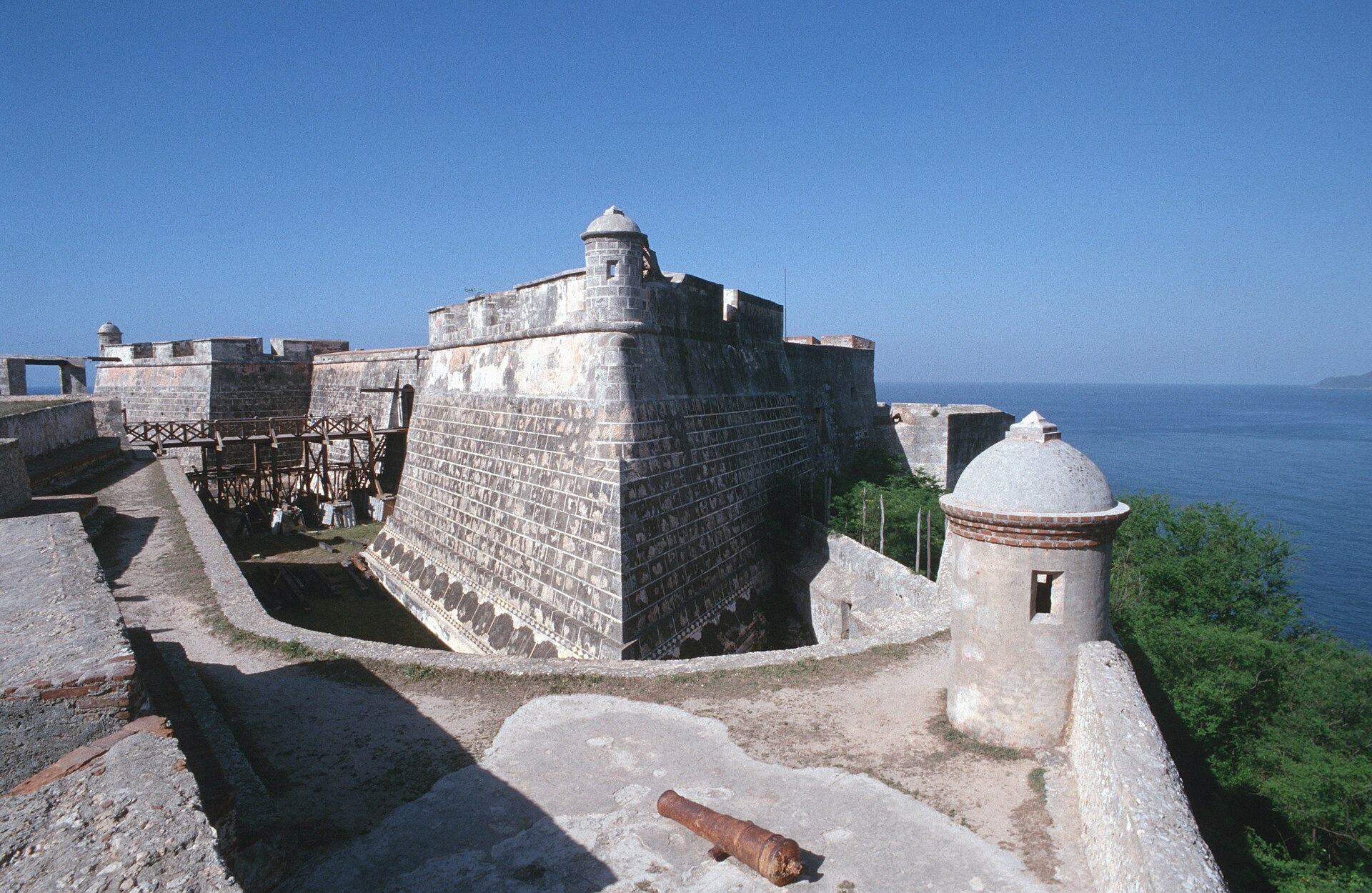
Perched on a rocky promontory at the entrance to Santiago de Cuba’s bay, the fortress of San Pedro de la Roca—known locally as El Morro—is one of the Caribbean’s most striking examples of military engineering. Its massive stone walls were built in the mid-17th century to repel pirates and rival fleets, projecting Spanish power across a region where control of the sea meant control of wealth. The fortress has endured centuries of conflict, its weathered ramparts witnessing the struggles that shaped Cuba’s past.
The design of El Morro shows both ingenuity and necessity. Italian engineer Giovanni Battista Antonelli adapted the fortress to its dramatic setting, using cliffs and ocean as natural defenses. Multiple levels connected by stairways and underground passages allowed defenders to move quickly during attacks. Bastions and gun platforms were arranged to command every approach to the bay. Thick walls of coral stone and mortar rise from the water’s edge, their angles calculated to deflect cannon fire.
Santiago de Cuba’s history is tied to its fortress. Founded in the early 1500s, the city became one of Spain’s most vital ports, funneling silver, sugar, and other riches from the Americas to Europe. This made it a target for raids. By the 1630s, the need for stronger defenses was clear. Construction of El Morro began in 1638 but dragged on for decades due to funding shortages and repeated assaults. The fortress took its final form in the late 1600s, a complex that could house hundreds of soldiers and dozens of cannons.
El Morro’s past is violent and resilient. In 1662, English forces under Christopher Myngs captured and looted Santiago, damaging parts of the fortress. Later, French privateers tested its defenses. During Cuba’s 19th-century wars for independence, the fortress served as a prison for revolutionaries. The cells where political prisoners were held still exist, their walls a reminder of suffering.
Now a UNESCO World Heritage site, El Morro draws visitors for its views and artifacts. Climbing to the upper battlements offers sweeping views of the bay, where fishing boats drift on turquoise waters. Inside, rusted cannons point toward the horizon. A small museum displays uniforms, weapons, and personal items of the soldiers who once stood guard here.
Visit in late afternoon. The sun casts long shadows, and the heat fades. Fewer tourists linger, leaving the fortress quiet. Waves crash against the rocks below, seabirds cry, and the breeze carries salt and dry earth. Locals sit on benches, watching the water or sharing a meal on the terraces.
UNESCO listed El Morro in 1997 as a masterpiece of Spanish colonial military architecture. It survives from an age when empires clashed over trade routes. Yet its significance goes beyond stone. The fortress was built to enforce control but became a symbol of resistance. It was designed to keep enemies out but ended up holding those who fought for freedom. Its stones tell stories of ambition, betrayal, and endurance.
Walking through El Morro feels like stepping into history. The worn steps, the chipped cannons, the narrow passages—they show the fragility of power and the stubbornness of those who sought to claim it. The bay below was once a gateway to the New World, where fortunes were made and lost. Today, the fortress stands as a monument to that era. The past isn’t as distant as it seems. The pirates and soldiers are gone, but their presence lingers in the salt air and the echo of footsteps on stone.