Qaitbay Citadel stands on Alexandria’s coastline, where the Mediterranean meets the weight of centuries. Its stones have watched over the harbor for over five hundred years, but the story of this place begins earlier. The island of Pharos once held the Lighthouse of Alexandria, one of the ancient world’s most legendary structures. Though the lighthouse is gone, its legacy remains in the fortress’s foundations, a reminder of Alexandria’s role as a crossroads of knowledge, trade, and power.
The citadel is named after Sultan Al-Ashraf Qaitbay, who ruled Egypt in the late 15th century. The Mamluk Sultanate was still strong then, though the Ottomans threatened its future. Qaitbay built mosques, madrasas, and fortifications across Egypt. The fortress on Pharos was one of his last major projects, designed to protect Alexandria’s harbor from naval attacks. The Mediterranean was a battleground, with Mamluks, Ottomans, and European powers competing for control.
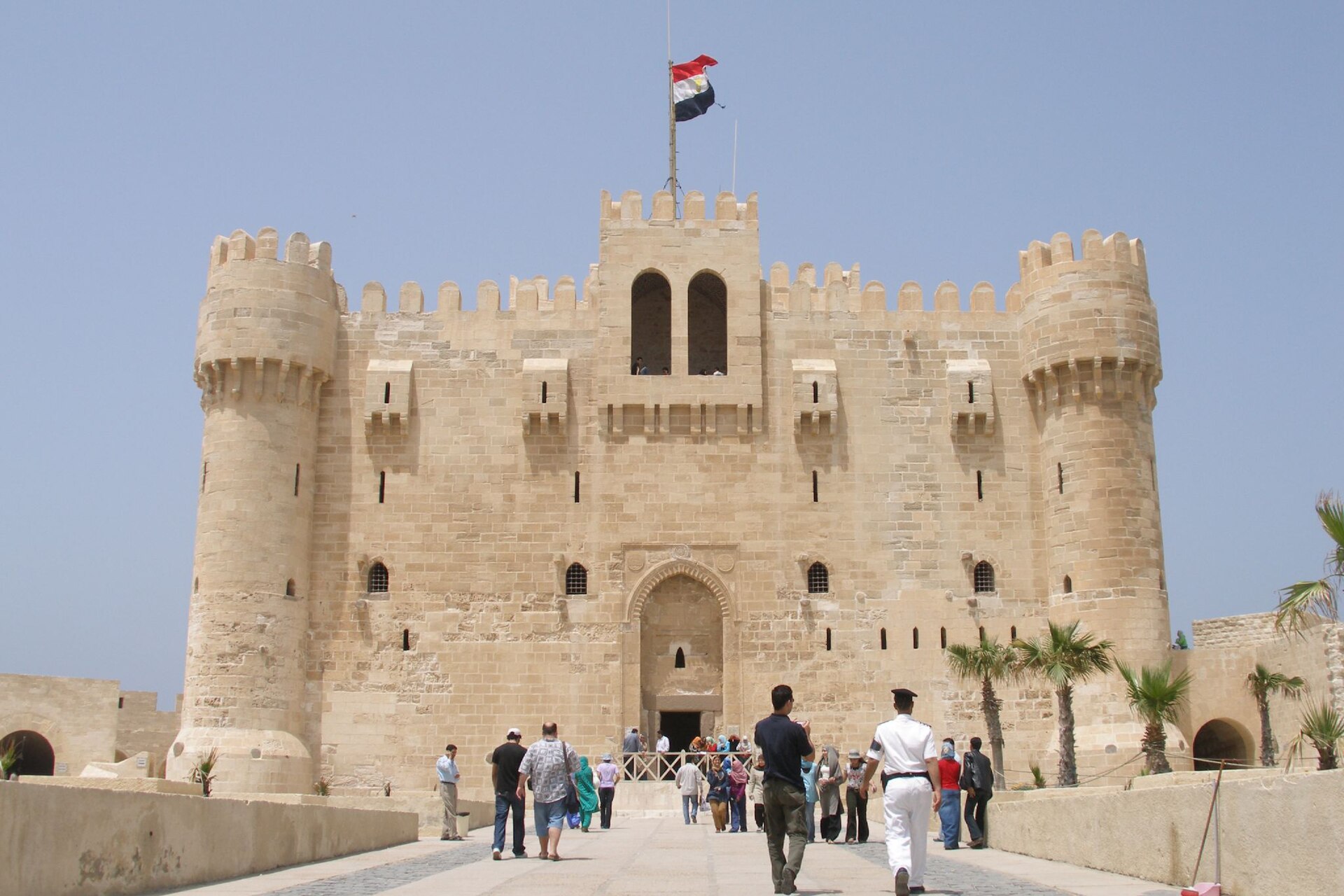
The citadel’s architecture is purely functional. Thick limestone walls, reinforced with square towers, rise from the rocky shore. Narrow arrow slits cut through the stone. The entrance is shielded by the remnants of a moat and a drawbridge—now replaced. Inside, a small mosque with a slender minaret still stands, alongside barracks and underground cisterns that once held water for the garrison.
From the upper terrace, the view takes in the harbor and the city. Modern buildings stand beside ancient stones. On clear days, the outline of the island where the lighthouse once stood is visible. At sunset, the water turns gold and rose, and the city’s lights flicker below.
The citadel has seen conflict. In 1798, Napoleon’s forces attacked, but the garrison held. By the 19th century, its military role had faded, and it fell into disrepair. Restoration in the mid-20th century turned it into an open-air museum. Visitors see fragments of the past: stone blocks from the lighthouse, pieces of ancient columns, and pottery from different eras.
Why does this place feel different?
The sea is always there. Its waves crash against the walls, its salt lingers in the air. You can almost hear the shouts of Mamluk soldiers watching for enemy sails or the creak of merchant ships anchoring in the harbor.
A visit here changes how you see Alexandria. From its heights, the city unfolds along the coast—hotels, quiet mosques, ports. The sea stretches endlessly, its surface shimmering. The past is still here, in the shadows of the fortress.
This isn’t a place of grand monuments. It’s a site where history is felt in every stone. The citadel has survived storms, battles, and time. For those who want to understand Egypt beyond the pyramids, it offers a different kind of legacy—one of trade, conflict, and the meeting of cultures. The Mediterranean’s waves still carry the stories of those who came before.