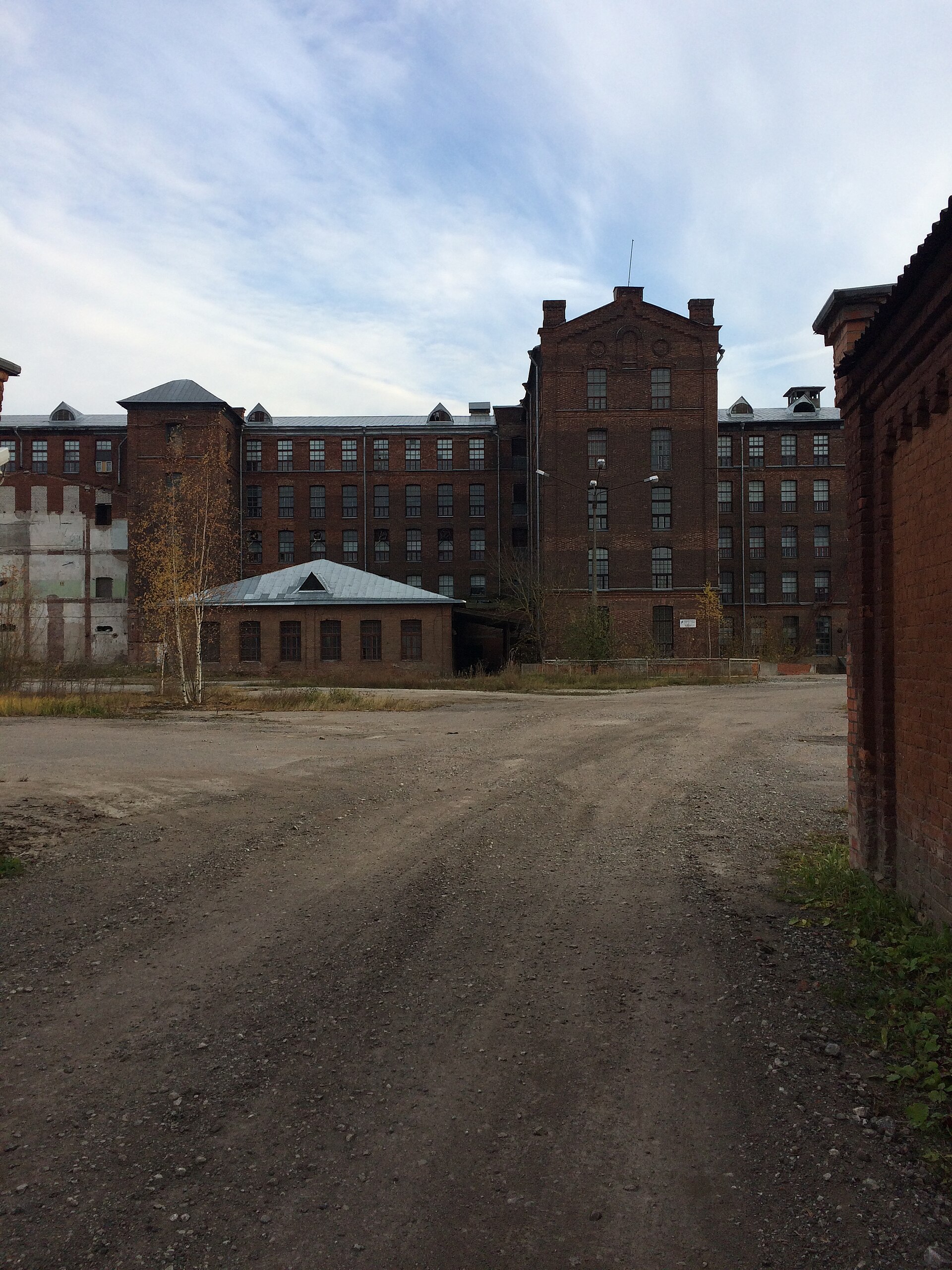
Narva’s Krenholm Manufacturing Complex stands on the banks of the Narva River, directly on the border with Russia. For over a century, this factory was the largest textile mill in Europe, shaping the city’s identity under the Russian Empire and later the Soviet Union. Its red-brick structures—some still operational, others abandoned—preserve the era when industry defined daily life here.
The mill’s history began in the mid-19th century when Ludwig Knoop, a German-Baltic industrialist, utilized the Narva River’s current to power machinery. By the late 1800s, the factory employed thousands, many relocated from across the empire. The architecture reflects this expansion: long, low buildings with tall windows, chimneys, and occasional decorative elements that reveal the wealth produced here.
The main halls, now partially empty, once housed spinning and weaving operations. Workers—often women and children—labored in shifts that exceeded modern standards. The factory was a self-sufficient ecosystem: housing, schools, hospitals, and a fire brigade were all part of the complex. The workers’ quarters, still visible, contrast sharply with the administrative buildings, illustrating the hierarchy of the company town.
The 20th century tested Krenholm’s resilience. During World War I, equipment was dismantled and moved deeper into Russia. Rebuilt in the 1920s, the factory was damaged again in World War II when Narva became a battleground. Under Soviet rule, it was revived as a state-owned enterprise, supplying textiles for the planned economy. For decades, it remained central to Narva’s identity, even as the city’s proximity to the Soviet border isolated it from the rest of Estonia.
After Estonia regained independence in 1991, Krenholm confronted new challenges. The Soviet market collapsed, and privatization efforts in the 1990s and 2000s led to mixed outcomes. Some buildings were repurposed for smaller industries, while others decayed. Once employing over 10,000 people, the mill now operates at a fraction of its former capacity but remains economically significant for Narva.
Krenholm’s appeal today lies in its connection to Narva’s layered history. The city is Estonian yet Russian-speaking, European yet tied to the East, industrial yet surrounded by nature. The factory mirrors these contradictions. Its walls have witnessed empires rise and fall, workers’ lives unfold, and borders shift. For visitors, it offers more than industrial history—it’s a place where the past lingers.
The future of Krenholm is unclear. Some buildings are being restored, while others await their fate, dependent on Narva’s economic trajectory. Yet the complex retains a quiet presence. The river that powered its looms still flows, carrying the same water that once transported cotton and finished fabrics. The chimneys, now silent, still dominate the skyline, marking the energy that once defined this place.
If you visit, explore the details. A worn staircase, faded paint on a door, or light through broken glass often reveals more than the grand architecture. The decay holds its own beauty, a reminder of time’s passage. You might even encounter someone who worked here—someone who can recount what it was like when Krenholm was Narva’s heartbeat. Those stories make the place real.