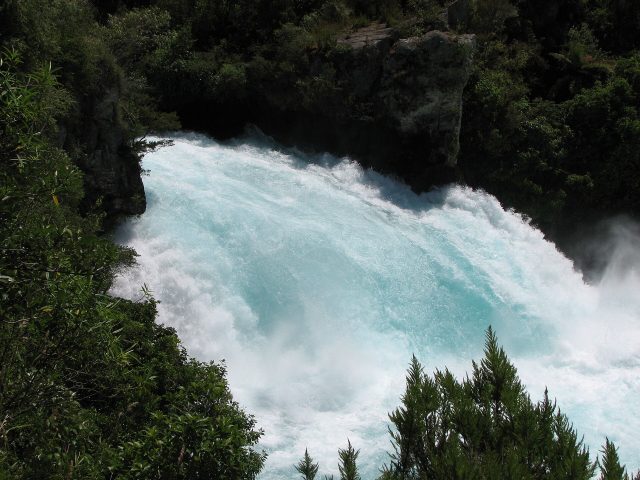
Lake Rotopounamu lies in the heart of New Zealand’s North Island, where the land bears the marks of ancient volcanic fire. Unlike Lake Taupo nearby, this place feels secluded—a near-perfect circle of blue-green water cradled by low hills. It formed around 9,000 years ago when an eruption sent ash and pumice into the sky, collapsing the earth into a caldera. Rain and snow filled the hollow over time, creating a lake that appears deceptively still.
The water’s unusual color comes from volcanic glass particles suspended in it, scattering light. It’s shallow for a volcanic lake, barely reaching 100 meters at its deepest, yet its clarity makes it seem bottomless. The surrounding landscape is rugged—grasses and shrubs cling to rocky soil, their roots anchored in earth that once boiled with molten rock. The land feels raw, as if it hasn’t yet recovered from the forces that shaped it.
Most visitors come for the quiet.
Rotopounamu doesn’t draw crowds. On weekdays, the shore might be empty. The silence is broken only by birdsong or wind through the tussock. Walking tracks loop around the lake, leading to viewpoints where the landscape unfolds in layers: water, hills, then the distant peaks of Tongariro National Park. The steep climb to Ngāuruhoe’s summit takes about an hour. From the top, the volcanic plateau stretches out, with Mount Ruapehu’s snow-capped cone visible on clear days. The effort is worth it—the space up there makes everything else feel distant.
For Māori, this place holds stories older than the lake itself. One legend tells of Ngātoro-i-rangi, a chief who lit a fire here for warmth. The earth split beneath him, flames surged, and the crater formed. The name Rotopounamu means "the place where fire meets water." Even now, the air feels heavy with history, or perhaps just the quiet presence of a landscape that has witnessed so much. People come to sit by the water, walk the tracks, or simply be still.
The water stays cold year-round. Swimming is rare, though a few wade in during summer. Fishing, though, is different. Rainbow trout thrive here, and anglers often arrive at dawn, casting lines into the mist. There are no boat rentals or charters—just the lake, the fish, and the occasional splash of a rising trout. The lack of amenities is part of the appeal; this isn’t a place for convenience, but for those who prefer solitude over ease.
The weather shifts as unpredictably as the landscape. Summer mornings may start with golden light, then darken with rain by midday. Winter brings frost and snow, turning the hills white. Spring and autumn are gentler, with tussock grass shifting from gold to green, and wildflowers appearing on the slopes. The seasons feel pronounced here, each change in light or temperature altering the mood.
To get here, drive from Taupo toward Tongariro National Park, then turn onto a gravel road. The last stretch is unpaved and can be slippery after rain. There’s no public transport, but local operators run day tours. No overnight stays are possible—there are no campsites or lodges nearby. Most visitors come for the day, bringing food and water.
What makes Rotopounamu special isn’t just the scenery. There are no cafes, no gift shops, no distractions—just the lake, the hills, and the sky. You could spend hours walking, sitting by the water, or watching the light shift. It’s a place that stays with you, not because of anything dramatic, but because of the quiet it offers. In a fast-moving world, that stillness is rare.