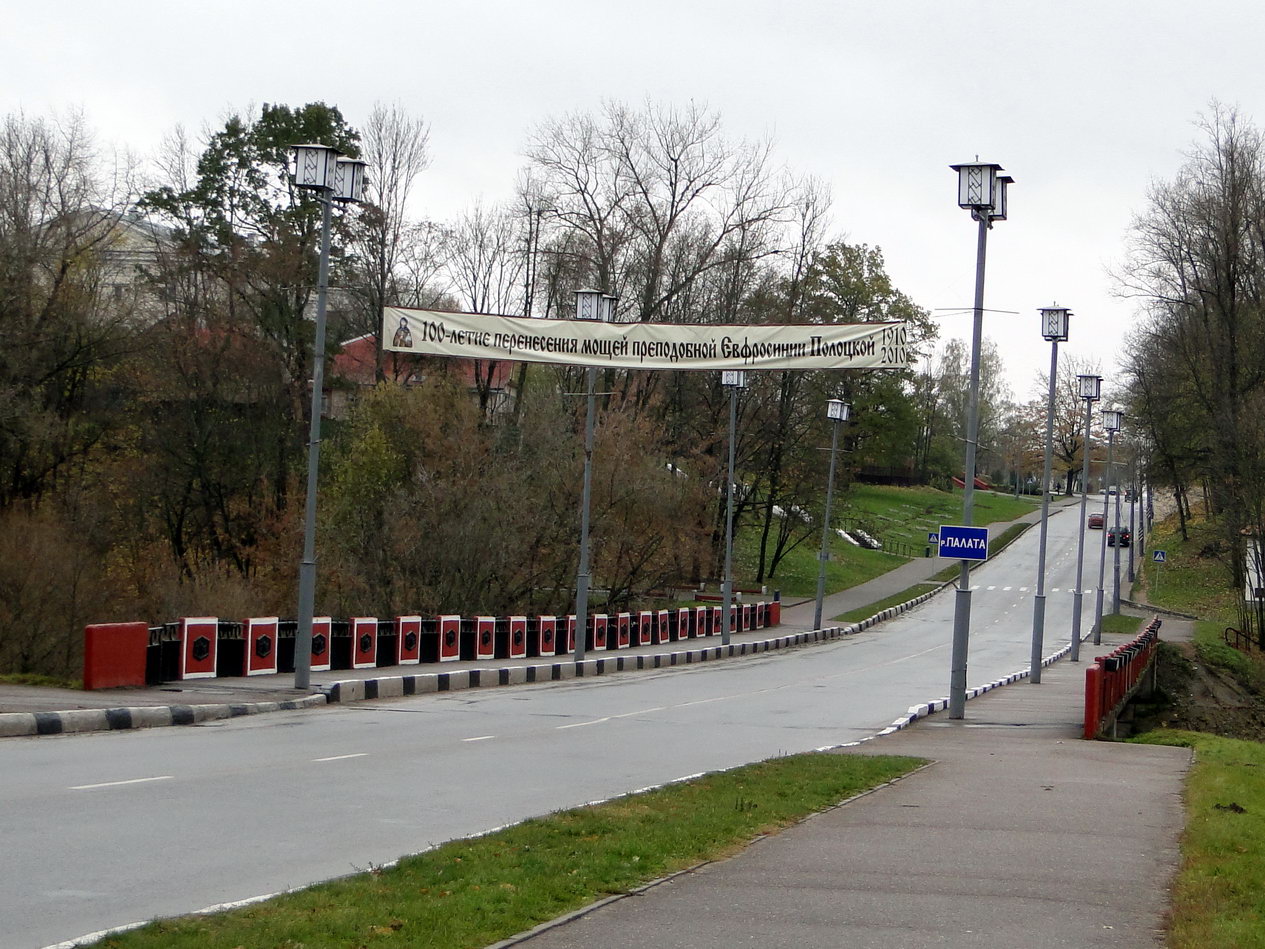
The Red Bridge in Polotsk is one of those places that doesn’t immediately catch the eye, but reveals its quiet charm once you learn its story. Spanning the Polota River, a small tributary of the Western Dvina, it connects the city’s historic center with its older outskirts. The bridge is unassuming in design—low, modest, and built to last. Its red hue, which gives the structure its name, isn’t bold or flashy; instead, it carries a sense of understated dignity, as if the bridge itself remembers the days when Polotsk was a key city in the Grand Duchy of Lithuania.
Built in the mid-19th century, the bridge was part of a broader effort to modernize Polotsk as it grew into an important trade and transport hub. At the time, the city lay along vital routes linking the western provinces of the Russian Empire with the Baltic region and Europe. The bridge was constructed from brick and stone, materials chosen for their durability, and it reflected the era’s belief in progress—not just as a practical crossing, but as a symbol of a city moving forward. These kinds of structures were more than just functional; they represented the ambitions of their time.
The name "Red Bridge" likely comes from the color of the bricks used in its construction. Red brick was common in 19th-century architecture, but in Polotsk, it was used in a way that made the bridge feel like a natural part of the landscape. The city at the time was a mix of wooden and stone buildings, and the slow-moving Polota River added to the sense of timelessness. Locals quickly grew accustomed to the bridge, and it became a familiar feature of the cityscape, blending seamlessly into the surroundings.
Today, the Red Bridge serves as a subtle dividing line between different eras of Polotsk. Walking toward the city center from the bridge, you enter a world of narrow streets and low-slung buildings, where time seems to move at a slower pace. Here, 18th- and 19th-century architecture still stands, and in places, you can find even older structures that hint at Polotsk’s status as one of Belarus’s oldest cities. In the other direction, the bridge leads to a more modern part of town, where life feels faster and the buildings less distinctive. Yet even here, on the outskirts, the past isn’t entirely absent.
What makes the Red Bridge special is that it has never been a major tourist attraction. Unlike Polotsk’s famous St. Sophia Cathedral or the Epiphany Monastery, it doesn’t appear in guidebooks or draw crowds. And that’s part of its appeal. The bridge doesn’t demand attention or try to impress visitors; it simply exists, woven into the fabric of daily life. Locals cross it without a second thought, while travelers often overlook it in their rush to see more famous sights. But if you pause on the bridge and take a closer look, you’ll notice how well it fits into the landscape—the way the Polota River flows past old embankments, how the sunlight dances on the water, how the bridge itself seems to belong to the city as much as the trees or the cobblestone streets.
The Red Bridge changes with the seasons. In summer, its bricks take on a warm, almost lively glow, while the greenery along the riverbanks adds a sense of comfort. In autumn, it becomes part of the golden landscape as leaves fall and the river turns a steely gray. Winter covers it in snow, giving it a quiet, romantic air, and in spring, when the Polota swells with meltwater, the bridge seems to hover above the rushing current, a reminder of nature’s power. No matter the season, it remains a silent witness to the city’s rhythms, unchanging yet always seen differently by those who pass over it.
More than just an engineering feat, the Red Bridge is a layer of Polotsk’s cultural history. It has survived wars, political upheavals, economic crises, and shifts in urban development. During the Soviet era, it was repaired several times, but efforts were made to preserve its original appearance. Today, it looks much as it did a century and a half ago, with only minor updates—like modern paving on the roadway—to show the passage of time. Yet even these small changes haven’t disrupted its sense of continuity. The bridge still serves its purpose while standing as a monument to the past.
For those who enjoy unhurried exploration, the Red Bridge can be a starting point for discovering Polotsk. From here, it’s easy to head toward the historic center, where the city’s main attractions are clustered, or to wander into quieter neighborhoods where life moves at a gentler pace. The Polota River itself is worth a closer look—narrow but full of character, with scenic banks that draw fishermen in the summer and ice-skaters in the winter. The bridge, meanwhile, offers a place to pause, to watch the water flow, or simply to enjoy a moment of stillness.
The Red Bridge doesn’t claim to be Polotsk’s most important landmark, and it doesn’t need to be. It exists as part of the city’s everyday fabric, a reminder that history isn’t just made of grand events and famous names, but also of small, enduring details. Walking across it is a way to connect with the past without reading plaques or listening to guides. You only need to look around to understand that Polotsk is more than its ancient churches and museums—it’s a living city where every street and every bridge has a story of its own.