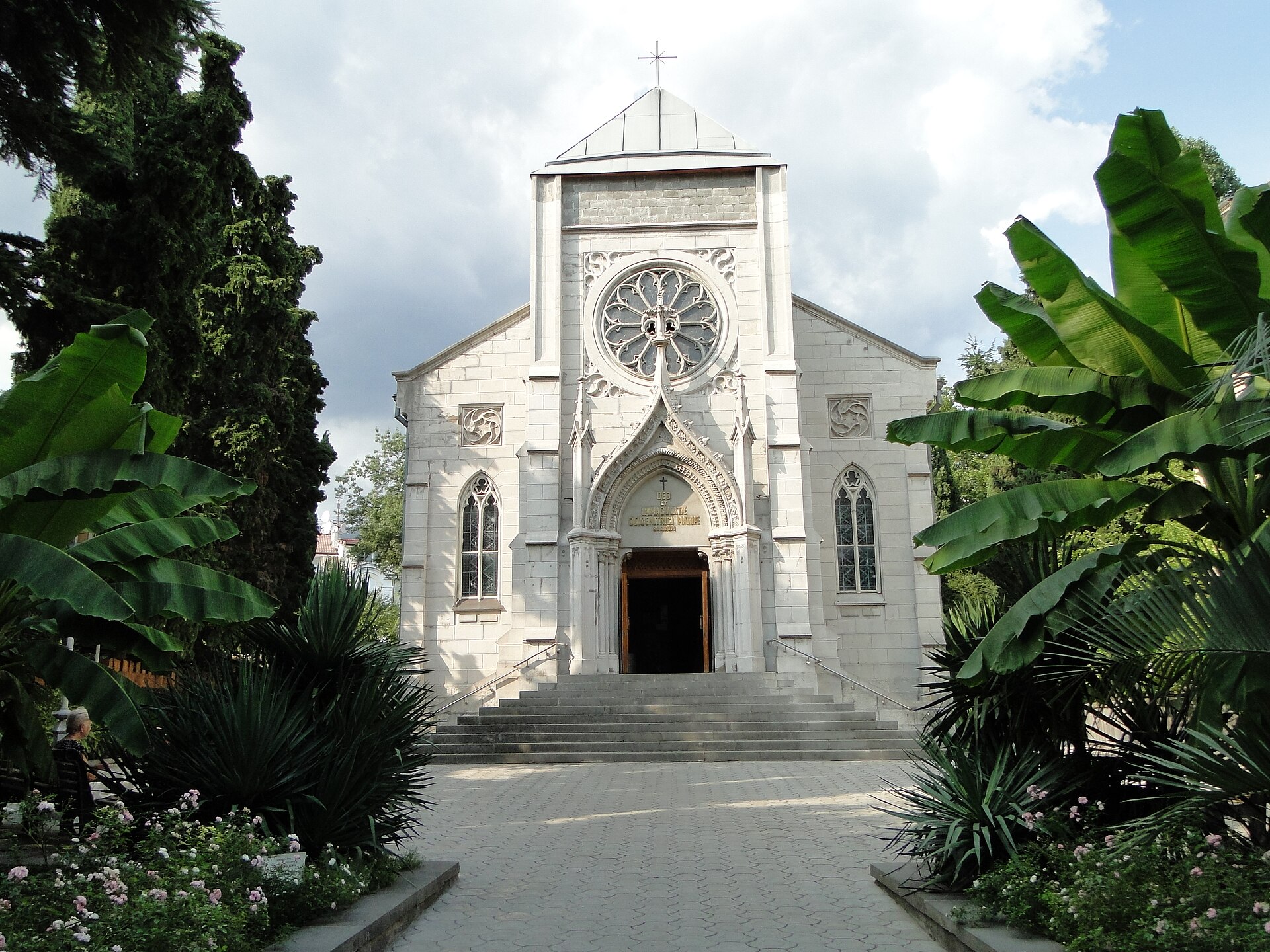
The Catholic church in Yalta is one of those rare places that seems to exist outside of time, preserving the spirit of an era long past. Built in the late nineteenth century, it stands not just as a religious structure but as a silent witness to the transformations that swept through Crimea over the decades. Its architecture blends neo-Gothic elements with the refined details typical of Catholic churches of that period. Tall, pointed windows and delicate tracery on the facade give the building an airy elegance, despite the solidity of its stone walls. Inside, the space feels open and luminous, with stained glass that, though not as vivid as in grand European cathedrals, casts a soft, tranquil light over the interior.
The history of this church is deeply intertwined with Yalta’s rise as a fashionable resort destination. By the late 1800s, Crimea had become a favored retreat for the Russian aristocracy and wealthy travelers from across Europe. Among them were many Catholics—Poles, Germans, French, and Italians—who sought a place to practice their faith. The church was built to serve this diverse community, its construction beginning in 1891 under the direction of architect Nikolai Krasnov. Krasnov was a prominent figure in Yalta’s architectural landscape, known for designing the Livadia Palace and many other buildings that now define the city’s character.
Though modest in size, the church played an outsized role in the lives of its congregation. During the Soviet era, like countless other religious sites, it was repurposed—first as a warehouse, later as a concert hall. It wasn’t until the 1990s that the building was returned to the Catholic community. After restoration, it resumed its original function, becoming one of the few active Catholic churches on the peninsula.
From the outside, the church appears unassuming, and that is part of its charm. It doesn’t aim to overwhelm with grandeur like some of Europe’s great cathedrals; instead, it fits seamlessly into Yalta’s urban fabric. Located in the heart of the city, it stands near other historic buildings, parks, and the seaside promenade. The bustle of the resort town fades away once you step inside, where the atmosphere is always quiet, even when the church is full. Sunlight filters through the stained glass, gently illuminating the wooden pews and altar, creating a sense of warmth and serenity.
For many locals and visitors, the church is more than just a place of worship—it’s a symbol of cultural heritage. Organ concerts are held here, drawing classical music enthusiasts. The sound of the organ resonates through the space, adding a layer of solemnity and depth. In those moments, the church becomes a meeting point for art and spirituality, offering something meaningful to everyone who enters.
While Yalta is often associated with Orthodox churches and imperial palaces, this Catholic church holds a unique place in its history. It serves as a reminder that the city has always been a crossroads of cultures and traditions. On Crimea’s southern coast, the destinies of people from different backgrounds and faiths have long intertwined, and this church is one of the few remaining testaments to that diversity.
Today, the church continues its quiet existence. It may not be as famous as other landmarks in Yalta, but those who visit often remark on its distinctive atmosphere. There are no crowds of tourists here, no rush for photographs—just a peaceful space where one can pause, reflect, or simply appreciate the beauty of the architecture. Its true value lies not in fame but in its ability to offer solace and inspiration to anyone who walks through its doors.