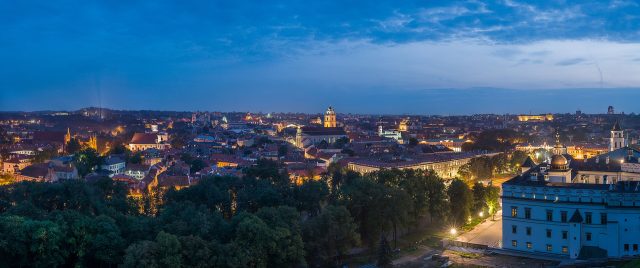
Stepping into the Church of St. Peter and Paul in Vilnius is like crossing into another world. From the outside, it appears as a restrained example of Baroque architecture—clean lines, modest ornamentation, nothing that immediately demands attention. But the moment you pass through its doors, the simplicity of the facade gives way to an explosion of white stucco, hundreds of sculptures, and the soft play of light filtering through tall windows. Every surface, from the vaulted ceilings to the columns and even the chandeliers, is covered in intricate carvings: saints, angels, mythological figures, and allegorical scenes unfold in a dizzying display. There is no empty space here, no unadorned corner. The architects and sculptors who worked on this church seemed determined to fill every inch, as if competing to see who could create the most elaborate detail. In the end, the true triumph was not any single element, but the overwhelming sense of abundance itself.
The church’s history begins in the 17th century, when Vilnius was one of the largest cities in the Polish-Lithuanian Commonwealth. The site had previously been home to a wooden church, destroyed during the war with Russia. The new stone structure was commissioned in 1668 by Michał Kazimierz Pac, a nobleman and military leader who wanted to commemorate his victory over Russian forces. Pac was also a patron of the arts, and his choice of location was deliberate. The church was built on the outskirts of the city, in Antakalnis, an area once home to pagan shrines. Some suggest that Pac intended the church as a symbolic assertion of Christianity over the older beliefs that had once held sway here.
Construction stretched over several decades, with some of the finest craftsmen of the era contributing to its creation. The initial design is attributed to the Italian architect Giovanni Battista Frediani, though the church’s final form took shape after his death. A key figure in shaping its interior was the sculptor Pietro Perti, who arrived in Vilnius from Milan with a team of woodcarvers and plasterers. It was their hands that brought to life the hundreds of figures that now fill the space. The stucco work here is more than mere decoration—it is a carefully constructed narrative. The vaulted ceiling depicts scenes from the lives of Saints Peter and Paul, while the walls are lined with allegories of virtue and vice, a visual reminder of the moral choices that define human existence.
What sets the Church of St. Peter and Paul apart from other Baroque churches in Europe is its restraint. Unlike the gilded opulence of Italian churches, where gold leaf and vibrant colors dominate, this space is almost entirely white. The effect is one of lightness, as if the figures are suspended in midair. Sunlight streaming through the large windows casts shifting shadows, giving the static sculptures a sense of movement. The high altar is particularly striking, with its central statue of the Virgin Mary and Child surrounded by a swirling cloud of angels. The composition feels alive, as though the figures might step down from their pedestals at any moment.
Over the centuries, the church has undergone several restorations, though its interior remains largely unchanged. It survived the devastation of World War II, when many of Vilnius’s other churches were destroyed or looted. During the Soviet era, it was repurposed first as a warehouse and later as a museum of atheism, yet even then, the stucco work was left untouched. Perhaps the authorities recognized that destroying such a masterpiece would have been an act of vandalism. Today, the church is once again an active place of worship, hosting services, organ concerts, and guided tours. Yet it retains a unique atmosphere—part museum, part living sanctuary, where the past and present coexist seamlessly.
For many visitors, the Church of St. Peter and Paul is more than just an architectural landmark; it is a place where the spirit of old Vilnius lingers. Unlike the bustling Old Town, with its crowded streets and tourist routes, Antakalnis is a quiet neighborhood where time moves at a slower pace. The area around the church has preserved its historic charm, with narrow streets, old mansions, and a small park where locals walk their dogs or push strollers. The church itself sits on a slight elevation, approached by a tree-lined path. In summer, the green foliage contrasts beautifully with the white walls, while in winter, snow transforms the building into something out of a fairy tale.
The church was originally intended to be part of a larger monastery complex, but the monastery was never completed. Instead, a cemetery was established nearby, where Vilnius’s nobility and prominent citizens were buried. Some of the old gravestones still remain, including those of the Pac family and other influential figures from the Grand Duchy of Lithuania. Though the cemetery is no longer active, its presence adds a layer of quiet melancholy to the site. It serves as a reminder that behind the grandeur of the stucco and the soaring arches lies the history of ordinary people who once lived, prayed, and were laid to rest here.
There is something deeply human about the Church of St. Peter and Paul. It is not a place that overwhelms with its scale or ostentation, but rather one that invites contemplation. Visitors often find themselves spending hours here, tracing the details of the carvings, deciphering the symbolism, or simply watching how the light shifts across the white surfaces. Each visit reveals something new—a hidden figure in the ornamentation, an unexpected gesture in a statue, or the way a beam of sunlight illuminates a particular scene. It is a rare example of art that does not impose itself but instead sparks curiosity and wonder. Perhaps that is why the church remains one of Vilnius’s most beloved places, cherished not just by tourists but by the city’s residents as well. It does not demand attention, yet it leaves no one indifferent, offering instead a quiet sense of encountering something truly extraordinary.