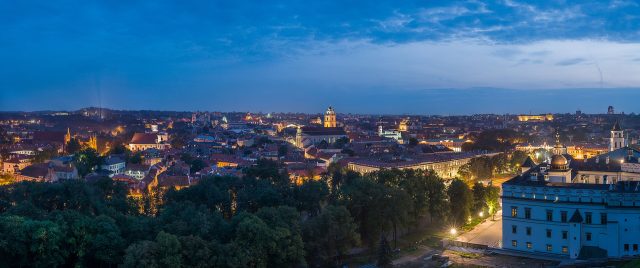
St. Catherine’s Church in Vilnius is one of those quiet places that doesn’t demand attention at first glance. Tucked away on a side street in the Old Town, it stands apart from the usual tourist paths, and that’s precisely what makes it special. While the rest of the city hums with activity, here the pace slows, as if the building itself has chosen to step out of time for a moment.
The church’s architecture tells a story of shifting tastes and ideas. Originally built in the late 18th century in the ornate late Baroque style, its facade was later redesigned in the 19th century to reflect the cleaner, more restrained lines of Neoclassicism. The result is an intriguing contrast—elaborate Baroque details meet the symmetry and simplicity of Classical design. Inside, the atmosphere remains firmly rooted in the 18th century, with high vaulted ceilings, soft light filtering through stained glass, and faded frescoes that seem to whisper stories of the past.
Like many churches in Vilnius, St. Catherine’s has lived multiple lives. During the Soviet era, it was repurposed as a warehouse and later as a concert hall. These transformations left their mark—peeling plaster in some corners, traces of shelves or equipment in others, and patches where restoration work has brought the old murals back to life. Rather than detracting from the experience, these signs of history add a layer of depth, as if the walls themselves remember what they’ve witnessed.
Today, the church serves its original purpose once again, though not exclusively. It has also become a venue for organ and classical music concerts, where the acoustics take on a life of their own. The sound here is rich and resonant, filling the space in a way that feels almost tangible. Attending a performance can be a transporting experience, imagining how the music might have sounded when the church was first built, its notes echoing under the same vaulted ceilings.
Outside, a small park surrounds the church, a favorite spot for locals to unwind. In summer, the rustling leaves create a gentle soundtrack, while in winter, snow blankets the benches and pathways, turning the scene into something out of a quiet postcard. It’s not a place for loud gatherings but rather for solitude, for sitting in silence and letting the weight of history settle around you.
St. Catherine’s is more than just an architectural landmark. It’s a living space that has evolved alongside the city, bearing witness to wars, political shifts, and changing fashions. Yet through it all, it has retained its essence. There’s no grand spectacle here, no overstated drama—just the quiet presence of time etched into its walls. That authenticity is what draws people in, offering a moment of stillness in a city that’s always moving.