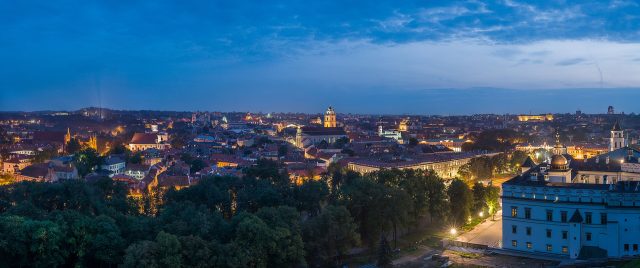
St. Raphael the Archangel Church in Vilnius is one of those quiet places that doesn’t demand attention but lingers in the memory long after you’ve left. Tucked away on the banks of the Vilnia River, just beyond the usual tourist paths, its unassuming facade might easily be overlooked. Yet those who take a moment to step inside discover something far richer than an old building—here, history breathes alongside the everyday life of the city.
Built in the mid-18th century, the church stands as one of the last Baroque structures in Vilnius, erected at a time when neoclassicism was already gaining ground. It replaced an earlier wooden church that had suffered through fires and wars, a common fate for many places of worship in this part of Europe. The architect, Johann Christoph Glaubitz, was a master of Vilnius Baroque, known for blending grandeur with an almost effortless harmony of proportions. The church’s facade, with its twin towers, graceful pilasters, and undulating cornices, manages to feel light despite the weight of its stone. Inside, the space is less about opulence and more about a quiet dignity—high vaulted ceilings, soft light filtering through stained glass, and an atmosphere that invites stillness.
The church is dedicated to St. Raphael, the patron saint of travelers and healers, a detail that adds a layer of meaning for those who come seeking solace or a brief respite. The main altar, with its depiction of the archangel, draws the eye, but the rest of the interior is understated. The wooden pews, the frescoes on the walls, even the wrought-iron grilles—each element was crafted with care, reflecting the meticulous workmanship of the era. There’s a sense of warmth here, a place where the sacred and the ordinary coexist without pretense.
St. Raphael’s is deeply tied to the history of Užupis, the neighborhood that was once a separate town and has since become one of Vilnius’s most creative districts. In the 18th century, this area was home to artisans, merchants, and minor officials, and the church served as both a spiritual and social hub. After the 1863 uprising, when Russian authorities banned the construction of new Catholic churches, St. Raphael’s remained one of the few places of worship for the local community, a small but resilient outpost of faith amid the growing number of Orthodox churches. Even during the Soviet era, when many churches were closed or repurposed, this one endured, though its upkeep suffered over the decades.
Today, the church is still an active parish, but it’s also part of the city’s cultural fabric. Its walls have witnessed processions, private prayers, and moments of quiet reflection through times of both celebration and hardship. The organ still plays on Sundays, and the congregation is a mix of longtime residents of Užupis and younger artists who have made the area their home. In recent years, it has also become a popular venue for weddings, particularly for couples drawn to its intimate atmosphere and the weight of history it carries.
Outside, a small park surrounds the church, a favorite spot for locals to sit in the warmer months. From here, the Vilnia River flows past old embankments, and the opposite shore is lined with red-tiled roofs. The pace of life seems to slow in this corner of the city, as if time itself moves more gently. It’s easy to see why St. Raphael’s appeals to those looking for a moment of calm in the midst of urban life.
Architecturally, the church holds traces of its layered past. Beneath the current floor lie remnants of earlier foundations, and the basement still houses old gravestones from the days when a cemetery surrounded the building. These details give the place a sense of depth, as if every stone holds a story. It’s the kind of history that doesn’t announce itself but reveals itself slowly to those who pay attention.
St. Raphael the Archangel Church isn’t a place that overwhelms you at first glance. Its beauty unfolds gradually, like a well-loved book that rewards rereading. There are no crowds, no pushy tour guides, no souvenir stalls at the door—just the quiet interplay of light and shadow, the hush of the nave, and the feeling that time here has paused, offering a moment of peace to anyone who needs it.