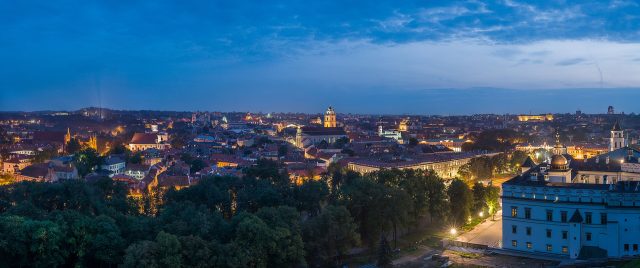
St. Nicholas Church stands on a narrow street in the Old Town, near the Vilnia River. It is the oldest surviving Catholic church in Lithuania. Built in the 14th century, it has witnessed the city’s changes—from a medieval trading hub to the Vilnius of today. Unlike larger churches, St. Nicholas has endured without fanfare, surviving fires, wars, and political upheavals in the same spot where it was first erected.
The church’s architecture is modest. A simple Gothic portal and whitewashed walls mark its exterior. Inside, high, narrow windows let in soft light, illuminating pale walls and faded frescoes. The contrast between the Gothic structure and the Baroque altarpiece shows how styles changed over time. There is no gilded opulence, just the quiet authenticity of a place that has not been polished for tourists.
St. Nicholas Church is tied to Vilnius’s history. When Lithuania adopted Christianity in the late 14th century, the city became a religious and cultural center, and this church was among the first built. While legends link its founding to Grand Duke Gediminas, records are unclear. What is certain is that the church originally served Vilnius’s German community—merchants and craftsmen who helped shape the city. By the 16th century, it became the spiritual home of the Brotherhood of St. Nicholas, a guild of tradesmen and artisans. For centuries, it was a gathering place for blacksmiths, carpenters, and shopkeepers who built Vilnius.
The church has faced hardship. In the 17th century, a fire damaged it, and it was rebuilt in a restrained style. The bell tower, added around the same time, rises above the rooftops. In the 19th century, under Russian rule, authorities tried to suppress Catholic influence, and St. Nicholas nearly closed. The local community kept it open, though it was often overshadowed by larger churches like the Cathedral or St. Peter and Paul. During the Soviet era, when religion was discouraged, the church remained active.
The church holds 17th-century frescoes. Their colors are muted by time, depicting the life of St. Nicholas and other biblical stories. The figures are simple, their expressions softened by centuries of candle smoke. The altar keeps an ancient icon of St. Nicholas, believed to have arrived in Vilnius in the Middle Ages. For worshippers, it is a revered object, said to hold miraculous powers.
St. Nicholas Church does not draw crowds. There are no tour groups or souvenir stands. Instead, it offers stillness in a city full of movement. The churchyard is quiet, with lime trees in summer and snow in winter. Inside, wooden pews creak, and the air smells of old wood and wax. The floor has worn gravestones, their inscriptions faded. Outside, small cafés and artisan workshops line the streets.
For those who care about history, St. Nicholas is a living piece of Vilnius’s past. It tells of a city where cultures overlapped—German merchants, Lithuanian craftsmen, Russian officers, and Polish nobility all left their mark. Today, it remains a place of worship, not a museum. It hasn’t been preserved in amber; it still serves those who walk through its doors.
Visiting St. Nicholas isn’t about checking a landmark off a list. It’s about stepping into a slower rhythm. The church doesn’t demand attention; it invites you to linger, to sit quietly, to listen to footsteps on the stone floor. Outside, the Old Town hums with life, but here, time pauses. It’s a place where you can imagine Vilnius as it once was—a small city where every street corner held a story. If you wander the Old Town, take a detour down this quiet side street. Step inside, breathe in the history, and let the silence speak.