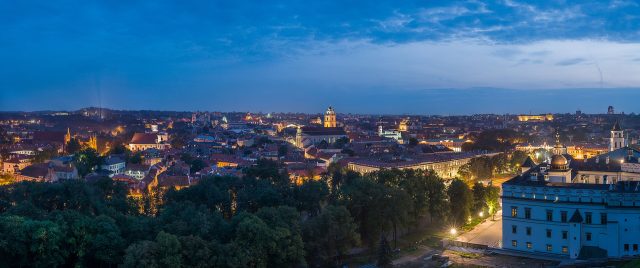
St. Michael’s Church in Vilnius is one of those rare places where the past lingers unobtrusively amid the rhythm of a modern city. Built in the early 17th century, it was the first church in Lithuania dedicated to the Archangel Michael, and its walls have witnessed centuries of history, politics, and faith. Commissioned by Lew Sapieha, one of the most powerful figures of the Grand Duchy of Lithuania, the church was more than a place of worship—it was a statement of influence, a family mausoleum, and a testament to the era’s artistic ambitions.
The church’s architecture strikes a balance between restraint and elegance. From the outside, it appears almost austere: tall red-brick walls, narrow arched windows, and a modest Baroque facade that avoids excess. Yet step inside, and the space opens up with light and air, revealing an interior where every detail feels deliberate. The early Baroque altar is the centerpiece, its craftsmanship refined without being ostentatious. The vaulted ceilings, adorned with delicate stucco work, and the old wooden pews, worn smooth by time, add to the sense of quiet dignity.
Beneath the church lies the crypt, the final resting place of Lew Sapieha and his family. The black marble tombs, carved with precision, are more than memorials—they are relics of an age when art and devotion were inseparable. Visitors can descend into the crypt, where the cool, dim light and the weight of history create an atmosphere of solemn stillness. It’s easy to imagine the generations of Sapiehas who once gathered here, their lives intertwined with the fate of the Grand Duchy.
Like many historic buildings, St. Michael’s Church has known both glory and neglect. After the 1831 uprising, it was closed and repurposed as a military warehouse, its interiors suffering from years of disuse. It wasn’t until the early 20th century that the church was returned to the faithful and painstakingly restored. Today, it remains an active place of worship, though services are less frequent than in its heyday. The doors are open to anyone who wishes to step inside, whether for prayer, reflection, or simply to admire the craftsmanship of another era.
The church stands in the heart of Vilnius’ Old Town, on a small square surrounded by centuries-old buildings. The area feels like a quiet pocket of history, far removed from the bustle of more tourist-heavy spots. Nearby, fragments of the old city wall hint at the fortifications that once protected Vilnius, while just a short walk away, Pilies Street leads to the Town Hall Square, one of the city’s oldest thoroughfares. It’s a place where the layers of the past are still visible, if you know where to look.
St. Michael’s is more than just an architectural landmark—it’s a crossroads of cultural influences. The church blends Western European Baroque with local artistic traditions, from the Renaissance-inspired frescoes on the vaults to the wooden sculptures of saints, carved in a style that reflects Lithuania’s folk art heritage. Even the building materials tell a story: the red brick, the black marble, the worn stone steps—all speak of a time when craftsmanship was measured in patience and skill.
Today, the church continues to serve as a living space, not just a museum. Services are held here, along with occasional concerts of sacred music and small exhibitions on the church’s history. There’s no grand tour or audio guide—just the quiet hum of the building itself, the play of light through the windows, and the sense that you’re sharing a space with those who came before. Unlike more famous landmarks, St. Michael’s doesn’t draw crowds, which makes it all the more special. Here, you can stand beneath the high vaulted ceilings and feel the weight of centuries without distraction.
For anyone exploring Vilnius, this church is a hidden gem. It may not have the fame of the Cathedral or St. Anne’s Church, but that’s part of its charm. There are no souvenir stands or guided tour groups—just the chance to experience a piece of the city as it once was. If you’re lucky, you might visit on a day when sunlight filters through the stained glass, casting warm hues across the stone, and for a moment, it feels as though time has truly stood still.