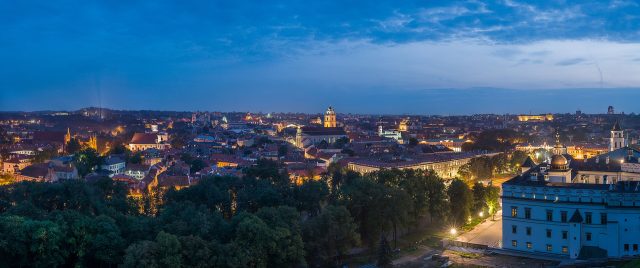
St. Casimir’s Church in Vilnius is a place where stone walls and faded frescoes hold centuries. Built in the early 17th century, it was the first Baroque church in Lithuania. Its white facade, flanked by two slender towers, stands in the heart of the Old Town. The Jesuits who founded it sought to strengthen Catholicism in a region where Protestantism was gaining ground. Today the church remains an active place of worship and a monument to the history that has shaped Vilnius.
Step inside, and the interior draws the eye upward. The high vaulted ceilings are covered with grisaille paintings, their monochrome tones creating the illusion of carvings. The altars, crafted from wood and marble and gilded with gold leaf, glow in the light that spills through the stained-glass windows. The main altar is dedicated to St. Casimir, Lithuania’s patron saint, and draws pilgrims and visitors. Nearby, a small chapel houses the saint’s relics. The air inside is cool and still, the kind of silence that invites reflection.
The church’s history is tied to that of Vilnius. During the era of the Polish-Lithuanian Commonwealth, it was a gathering place for civic life, where brotherhoods met and charity was organized. Wars and occupations tested its resilience; at one point, it served as a refuge for townspeople. In the 19th century, when Lithuania fell under Russian rule, the church was converted into an Orthodox cathedral, then later into a military church. It wasn’t until the early 20th century that it was restored to its original purpose.
Architecturally, St. Casimir’s is an example of early Baroque. The facade is symmetrical, with pilasters, volutes, and a semicircular pediment framing the entrance. The two towers rise gracefully. Originally, the church was meant to be part of a larger Jesuit complex that included a college and library, but only the church survived. Inside, the space is divided into three naves, with the main altar positioned in the apse. The design balances grandeur and intimacy.
St. Casimir, the saint to whom the church is dedicated, was a prince of the Jagiellonian dynasty. He turned down the crown of Hungary to live a life of humility and devotion. Known for his compassion toward the poor and sick, he was canonized after his death. His relics became a symbol of hope for generations. People came to venerate him in times of hardship. Legends tell of prayers answered during plagues and wars.
Beyond its religious significance, St. Casimir’s Church is part of Vilnius’s cultural heritage. Organ concerts fill the space with music. Exhibitions of sacred art draw visitors. On feast days, choirs sing in the nave. For tourists, it offers a glimpse into the city’s past. Unlike crowded tourist spots, the church remains a quiet sanctuary.
Vilnius is a city of contrasts, and St. Casimir’s Church embodies that. It stands at the intersection of old and new—medieval streets on one side, contemporary cafes on the other. The church is a reminder that history continues to shape the present. For locals, it’s a place of milestones. For visitors, it’s an opportunity to step into a different era.
If you find yourself in Vilnius, visiting St. Casimir’s is worth more than a quick photo. Sit on one of the wooden pews and listen to the echo of footsteps on the stone floor. Look up at the ceiling, where the patterns of the frescoes seem to tell stories. Time moves differently in places like this. Even if you’re not religious, there’s a sense of connection to something larger than yourself, a feeling that lingers after you’ve left.