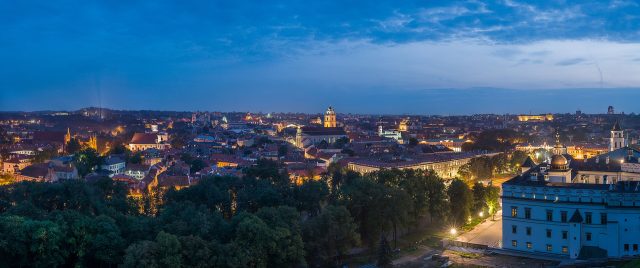
St. Francis of Assisi Church in Vilnius is one of those quiet places that lingers in your memory long after you’ve left. Tucked away in the Old Town, it sits just off the well-trodden paths leading to the Cathedral Square or the Town Hall. The streets around it are narrow and winding, lined with buildings that have stood for centuries, their facades weathered by time. Inside the church’s small courtyard, the hustle of the city fades into a hush, broken only by the echo of footsteps on the stone slabs. It’s not a grand or imposing structure, but there’s something about its unassuming presence that draws you in—especially if you’re looking for more than just the city’s most famous landmarks.
The church was built in the first half of the 18th century, a time when Vilnius was already a thriving cultural and religious hub within the Polish-Lithuanian Commonwealth. The Franciscans, known for their vow of poverty and simplicity, were the ones who commissioned it. That ethos is reflected in the architecture: the facade is restrained, almost austere, with none of the ornate flourishes typical of Baroque churches from that era. Instead of gilded details and elaborate stucco, there are clean lines, modest pilasters, and a plain pediment. The interior follows the same principle—whitewashed walls, wooden pews, a handful of old icons. There’s no opulence here, but that’s precisely what makes it feel authentic, as if the place has remained untouched by the passage of time.
History hasn’t always been kind to this church. In the 19th century, when Lithuania was under Russian rule, many Catholic churches were either shut down or repurposed for Orthodox services. St. Francis of Assisi survived, though it lost some of its land and influence. During the Soviet era, it managed to avoid closure, perhaps because it wasn’t a major cathedral or simply because it slipped through the cracks. Today, it remains an active place of worship, frequented not just by parishioners but also by those seeking a moment of quiet in the middle of the city.
The interior of the church is modest, but it has its own understated charm. The main altar, with its classical columns and statues of saints, is the focal point. The image of St. Francis of Assisi—patron saint of animals and the environment—holds a special place here, and you’ll often find people lighting candles in front of it. In one of the side chapels, faint frescoes from the early 19th century still cling to the walls, their colors faded but their scenes from the lives of Christ and the saints still discernible. There’s a local legend that the church houses a relic of St. Francis, though no one seems to know for sure if it’s true.
Next to the church stands a small monastery, once part of the Franciscan complex. These days, it houses various church offices, and access is limited—it’s not a museum, after all. But the monastery courtyard is open to visitors, offering a peaceful spot to sit and take in the old stone walls. A few times a day, the sound of the church bells drifts through the air, mingling with the scent of linden trees in the warmer months. It’s a place where the past feels very much alive, even if it’s not immediately obvious.
This isn’t a church that demands attention. There are no crowds, no souvenir stalls, no tour guides reciting rehearsed facts. Instead, it offers something rarer: a sense of stillness, a break from the noise of the city. The light filters through the tall windows, casting soft shadows on the worn floorboards. Time seems to move differently here, as if the walls themselves are holding their breath. Maybe that’s why people who stumble upon this place often find themselves returning—drawn back by the quiet, the simplicity, and the feeling that some things are best discovered when no one’s looking.