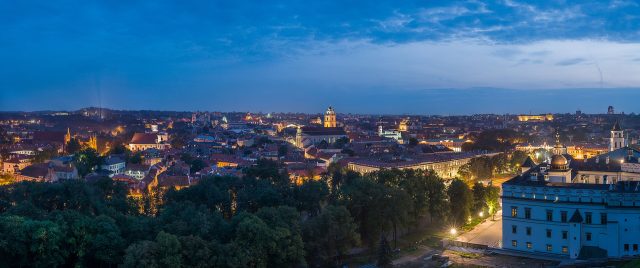
The Church of the Holy Spirit stands quietly on Dominikonų Street, tucked away in the heart of Vilnius where the city’s medieval lanes weave through layers of history. It doesn’t demand attention like some of the more imposing landmarks—its facade is unassuming, almost blending into the surrounding buildings. Yet that very modesty gives it a distinct character. Belonging to the Dominican Order, one of Lithuania’s oldest religious communities, the church has witnessed centuries of change. The first records of a wooden structure here date back to the mid-16th century, when Vilnius was not only the political but also the spiritual center of the Grand Duchy of Lithuania. That early church was lost to fire, a fate that befell much of the city during its turbulent past.
The stone building we see today took shape in the early 18th century, a time when Baroque architecture flourished in Lithuania. The Church of the Holy Spirit became one of its finest examples, balancing grandeur with restraint. Inside, soaring vaults, ornate altars, and intricate stucco work create a sense of solemnity without overwhelming the space. The main altar, dark with gilded accents, contrasts sharply with the lighter walls, drawing the eye immediately. Later renovations introduced elements of Rococo, particularly after another fire, adding a layer of elegance to the interior.
This church has been a silent witness to Vilnius’s history. Over the centuries, it has seen the city’s fortunes rise and fall—serving as a place of worship, a refuge during wars, and a bastion of faith under foreign rule. In the 19th century, when Lithuania was part of the Russian Empire, the Church of the Holy Spirit remained one of the few places where Catholic traditions endured. Even during the Soviet era, when many religious sites were closed, it continued to hold services, a rare exception that allowed it to remain an active part of the community.
The interior holds details that tell their own stories. Among the old icons, the image of Saint Dominic, the order’s founder, stands out. The crypt beneath the church is another point of interest, housing the remains of Dominican monks and preserving 18th-century frescoes that depict scenes from the lives of saints. Though time has faded them, their expressiveness still lingers. The 19th-century organ, too, is a treasure—its music filling the church during services and occasional concerts, echoing through the centuries-old walls.
Dominikonų Street, where the church stands, is one of Vilnius’s oldest thoroughfares. The surrounding buildings, some dating back to the 17th and 18th centuries, retain the charm of a bygone era with their narrow facades and hidden courtyards. In warmer months, the steps of the church often become a gathering spot for locals and visitors alike, watching the street’s quiet rhythm. Nearby cafes and small shops offer a place to pause, whether for a coffee or a souvenir. The atmosphere here feels suspended in time, as if the city’s modern hustle fades into the background.
Beyond its religious role, the Church of the Holy Spirit serves as a cultural hub. Exhibitions, lectures, and musical performances are held here regularly, with classical concerts drawing audiences from across the city. Unlike more crowded tourist spots, this church offers a sense of tranquility, a place to step away from the noise and reflect. It’s open to anyone seeking a connection to history, a moment of quiet, or simply the chance to experience a piece of old Vilnius.
What makes the Church of the Holy Spirit special is its living presence. It’s not a museum but a place where daily life unfolds—where masses are still celebrated, baptisms and weddings take place, and people come to light a candle or pray. For many in Vilnius, it holds personal significance, tied to family milestones or quiet moments of faith. This continuity between past and present gives the church its unique character, making it more than just an architectural landmark.
If you find yourself in Vilnius, the Church of the Holy Spirit is worth a visit for the way it quietly bridges history and the present. There’s no ostentatious grandeur here, just an understated beauty that reveals itself slowly. Walk through its halls, listen to the silence, and take in the frescoes and altars—you’ll sense the layers of tradition and belief that have shaped this place. And if you’re lucky, the sound of the organ will fill the air, leaving behind a quiet sense of peace.