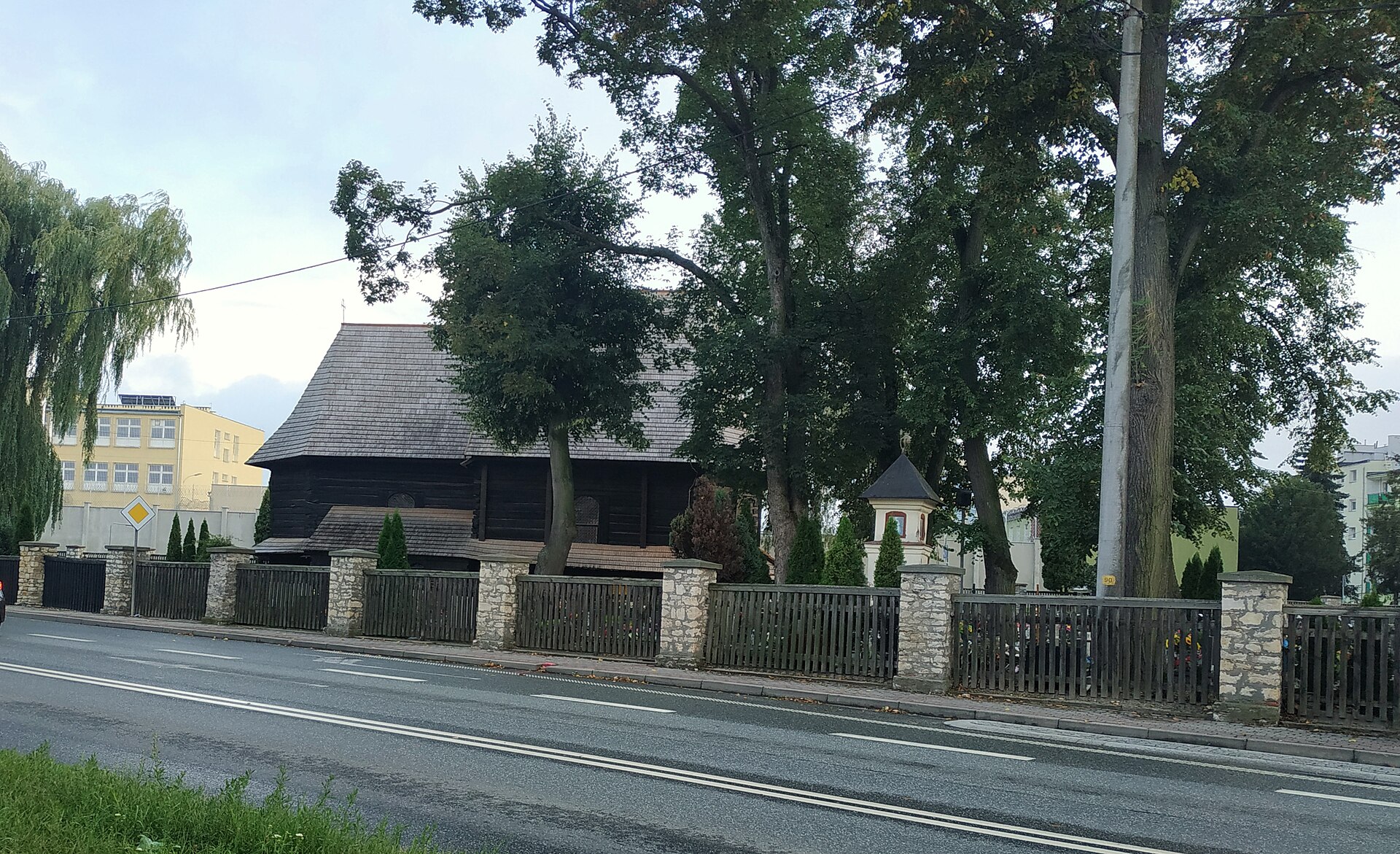
Saint Barbara’s Church in Jastrzębie-Zdrój is one of those quiet places where history, faith, and the rhythm of everyday life come together almost unnoticed. Built in the early 20th century, it stands as a testament to the region’s layered identity, shaped by the mingling of cultures, languages, and beliefs that have long defined Silesia. The church isn’t just a building; it’s a reflection of the people who built it, prayed in it, and kept it alive through decades of change.
The architecture blends late Gothic revival with Art Nouveau influences, creating something both familiar and unexpected. Tall, pointed windows let in streams of colored light, while the exterior’s intricate stonework gives the structure a sense of delicate strength. Inside, the space feels open and airy, with high vaulted ceilings and stained glass that tell stories of saints and biblical scenes in muted, jewel-like tones. The main altar, dark and richly gilded, anchors the space with a quiet solemnity, its details catching the light in a way that makes the whole interior feel alive.
The church was constructed during a time of rapid transformation for Jastrzębie-Zdrój. The late 19th and early 20th centuries brought an industrial boom to the region, driven by coal mining, and the town grew almost overnight. As new neighborhoods sprang up, so did the need for places of worship. Funding for Saint Barbara’s came from all corners of the community—wealthy industrialists, local merchants, and even miners who donated part of their wages. For many workers, faith was a source of resilience in a life marked by hard labor and uncertainty. The church became more than a place of prayer; it was a symbol of shared struggle and hope.
Saint Barbara herself holds a special place in the hearts of Silesians. As the patron saint of miners, her image was a constant presence in a region where coal shaped both the economy and the landscape. Statues and depictions of her inside the church often show her holding a tower—a reference to her imprisonment—or a chalice, symbols that resonated deeply with those who risked their lives underground. The church doesn’t just honor her as a saint; it preserves the memory of a way of life that defined generations of families in the area.
Beyond the main altar, the church is filled with smaller chapels, each with its own character. One is dedicated to scenes from the life of Christ, painted in soft, faded frescoes that seem to glow in the dim light. Another holds statues of local saints, their faces worn smooth by time and devotion. The chapel of the Virgin Mary is perhaps the most intimate space, where candles flicker day and night, and visitors leave quiet prayers scribbled on slips of paper. There are also relics tied to Silesia’s history, though these are rarely displayed, kept instead for special occasions when the past feels closer to the present.
Jastrzębie-Zdrój is often seen as a place of industry, its identity tied to mines and factories. But Saint Barbara’s Church offers a different perspective, one rooted in the spiritual life of the community. On Sundays, the pews fill with families, their voices rising in hymns that have been sung here for over a century. During the week, the church is quieter, a place for solitary reflection or the occasional visitor drawn by the sound of the organ. Weddings, baptisms, and holiday services bring the space to life in different ways, each event adding another layer to its story.
Outside, a small park surrounds the church, its paths winding between trees and benches. In summer, it’s a place for quiet walks or gatherings after Mass; in winter, it’s transformed by strings of lights and nativity scenes. The church’s tall spire is visible from almost anywhere in town, a familiar landmark that orients both locals and visitors. It’s not an imposing structure, but its presence is steady, a reminder of something enduring in a place that has seen so much change.
For those who venture beyond Poland’s well-trodden tourist routes, Saint Barbara’s Church offers a glimpse into the soul of Silesia. It’s not a grand cathedral, nor does it claim to be. Instead, it’s a place where the past feels tangible—not through grand gestures, but through the small, everyday acts of faith that have kept it alive. The church doesn’t ask for attention; it simply exists, as it has for over a hundred years, a quiet witness to the lives that have unfolded within and around it.