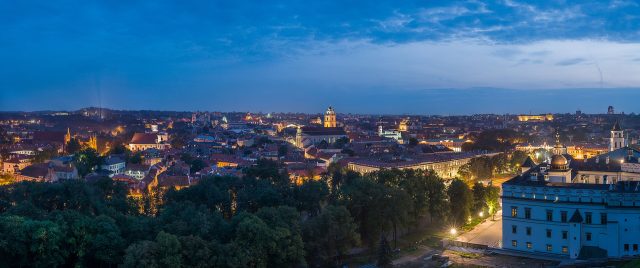
Perched on a quiet hill in Vilnius’s Antakalnis district, the Church of Divine Providence is one of those places that doesn’t demand attention but lingers in the mind long after you’ve left. It stands apart from the well-trodden paths leading to the Old Town or Gediminas Tower, where tourists cluster for photographs. Here, there are no crowds, no hurried footsteps—just the stillness of a building that has witnessed generations of prayers, joys, and sorrows. The church doesn’t invite admiration so much as reflection: on the people who have walked through its doors over the centuries, the whispered hopes they carried, and why this unassuming place has mattered to so many.
The story of the church begins in the mid-18th century, when Vilnius was part of the Polish-Lithuanian Commonwealth and the city was embracing the grandeur of Baroque architecture. Bishop Michał Jan Zienkowicz envisioned the church as a gesture of gratitude after Vilnius was spared from a devastating plague. Yet what should have been a swift construction stretched into decades. Wars, political upheavals, and financial struggles delayed its completion until 1793, by which time Lithuania had fallen under Russian rule. Despite these turbulent beginnings, the church became a steadfast spiritual refuge, particularly during periods when Catholic worship faced restrictions.
Architecturally, the Church of Divine Providence is a blend of late Baroque and early Neoclassical influences, a style that emerged in Lithuania as the 18th century drew to a close. Its façade is restrained, almost austere, with none of the exuberant ornamentation found in earlier Baroque churches. Two modest towers flank the entrance, lending the building a sense of balance, while the triangular pediment above the portal hints at the classical ideals seeping into local design. Inside, the space feels intimate yet airy, with proportions carefully calculated to create a sense of openness. The main altar features a painting of Divine Providence, and the side chapels are adorned with a mix of wooden sculptures and 19th-century frescoes, each telling its own quiet story.
The church’s role in Vilnius’s history goes beyond its architectural merits. In the 19th century, when the Russian Empire sought to suppress Catholicism and impose Russian culture, the Church of Divine Providence remained a vital sanctuary. Services were held in Lithuanian, a small but defiant act during a time when the use of the language in religious settings was discouraged. Later, under Soviet rule, the church survived where many others were shuttered, though its activities were closely monitored. It wasn’t until Lithuania regained independence in 1990 that the church fully reopened as a place of worship, drawing not only the faithful but also those curious about the city’s layered past.
Today, the Church of Divine Providence is more than just an active parish—it’s a living piece of Vilnius’s heritage. It doesn’t appear in most guidebooks or feature on postcards, which makes visiting it feel like stumbling upon a secret. The scent of beeswax and aged wood fills the air, while sunlight filters through tall windows, casting a soft glow on the walls. On Sundays, the church comes alive with the sound of hymns sung in Lithuanian, the voices of the congregation filling the space. On weekdays, it’s quiet enough to hear the creak of floorboards as you sit on one of the wooden pews, studying the faded frescoes or simply soaking in the atmosphere.
The surrounding Antakalnis district is worth exploring in its own right. Once a suburb of Vilnius, it was home to noble estates and monasteries, and traces of that past remain. Nearby, the Church of Saints Peter and Paul dazzles with its intricate stucco decorations, while the former Bernardine monastery offers another glimpse into the city’s religious history. Wandering these streets, you get a sense of Vilnius as it once was—before modern development reshaped its character. Narrow lanes, stone walls, and old trees create a peaceful backdrop, and the Church of Divine Providence fits seamlessly into this setting, as if it has always been here.
For travelers who seek more than just the highlights of a city, this church offers something unexpected. It doesn’t compete with the grandeur of Vilnius Cathedral or the whimsy of St. Anne’s Church. Instead, it provides a quieter kind of connection—one that ties the city’s history to the lives of its people. Perhaps that’s why visitors often return, not for photographs, but for the sense of stillness and the quiet realization that they’re not just passing through, but touching a thread in the fabric of Vilnius itself.