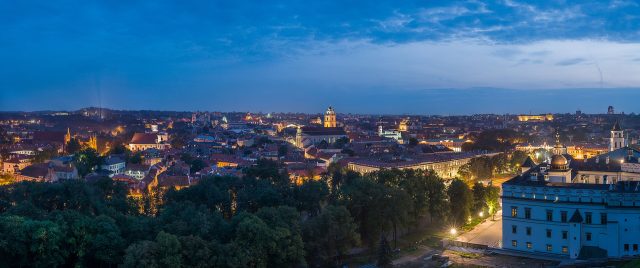
Nestled on a quiet side street in Vilnius’ Old Town, the Church of Our Lady of Consolation feels like a place where time has paused. Its unassuming facade doesn’t demand attention, blending into the narrow lane. That modesty is what makes it special—here, the city’s usual hum fades, and the weight of centuries settles on your shoulders.
The church’s origins trace back to the early 1600s, when Vilnius was a center of the Polish-Lithuanian Commonwealth. Carmelite monks, who arrived in the 1620s, first built a wooden chapel on this site. By the mid-17th century, it had been replaced with a stone structure in the early Baroque style. The church was part of a larger monastery complex, though little remains of those buildings today. What endures is the sense of continuity—a place that has witnessed history while retaining its quiet dignity.
Architecturally, the church favors simplicity. The facade is uncluttered: tall, narrow windows, a modest pediment with a small cross, and sturdy buttresses. Inside, the space feels airy, with high vaulted ceilings and whitewashed walls that amplify natural light. The dark wood of the main altar provides contrast, its tones drawing the eye without overwhelming.
At the heart of the church’s history is the icon of Our Lady of Consolation. According to tradition, it was brought from Rome in the 17th century and became a focal point of devotion. Pilgrims from across Lithuania prayed before it, believing in its miraculous powers. In the 18th century, the icon was adorned with a silver frame, fragments of which survive. Though fewer pilgrims visit now, the icon still holds a central place in the altar. Visitors light candles or offer quiet prayers.
The church has weathered turbulent times. After the 1831 uprising, Russian authorities dissolved the Carmelite monastery and repurposed the building as a parish church. During the Soviet era, it was used as a warehouse. It wasn’t until the late 1980s that the church was returned to the faithful, and restoration efforts began.
Today, it stands preserved with care—ancient pews, confessionals, and 17th- and 18th-century tombstones remain inside.
The Church of Our Lady of Consolation remains an active place of worship. Services are held regularly, but the atmosphere is never rushed. On a weekday afternoon, you might find only a handful of people inside, their murmured prayers blending with footsteps. The organ’s music fills the space with warmth. In summer, sunlight filters through the tall windows; in winter, candles and chandeliers lend a gentle radiance.
Beyond the church, a small courtyard hints at the monastery that once stood here. Old linden trees shade the space, and fragments of the original walls still stand. The city’s noise seems to dissolve here. You might see nuns tending to flowers or locals hurrying in for mass.
Vilnius has many sacred spaces. This one stands apart. It doesn’t vie for grandeur; instead, it offers stillness. There are no soaring domes or gilded frescoes, just a space that invites you to sit, to listen, to breathe. Its true value lies not in what it shows, but in what it allows you to feel.