The Royal Palace in Phnom Penh stands as one of Cambodia’s most enduring symbols, a place where the country’s past and present intersect with quiet grandeur. Built in the mid-19th century, shortly after King Norodom moved the capital from Oudong to Phnom Penh, the palace complex has served as the official residence of Cambodia’s monarchs for generations. Its golden roofs and intricate spires rise above the city’s skyline, a reminder of the Khmer architectural traditions that have shaped the nation’s identity. Unlike the ancient temples of Angkor, which speak of a distant empire, the Royal Palace feels alive—still used for state ceremonies, royal functions, and as a place where Cambodians come to pay their respects.
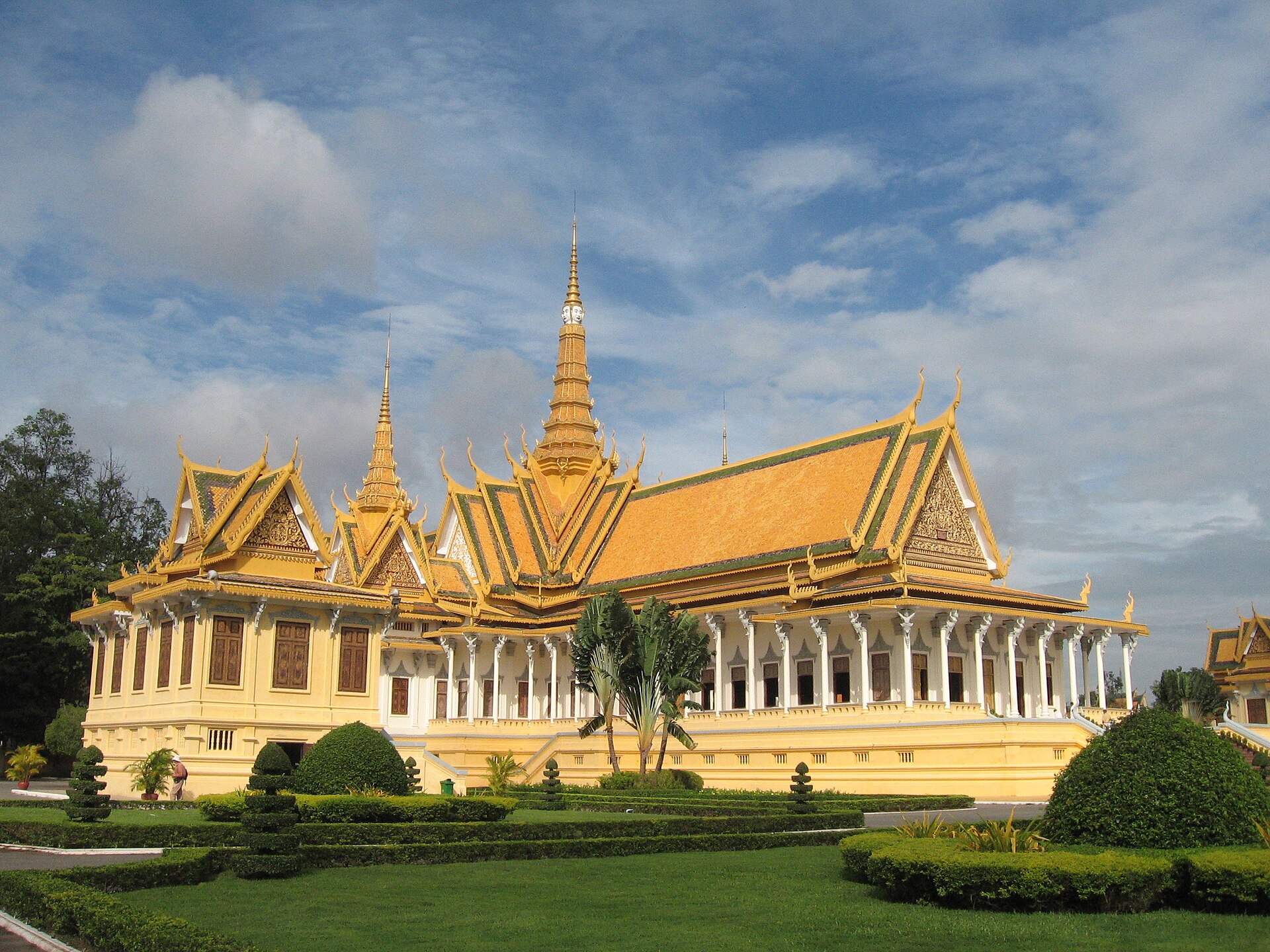
The palace grounds are a carefully arranged sequence of buildings, pavilions, and gardens, each with its own purpose and history. The most striking structure is the Throne Hall, where coronations and official receptions take place. Its tiered roof, adorned with nagas—serpent-like figures from Khmer mythology—dominates the central courtyard. Inside, the hall is a study in opulence, with gilded columns, intricate murals depicting scenes from the Reamker (Cambodia’s version of the Ramayana), and a ceiling painted in deep blues and reds. The hall’s centerpiece is the royal throne, a symbol of the monarchy’s continuity through centuries of upheaval.
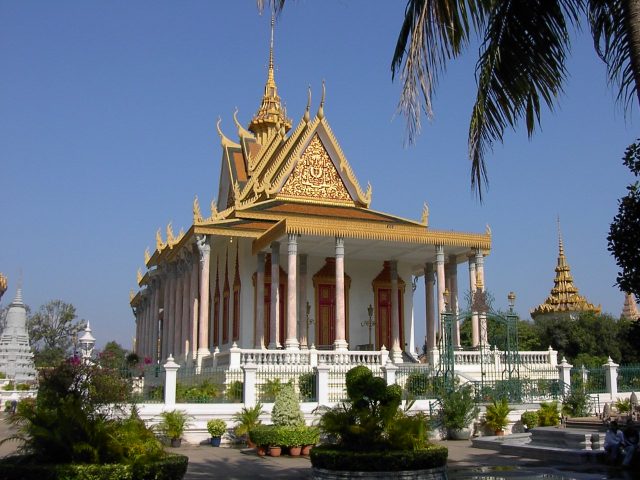
Adjacent to the Throne Hall is the Silver Pagoda, perhaps the most visited part of the complex. Its name comes from the 5,329 silver tiles that cover the floor, each weighing over a kilogram. The pagoda houses a collection of Buddha statues, the most revered being the Emerald Buddha, though the one on display is actually made of Baccarat crystal. Nearby stands a life-sized gold Buddha encrusted with over 9,000 diamonds, a dazzling sight that underscores the palace’s role as a spiritual as well as a political center. The walls of the pagoda are lined with murals depicting the Jataka tales, stories of the Buddha’s past lives, rendered in vibrant colors that have faded only slightly over time.
Beyond the grand halls and sacred spaces, the palace grounds offer quieter corners where the atmosphere shifts. The gardens, though manicured, feel less formal than one might expect, with frangipani trees casting dappled shade over pathways. The Khemarin Palace, the private residence of the current king, sits at the northern edge of the complex, its traditional Khmer design softened by the presence of modern touches. Unlike the public areas, this part of the palace is off-limits to visitors, a reminder that while the palace is a historical site, it is also a living home.
The Royal Palace has witnessed some of Cambodia’s most turbulent moments. During the French colonial period, it became a focal point of both resistance and accommodation, as the monarchy navigated its relationship with the foreign powers that sought to control the country. Later, under the Khmer Rouge, the palace was looted, its treasures scattered or destroyed. The fact that it stands today, restored and revered, is a testament to Cambodia’s resilience. The scars of that era are not always visible, but they linger in the stories of those who remember the palace before its desecration.
Visiting the palace is not just about admiring its architecture or its art; it’s about understanding the layers of meaning embedded in its walls. For Cambodians, the palace represents stability—a thread connecting the present to the golden age of Angkor and beyond. For foreigners, it offers a glimpse into a culture where tradition and modernity coexist, sometimes uneasily. The dress code, which requires modest clothing covering shoulders and knees, is strictly enforced, a nod to the respect the palace commands. Tourists who arrive in shorts or tank tops are often turned away, a small but telling detail about the place’s significance.
The best time to visit is early in the morning, when the light is soft and the heat hasn’t yet settled over the city. The palace opens at 8 AM, and those who arrive early can wander the grounds with fewer crowds, listening to the distant chatter of monks or the rustle of leaves in the breeze. By midday, the sun is relentless, and the reflective surfaces of the buildings seem to amplify the heat. The palace closes for a few hours in the afternoon, reopening in the late afternoon when the light takes on a golden hue, casting long shadows across the courtyards.
Phnom Penh itself has changed dramatically in recent decades, with modern high-rises and bustling markets transforming the cityscape. Yet the Royal Palace remains a constant, its silhouette unchanged against the skyline. It’s a place where history is not just preserved but lived, where the past is not a relic but a living part of Cambodia’s story. Whether you’re drawn by its architectural beauty, its historical weight, or simply the chance to step into a world that feels both ancient and immediate, the palace offers something rare—a connection to a nation’s soul.