The cable car from Yalta’s waterfront to Darsan Hill is one of those quiet, unassuming experiences that somehow manages to feel both ordinary and magical. Built in the late 1960s, it’s a short ride—just under six hundred meters—but the way it moves over the city makes it feel much longer. The chairs, open and swaying slightly, glide low above rooftops, backyards, and the weathered tiles of old Yalta. There’s no dramatic height here, no stomach-dropping drops, just the slow unraveling of the city beneath you, as if you’re floating through someone’s memories rather than taking a tourist attraction.
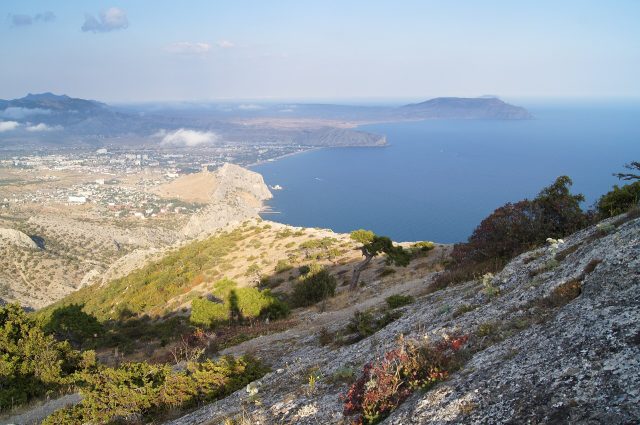
The journey takes about twelve minutes, enough time to notice the details: the way laundry hangs between buildings, the overgrown gardens behind crumbling fences, the occasional cat sunning itself on a windowsill. The cable car doesn’t rush, and neither do the views. At the top, the hill rises to around a hundred and forty meters, offering a panorama of Yalta Bay, the jagged silhouette of Ai-Petri in the distance, and the dark curve of Ai-Todor Cape. On clear days, the sea stretches out like a sheet of hammered metal, but even when the weather is hazy, the perspective feels intimate, as if the city has tilted just enough to let you see it properly.
The upper station is modest, little more than a platform with a small square and a few benches. A memorial obelisk stands there, dedicated to the soldiers who fought in Crimea during the Second World War, its stone surface worn smooth by decades of wind and rain. Nearby, a café spills out onto a terrace, serving coffee and local pastries to visitors who linger, reluctant to leave the view. The hill itself is gentle, with winding paths that lead down through residential neighborhoods, where the streets narrow and the houses grow older. It’s an easy walk back to the city, about twenty minutes if you take your time, though most people eventually find their way back to the cable car, drawn by the promise of another slow ascent.
The system is old, and you can tell. The machinery hums with a deep, rhythmic groan, and the chairs creak as they sway. There’s something reassuring about its age, though—it feels solid, like something that’s been here long enough to become part of the landscape. That said, it’s not without its quirks. Repairs happen occasionally, shutting the line down for weeks at a time, and in bad weather—strong winds or heavy rain—it simply stops running. In winter, the schedule shrinks, and the crowds thin out, leaving the cable car to its quiet, mechanical rhythm.
The lower station sits at the start of the waterfront, just steps from the sea terminal and a cluster of hotels. It’s impossible to miss, tucked between the promenade and the first of the city’s many cafés. Tickets are sold at a small booth, and while the line can stretch in peak season, it moves quickly. In the evenings, it’s usually quieter, the chairs swinging empty as the last of the daylight fades. The ride is particularly good for photography—the open chairs mean nothing blocks the view, though you’ll want to hold onto your phone or camera tightly. The lack of barriers or glass makes it feel almost like you’re suspended in midair, with only the cable and the wind keeping you aloft.
Darsan Hill isn’t a place for grand adventures. There are no zip lines or extreme sports here, just a handful of viewpoints and a network of footpaths that weave through the hillside. It’s the kind of spot that rewards patience, where the best moments often come from simply sitting on a bench and watching the city below. The height is modest, making it a good option for those who might be nervous about taller cable cars, and the ride itself is smooth enough to feel safe even for children. The hill is small, but it has a way of making Yalta feel larger, as if the city has been folded into a space just big enough to hold it.
In many ways, the cable car is a relic of another era, a time when such things were built for practicality as much as spectacle. It was never meant to be a major attraction, just a way to get from one part of the city to another. That it’s still running, still carrying passengers up and down the hill decades later, says something about its place in Yalta’s daily life. Locals use it, tourists ride it, and in between, it sits quietly, doing its job. There’s no grandiosity here, no attempt to impress—just a simple, functional piece of infrastructure that has, almost by accident, become one of the city’s most enduring views.
The area around the lower station is lively, with cafés and small shops selling souvenirs, ice cream, and local wine. The Primorsky Park is a short walk away, its paths lined with palm trees and benches, offering a shady retreat from the summer heat. But the real draw is the cable car itself, not just for the ride, but for the way it changes your perspective. Up on Darsan Hill, Yalta looks different—less like a tourist destination, more like a place where people actually live. The city spreads out beneath you, a patchwork of old and new, and for a few minutes, it’s easy to forget that you’re just a visitor passing through.