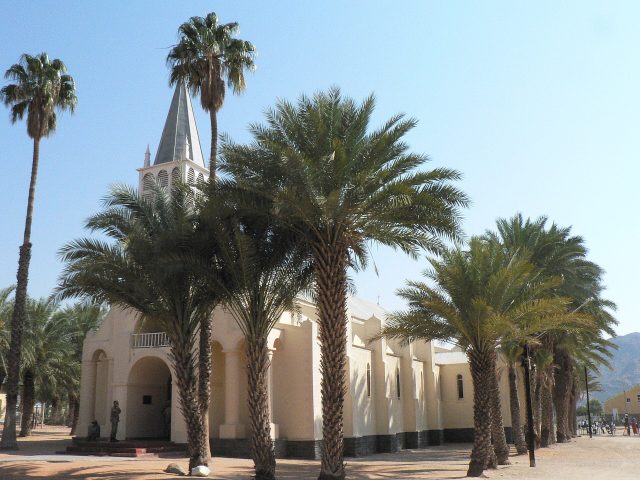
Nestled in the quiet expanse of South Africa’s Northern Cape, where the Kalahari Desert softens into semi-arid plains, Pella feels like a place where time moves differently. Far from the well-trodden paths of the country’s tourist circuits, it exists as a whisper of the past, a settlement that has seen generations come and go without much fanfare. The Historical Society of Pella is where much of that past is kept—not in a grand museum, but in a modest collection that feels more like a family archive than a formal exhibit. It’s the kind of place where history isn’t just displayed; it’s lived, remembered, and passed down through the stories of those who still call this land home.
Pella’s origins trace back to the mid-19th century, when Catholic missionaries from the Oblates of Mary Immaculate arrived in this remote corner of southern Africa. Their mission was to convert the local Nama and San communities to Christianity, but what emerged over time was something more enduring: a small, self-sustaining community built around farming, trade, and the rhythms of life in a harsh environment. The missionaries constructed simple but sturdy buildings from local stone and clay, materials that could withstand the scorching days and chilly nights. The old church, with its thick walls and unassuming design, still stands as a testament to those early days. For decades, Pella served as a vital stopover for travelers moving between the interior and the coast, a place where farmers, traders, and weary wayfarers would gather, rest, and exchange news before continuing their journeys.
The Historical Society itself didn’t take shape until much later, in the late 20th century, when a handful of locals realized that their history was slipping away. Younger generations were leaving for cities, old homes were crumbling, and the oral traditions that had preserved the stories of Pella for so long were at risk of fading. A group of teachers, farmers, and descendants of the original settlers began gathering whatever remnants of the past they could find—photographs, letters, tools, clothing, and household items. At first, these treasures were kept in private homes, but eventually, a small space near the church was set aside to house them. Today, the collection offers a fragmented but vivid glimpse into the layers of life in Pella, from the ancient San people who once roamed these lands to the heyday of the mission station and the slow decline that followed.
One of the most striking parts of the collection is the photographs. Black-and-white images capture the faces of people who lived here a century ago: weathered farmers in wide-brimmed hats, women in long dresses standing outside their homes, children playing in the dusty streets. Many of these photos date back to the early 1900s, when Pella was still a bustling, if modest, hub of activity. Alongside them are yellowed letters, diaries, and church records—fragments of everyday life that reveal the struggles and small triumphs of the community. There are accounts of droughts that withered crops, locust plagues that devoured fields, and illnesses that swept through the settlement. These stories aren’t always easy to read, but they paint a picture of resilience, of people who chose to make a life in a place where survival was never guaranteed.
The architecture of Pella tells its own story, though it’s far from the grand structures found in more famous historical sites. The buildings here were constructed from whatever materials were available—stone, clay, wood—and designed to cope with the extremes of the climate. Roofs were thatched or covered with corrugated iron, windows were kept small to keep out the heat, and walls were built thick to retain warmth during the cold nights. Some of the oldest structures still stand, though others have succumbed to time. The old schoolhouse, a single-story building with wooden desks and a chalkboard bearing faded lessons, is one of the most evocative. It’s easy to imagine the children of farmers and missionaries sitting in those same desks, learning their letters and numbers in a place where education was as much about survival as it was about knowledge.
Today, Pella is home to just a few hundred people, most of them descendants of the original settlers. Life here moves at a slower pace, much as it has for generations. Many still speak Afrikaans, the language brought by Dutch colonists, and their days are shaped by the same rhythms that have defined this place for over a century: tending livestock, growing vegetables in small gardens, and gathering in the evenings to share stories over tea. The Historical Society plays a quiet but vital role in this community. It’s not just a repository of the past; it’s a place where people come together to remember who they are and where they came from. For the locals, it’s a reminder that their stories matter, even if the rest of the world has largely forgotten them.
Visiting Pella isn’t about ticking off tourist attractions or seeking out grand spectacles. There are no crowds, no souvenir shops, no guided tours with scripted narratives. Instead, there’s a sense of stepping into a living history, one that’s still unfolding in the quiet corners of the settlement. If you’re lucky, one of the caretakers of the Historical Society might sit down with you and share the stories behind the artifacts—the old farming tools, the faded photographs, the handwritten letters. Sometimes, they’ll even pull out a reel of film, showing grainy footage of weddings, festivals, and everyday moments from Pella’s past. It’s an intimate experience, one that feels more like being invited into someone’s home than visiting a museum.
What makes Pella special is its unassuming authenticity. This was never a place of wealth or fame, and its history isn’t marked by dramatic events or larger-than-life figures. Instead, it’s a story of ordinary people living in an extraordinary landscape, of a community that endured because it had to. The Historical Society doesn’t try to glamourize the past; it presents it as it was—messy, difficult, but undeniably human. Walking through the settlement, it’s easy to imagine what life must have been like a hundred years ago: the slow pace of days dictated by the sun and the seasons, the hard work of eking out a living from the land, the quiet moments of connection that made it all worthwhile.
In a world where history is often reduced to monuments and museums, Pella offers something different. Here, the past isn’t confined to glass cases or plaques; it’s woven into the fabric of everyday life. The old church still stands, the schoolhouse still holds its memories, and the people still carry the stories of those who came before them. It’s a place that reminds us that history isn’t just about the grand narratives we read in books—it’s also about the small, personal moments that shape who we are. Pella may not be a destination for those seeking excitement or luxury, but for those willing to listen, it offers something far more valuable: a chance to step back in time and see the world through the eyes of the people who lived it.