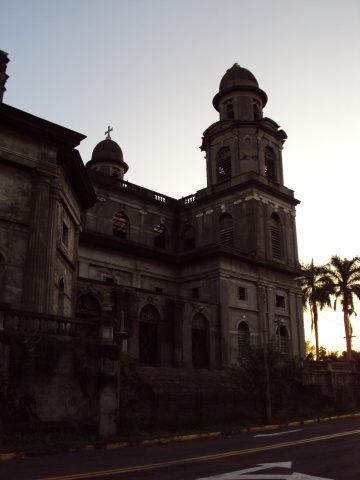
The Immaculate Conception Cathedral in Managua is one of those places that doesn’t reveal itself at first glance. From a distance, it might seem like just another building in the heart of Nicaragua’s capital, blending into the cityscape. But step closer, and you begin to sense its weight—not just as a place of worship, but as a silent witness to a history that has never been easy.
Built in the 1950s during a rare period of stability under the Somoza regime, the cathedral was designed by Mexican architect José Obregón Morales. His vision was unusual for the time, blending modernist simplicity with neo-Gothic elements. The result is a structure that feels both grand and grounded, with towering spires and pointed arches that echo European cathedrals but lack their ornate flourishes. Inside, the space is airy and bright, with columns supporting high vaults and stained glass casting a soft, diffused light. It’s not as dazzling as the great European churches, but there’s a quiet dignity to it, a sense of purpose beyond mere spectacle.
The cathedral’s history is inseparable from Managua’s own turbulent past. The city has been shaken by earthquakes time and again, each one leaving scars. The original cathedral, built in the 19th century, was destroyed in the devastating 1972 quake that leveled much of the city. This new cathedral was meant to symbolize rebirth, though its construction dragged on. By the time it was completed, Nicaragua was already descending into revolution. In 1979, as the Somoza dictatorship fell, the cathedral found itself at the center of political upheaval. It became a gathering place for protests, a makeshift hospital for the wounded, and its walls still bear the marks of bullets—a stark reminder of how faith and politics once collided here.
Today, the cathedral remains an active place of worship, but its significance goes beyond religion. It’s a place where you can feel the pulse of Managua, a city that has always been different from other Central American capitals. There are no crowds of tourists here, no guides shouting over one another. Instead, there’s a quiet that’s broken only by the footsteps of parishioners and the occasional toll of the bells. Inside, the scent of wax and aged wood lingers, while paintings of saints and local martyrs line the walls. The image of the Virgin Mary, Nicaragua’s patroness, draws the most devotion, with candles flickering before her day and night.
What makes the cathedral’s architecture particularly interesting is how it reflects the aspirations of its time. The 1950s were a period of hope in Nicaragua, a belief that the country was on the cusp of progress. The cathedral was meant to embody that optimism, a modern yet timeless structure that would stand as a testament to the nation’s future. But history had other plans. The cathedral endured revolution, civil war, economic collapse, and natural disasters, surviving when so much around it crumbled. Today, it shows its age—the plaster is chipped in places, the paint on the doors is faded—but that only adds to its authenticity. It feels lived-in, like the city itself.
On a weekday, you might find locals here not just for mass, but simply to sit in silence. Some pray, others whisper to one another, and a few just rest on the pews, gazing at the altar. There’s no sense of formality, no feeling that you’ve stepped into a museum. This is a working church, where faith is woven into everyday life. Occasionally, the sound of an organ fills the space, the music echoing under the high ceilings, and for a moment, the weight of history feels lighter.
The cathedral stands on a square that is itself a microcosm of Managua’s past. Nearby, monuments to revolutionary heroes share space with older buildings that survived the earthquakes, alongside newer structures that struggle to fit into the city’s patchwork landscape. In the evening, when the streetlights come on, the cathedral takes on a different presence. Its silhouette stands out against the dark sky, the warm glow from its windows spilling onto the pavement. It’s a moment when time seems to slow, when the noise of the city fades into the background.
For those curious about Nicaragua’s history, the cathedral is more than just a landmark. It’s a key to understanding how faith has sustained people through hardship, how a church could become a literal sanctuary in times of crisis, and how religion and politics have always been intertwined here. At the same time, it’s a place where you can simply sit and reflect, watching the candlelight flicker and listening to the quiet. In a city that isn’t always welcoming to outsiders, the Immaculate Conception Cathedral offers a rare sense of stillness, a chance to feel connected to something larger than yourself.