Perched in the quiet foothills of Kosovo, far from the well-trodden paths and the hum of tourist crowds, the Hermitage of St. Peter Koriški feels like a place suspended in time. Unlike the grand monasteries with their gilded domes and ornate facades, this hermitage is unassuming, almost hidden among the rocks and greenery. It was here, in the 13th century, that St. Peter of Koriša, a Serbian ascetic, chose to retreat from the world, seeking solitude in a cave near what would later become a small monastic community. The hermitage grew around his simple cell, drawing those who, like him, sought silence and spiritual refuge.
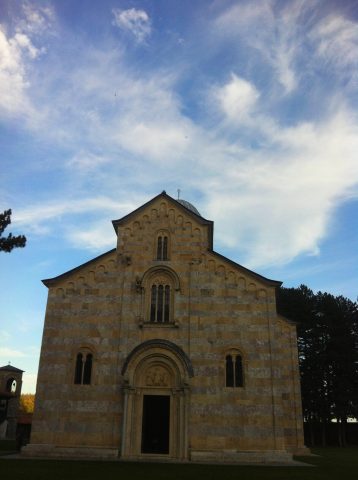
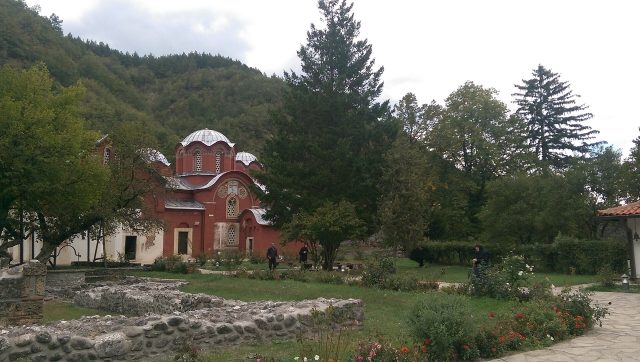
The architecture of the hermitage reflects the life of those who built it—modest, practical, and in harmony with the landscape. The stone walls, rough-hewn and unadorned, blend seamlessly with the surrounding cliffs, while the low vaults of the chapel create an intimate, almost protective atmosphere. Inside, the walls are covered with faded frescoes, their medieval style still visible despite the passage of centuries. The faces of saints, darkened by time, gaze solemnly from the walls, their expressions a mix of quiet reverence and endurance. Among them, the image of St. Peter himself stands out, depicted in prayer against a backdrop of rugged mountains. These paintings are a rare surviving example of Serbian ecclesiastical art in a region where history has often erased such traces.
The area around the hermitage is as much a part of its story as the buildings themselves. A narrow path, winding through juniper thickets and rocky outcrops, leads to the cave where St. Peter once lived. It’s a short walk, but one that feels like stepping into another era. Locals still speak of the spring near the cave, its water said to hold healing properties, and on certain days, people come to collect it in bottles. Beyond the path, the landscape opens up to rolling pastures where sheep graze, their bells echoing faintly in the distance. The peaks of the Mokra Gora mountains rise on the horizon, their slopes often shrouded in mist. It’s easy to imagine St. Peter here, living in silence, with only the wind and the distant chime of bells for company.
The hermitage hasn’t always been this quiet. In the Middle Ages, it served as a spiritual hub for the surrounding villages, a place where monks copied manuscripts, tended to the sick with herbal remedies, and offered shelter to travelers. Even during the Ottoman era, when Orthodox communities faced persecution, the hermitage remained a bastion of faith. After World War II, it fell into disrepair, and it wasn’t until the late 20th century that efforts began to restore it. Today, a small community of monks lives here, their days marked by prayer, work in the garden, and the occasional visitor seeking solace.
Visiting the Hermitage of St. Peter Koriški isn’t about grand sights or tourist attractions. It’s about the quiet, the stillness, and the sense of time moving differently here. In summer, the air hums with the sound of cicadas; in winter, snow blankets the paths leading to the cave. Autumn turns the mountains into a blaze of red and gold, a reminder of the fleeting nature of life. People come not for spectacle, but for the chance to pause, to listen, and to step away from the noise of everyday existence.
Reaching the hermitage takes some effort. The nearest city, Prizren, is about 50 kilometers away, and the road to the hermitage winds through mountain passes, narrow and uneven. There’s no public transport, so most visitors arrive by car or taxi. The village of Koriša, nestled at the foot of the mountains, offers little in the way of tourist amenities—just a couple of cafés where you can sip coffee and try a homemade pie, and a few guesthouses with simple rooms. But it’s this lack of tourist infrastructure that makes the hermitage feel so untouched, so authentic.
For those who make the journey, it’s important to remember that this is a living monastery, not a museum. Silence is expected, photography is often restricted, and modest dress is required inside the chapel. The monks here rarely speak English, but their hospitality is evident in small gestures—a cup of tea, a quiet tour of the frescoes, or a few words about the life of St. Peter if they sense genuine interest. Even without conversation, the visit leaves a lasting impression, a sense of having touched something timeless.
Kosovo is a land where history and the present intertwine in complex ways, and the Hermitage of St. Peter Koriški is one of those rare places where the past doesn’t feel distant. There are no grand ceremonies here, no crowds of tourists, just the quiet, the mountains, and the memory of a man who chose this solitude for his faith. Perhaps that’s why people return—not for answers, but for the chance to ask themselves the right questions.