Mount Kenya isn’t just the country’s highest peak—it’s a place where the land seems to gather all its wild beauty into one dramatic statement. Rising from the savannah like a forgotten giant, this ancient volcano wears its history in layers: glaciers clinging to its shoulders, dense forests wrapping its lower slopes, and alpine meadows unfolding like a secret world above the clouds. The mountain changes with every step, shifting from steamy lowland jungles to stark, wind-scoured ridges where the air grows thin and the silence feels absolute. For centuries, the Kikuyu and Embu peoples have called it Kirinyaga, the "mountain of whiteness," believing its peaks to be the home of Ngai, their supreme god. Even now, the name carries weight, as if the mountain itself remembers its sacred past.
Europeans first glimpsed Mount Kenya in 1849, when the German missionary Johann Krapf spotted its snow-capped summit from hundreds of miles away. Yet it would be another fifty years before anyone dared to climb it. The delay wasn’t just about the challenge—though the terrain was formidable—but also about the mountain’s reputation. Local communities warned of spirits guarding its heights, and early explorers, more drawn to the Himalayas or the Alps, saw little reason to test those stories. The first successful ascent finally came in 1899, when a British expedition led by Halford Mackinder reached the summit of Batian, the highest peak. Even then, the climb was more an act of stubborn curiosity than the start of a trend. For decades afterward, Mount Kenya remained a quiet giant, overshadowed by its more famous neighbor, Kilimanjaro.
Today, the mountain offers two distinct experiences: trekking and technical climbing. The trekking routes are the gentler option, winding through forests and moorlands up to around 4,000 meters, where the air is crisp and the views stretch across valleys carved by ancient glaciers. These paths don’t require ropes or ice axes, just a decent pair of boots and a willingness to walk. The most popular trail starts in Mount Kenya National Park, established in 1949 to protect the mountain’s fragile ecosystems. But for those who come to climb, the real test begins above the treeline. Batian and Nelion, the two highest peaks, are among the most demanding climbs in Africa, with sheer rock faces and unpredictable weather that can turn a routine ascent into a battle for survival. Even seasoned mountaineers sometimes retreat, humbled by the mountain’s raw power.
Yet Mount Kenya isn’t just a playground for adventurers. It’s a place where time moves differently, where the rhythms of life still follow the old ways. On its lower slopes, small communities of Embu and Kikuyu farmers tend to coffee and tea plantations, their terraced fields clinging to the hillsides like green steps. In the villages, life hasn’t changed much in generations. Clay-walled huts with thatched roofs dot the landscape, and the scent of woodsmoke lingers in the air. Elders still tell stories of the mountain’s spirits, and the land provides—maize for ugali, the thick porridge that’s a staple here, or fresh milk from the cattle that graze on the high pastures. It’s easy to imagine that the mountain has always been this way, untouched by the rush of the modern world.
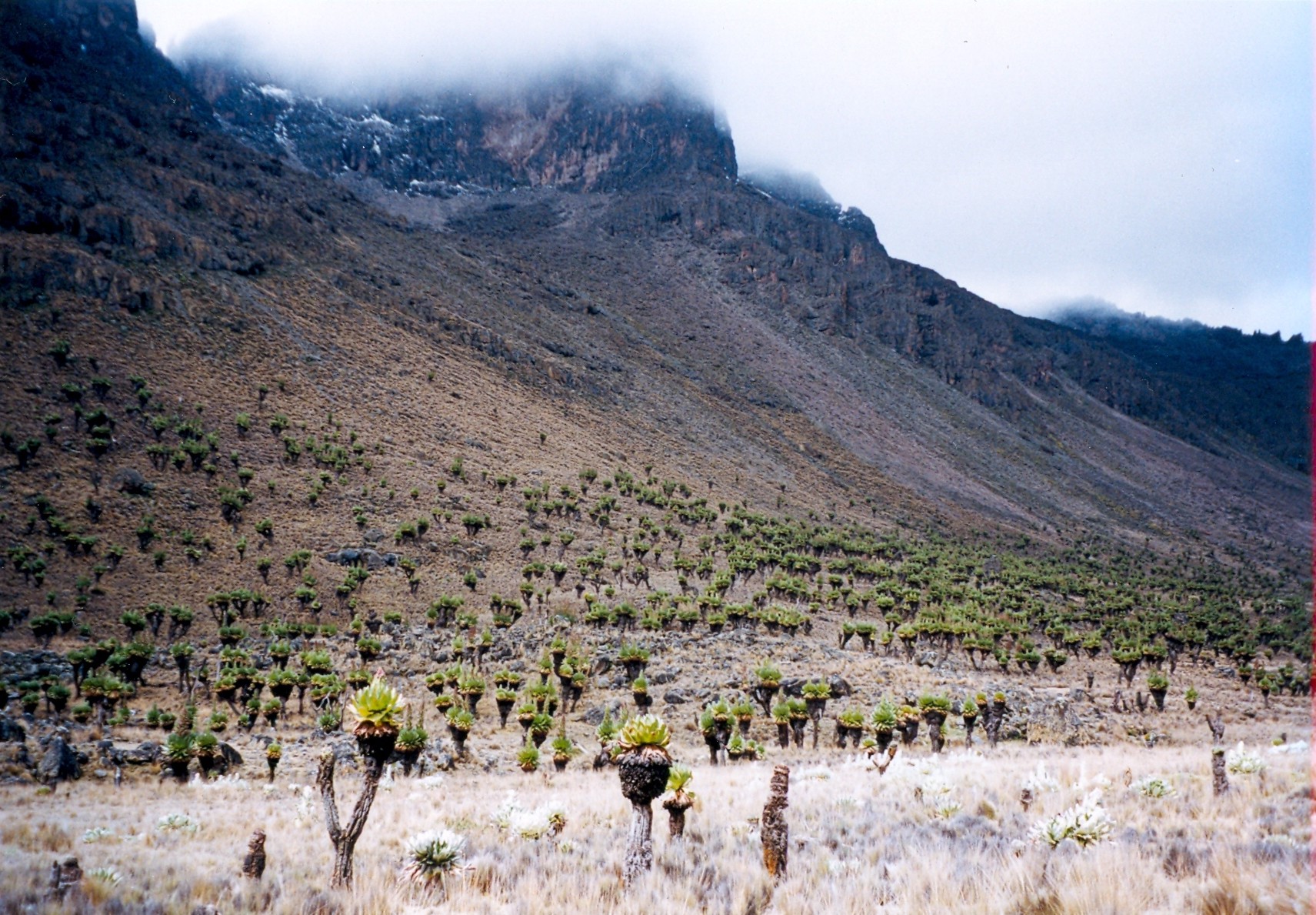
The glaciers that once crowned Mount Kenya are fading. A century ago, they covered vast stretches of the summit, but today only a few shrunken remnants remain, clinging to the highest ridges. Scientists predict they’ll vanish entirely within decades, another casualty of a warming planet. For now, though, they still glint in the sunlight, a reminder of how quickly the world is changing. Below them, the landscape shifts again—alpine deserts stretch across the upper slopes, where giant lobelias stand like sentinels among the rocks. These plants, some over six feet tall, seem almost otherworldly, their spiky leaves and towering flower stalks adding to the sense that this is a place apart.
Mount Kenya National Park isn’t just a backdrop for climbers and hikers—it’s a sanctuary for wildlife that has adapted to life at high altitudes. Elephants and buffalo roam the lower forests, while leopards and hyenas move through the shadows, rarely seen but always present. The real stars, though, are the birds. Over a hundred species live here, from tiny sunbirds that flit between flowers to massive lammergeiers, their wingspans wide enough to cast shadows over the valleys below. Dawn is the best time to watch them, when the first light spills over the ridges and the mist still clings to the trees. In those quiet moments, the mountain feels alive in a way that’s hard to describe—less like a place you visit, and more like a world you step into.
For those who prefer to keep their feet on the ground, the mountain still has plenty to offer. A short hike leads to Lake Ellis, a serene crater lake surrounded by dense forest, its waters reflecting the sky like a mirror. Nearby, Thomson’s Falls tumbles over a rocky ledge, its mist cooling the air even on the hottest days. The waterfall is named after Joseph Thomson, the Scottish explorer who first reached this part of Kenya in the late 1800s, though the local people have known it for far longer. Another option is a visit to one of the coffee farms that dot the lower slopes, where the rich volcanic soil produces some of the best beans in Africa. Watching the harvest, or sipping a freshly brewed cup under the shade of a fig tree, it’s easy to forget how close you are to the wild heart of the mountain.
What makes Mount Kenya special isn’t just its height or its beauty—it’s the way it makes you feel. One moment, it can be fierce, with winds howling across the ridges and clouds swallowing the peaks whole. The next, it’s impossibly peaceful, the morning sun turning the savannah gold while the forests below hum with life. There are no crowds here, no souvenir stands or guided tours with set itineraries. The mountain doesn’t perform for visitors; it simply exists, vast and unyielding, as it has for millennia. To experience it is to step into a different kind of Africa—one where the land still dictates the rules, where the past lingers in the rustle of the trees and the silence of the high peaks. It’s not a place for those who want comfort or convenience, but for those who are willing to meet it on its own terms.