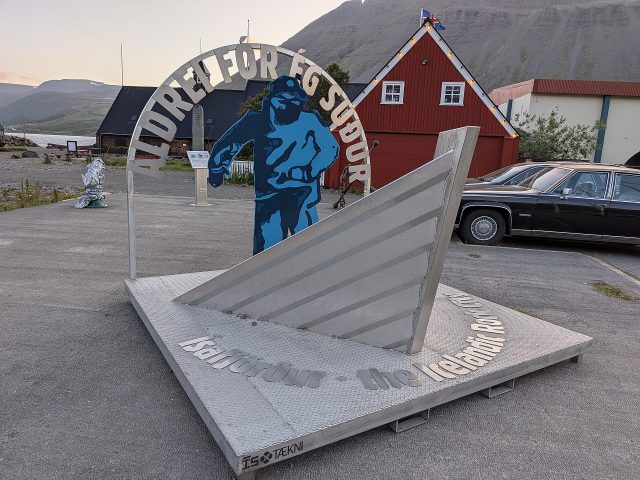
Ísafjörður’s harbor is where the Westfjords of Iceland meet the North Atlantic, a place where the town’s life has always been tied to the sea. There are no bustling promenades lined with cafés or souvenir shops here, no polished tourist facades. Instead, there’s a quiet, rugged charm—a working harbor where the past and present coexist in the salt-tinged air. This is the heart of Ísafjörður, a place that feels both timeless and deeply alive.
The harbor’s history is inseparable from the town’s own. Ísafjörður began as a trading post in the 16th century, when Danish and Dutch merchants arrived, drawn by the riches of Icelandic waters. Back then, the harbor was little more than a natural bay, sheltered by rocky headlands from the worst of the Atlantic storms. Yet it was here that the town’s fate was decided. Cod, above all, became the lifeblood of the economy, and the harbor the gateway through which it reached European markets. By the 19th century, Ísafjörður had grown into one of Iceland’s largest fishing hubs, with the harbor at its core.
The architecture along the waterfront tells this story. Many of the old wooden buildings, constructed in the early 20th century during the town’s boom years, still stand today. Their bright colors—red, blue, green—weren’t just for aesthetics; they helped fishermen spot their homes through the fog. Some of these structures were once warehouses for fish and gear, others the homes of merchants and sailors. Now, a few have been repurposed into small guesthouses, cafés, or workshops, but the character of the place remains unchanged. The narrow streets leading away from the harbor feel suspended in time, especially when mist rolls in over the fjord.
Today, the harbor is still a working port. Fishing boats, from small local vessels to large trawlers that spend weeks at sea, dock here year-round. In summer, it becomes a hub for tourism—boats depart for whale-watching excursions, trips to the nearby islands of Vigur and Hornstrandir, and ferries connecting Ísafjörður to other fjord communities. Winter quiets things down, but the harbor never empties. Fishermen still set out to sea, and locals come to breathe in the briny air or watch the northern lights flicker over the water.
One of the harbor’s most striking landmarks is the old fish factory, once the largest in Iceland. Though it no longer operates, the building still stands as a monument to the town’s industrial past. Its massive concrete and steel walls evoke the days when fish were cleaned, salted, and packed around the clock for export. Inside, rusted machinery and conveyor belts remain, while outside, giant tanks for storing fish oil hint at the scale of operations. Locals sometimes call it a ghost of the industrial era, but there’s no sense of decay—just a quiet respect for the labor that once defined this place.
The harbor isn’t just a place to walk—it’s where the best views of Ísafjörður unfold. From a small hill to the east, the town spreads out between mountains and sea, its colorful houses looking almost toy-like against the dramatic backdrop of cliffs. Sunset is especially magical here, when the light turns the water gold and pink. It’s easy to see why people have chosen to live in this remote corner of the world for centuries, despite the harsh climate. The harbor’s beauty isn’t in grand gestures but in its raw, unfiltered connection to the land and sea.
Winter transforms the harbor into something even more elemental. The sea churns, waves crash against the docks, and the wind howls through the streets. Yet this is when the harbor feels most alive in its own way—when the power of nature, always a part of life in Iceland, is impossible to ignore. Locals say the harbor becomes even more central to the town in winter, a reminder of how fragile human life can be in these parts. Even on the coldest days, though, there’s warmth to be found in the small cafés along the waterfront, where hot coffee and fresh fish offer comfort.
Ísafjörður’s harbor doesn’t have museums or flashy exhibits, but the town itself is a living archive. Walking along the docks, it’s easy to imagine the past—the sailing ships that once moored here, the dockworkers hauling sacks of cod, the women mending nets as they waited for their husbands to return from the sea. That history lingers in the air, in the scent of salt and fish, in the creak of old wood underfoot, in the cries of gulls circling overhead.
This isn’t a place that overwhelms with spectacle. There’s no grandeur, no excess—just the sea, the mountains, the people, and their stories. For some, it’s just a harbor in a remote part of Iceland. For others, it’s a symbol of resilience, a testament to the bond between people and the natural world. Visiting here isn’t about chasing excitement; it’s about stepping into a rhythm older than tourism, where the quiet moments leave the deepest impression.