Aqaba’s flagpole isn’t the kind of landmark that demands attention, but it lingers in memory. Where the Red Sea meets the desert, it rises against the horizon, the Jordanian flag snapping in the wind above the bay. It’s not just a symbol of the city—it feels like an anchor for history, geography, and modern life.
The flagpole was erected in the early 2000s, yet its significance stretches back much further. Aqaba has always been a crossroads, a port linking the Arabian Peninsula to Egypt, the Levant, and beyond. Nabateans, Romans, Byzantines, Arabs, and Ottomans ruled here before it became part of modern Jordan. The flagpole marks the end of that journey—a reminder that this city has always been a point of connection.
At forty-three meters high, the flagpole’s dimensions correspond to 1946, the year Aqaba officially joined Jordan after British rule. From that height, the flag is visible from land and sea, a practical detail for Jordan’s only maritime gateway. Cargo ships still unload here, and the country’s naval fleet operates from its waters. The flag isn’t just decorative; it asserts Aqaba’s role as a vital link.
The square around the flagpole is one of the city’s most relaxed gathering spots. In the evenings, when the heat subsides, families sit on benches, watching the sunset or enjoying the breeze. Occasionally, there are small concerts or local celebrations. Mostly, though, the only sounds are waves and seagulls.
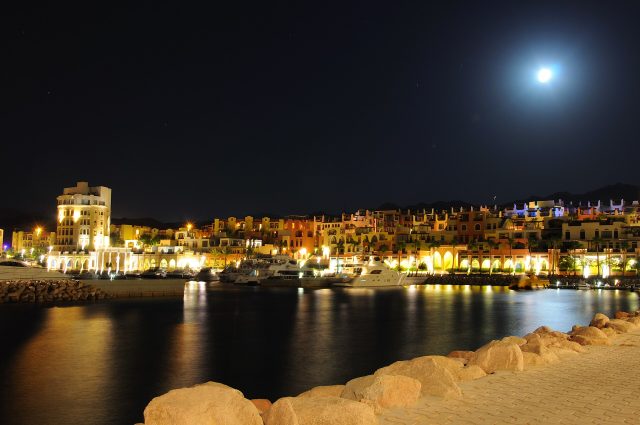
The flagpole’s design is simple. Its clean lines and light stone base evoke an old ship’s mast, fitting for a city tied to the sea. The surrounding buildings—low-slung, with flat roofs and arched windows—reflect traditional Arab architecture. There are no towering hotels or glass facades. The absence of modern excess gives the place a timeless quality, as if it exists apart from the rest of Aqaba.
For Jordanians, the flagpole is a point of national pride. Aqaba is Jordan’s only coastline, a hub for trade and travel, and a meeting point for cultures. The flag waving over the bay reminds them that even a small country can have an outsized presence when it uses its geography well.
Aqaba’s flagpole doesn’t aim for spectacle. It doesn’t compete with the sea or the mountains but complements them. That restraint makes it feel authentic—a symbol that belongs to the place rather than imposing on it.
From the flagpole, the entire bay unfolds. To the west, the mountains of Egypt’s Sinai Peninsula rise in the distance. To the south, the border with Saudi Arabia. To the north, Jordan’s hills give way to desert. On clear days, you can see Eilat across the water. It’s a rare vantage point where borders, histories, and cultures converge.
There are no museums or souvenir stalls here. You don’t come to buy anything or pose for photos. You come to stand, watch the flag ripple, and feel the city’s pulse. Aqaba doesn’t dazzle with luxury—it offers something rarer: genuineness. The flagpole, unassuming yet meaningful, embodies that.