The European Solidarity Centre in Gdańsk is more than a museum—it’s a place where the recent history of Poland and Eastern Europe comes into sharp focus. Built on the grounds of the former Lenin Shipyard, where the Solidarity movement took shape in August 1980, the centre stands as a testament to the struggle for freedom and democracy. This was where workers, intellectuals, and the Church united against an oppressive regime, where strikes and negotiations reshaped not just a country, but an entire political order. The shipyard wasn’t just a backdrop to these events; it was an active participant, its gates and workshops witnessing the birth of a movement that would echo far beyond Poland’s borders.
The building itself is a striking piece of architecture, designed to bridge the gap between past and present. Its modern structure of glass, steel, and weathered metal rises from the industrial landscape, its forms evoking both ship hulls and the pages of an open book. Inside, the space is carefully arranged to immerse visitors in the atmosphere of the era. The sounds of factory whistles, the murmur of protesters, the rustle of underground pamphlets—all of it lingers in the air, creating a sense of immediacy that most museums struggle to achieve. There’s no grandiosity here, just a quiet authenticity that makes the past feel tangible.
The exhibition begins with the everyday realities of 1970s Poland, a time when shortages, queues, and censorship were part of daily life. From there, it moves to the pivotal events of August 1980, when a strike at the Gdańsk Shipyard grew into a mass movement. While figures like Lech Wałęsa and Anna Walentynowicz are central to the story, the exhibition gives equal weight to the ordinary people who made Solidarity possible—workers, students, priests—presenting their experiences not as heroic myths, but as the actions of people caught in extraordinary circumstances. Documents, photographs, and video recordings bring the era to life, making it feel as though you’re standing among the crowds at the shipyard gates.
But the centre doesn’t stop at Poland’s borders. It traces how the ideas of Solidarity spread across Eastern Europe, contributing to the fall of the Berlin Wall and the collapse of the Soviet Union. Exhibits from Czechoslovakia, Hungary, and East Germany—posters, badges, personal items—show how hope for change took root in different countries. Yet the centre avoids oversimplification. It acknowledges that democracy’s victory wasn’t inevitable, that it came through years of struggle, compromise, and even setbacks. One gallery documents the period of martial law in Poland, when Solidarity was banned and its leaders imprisoned, a reminder that progress is rarely linear.
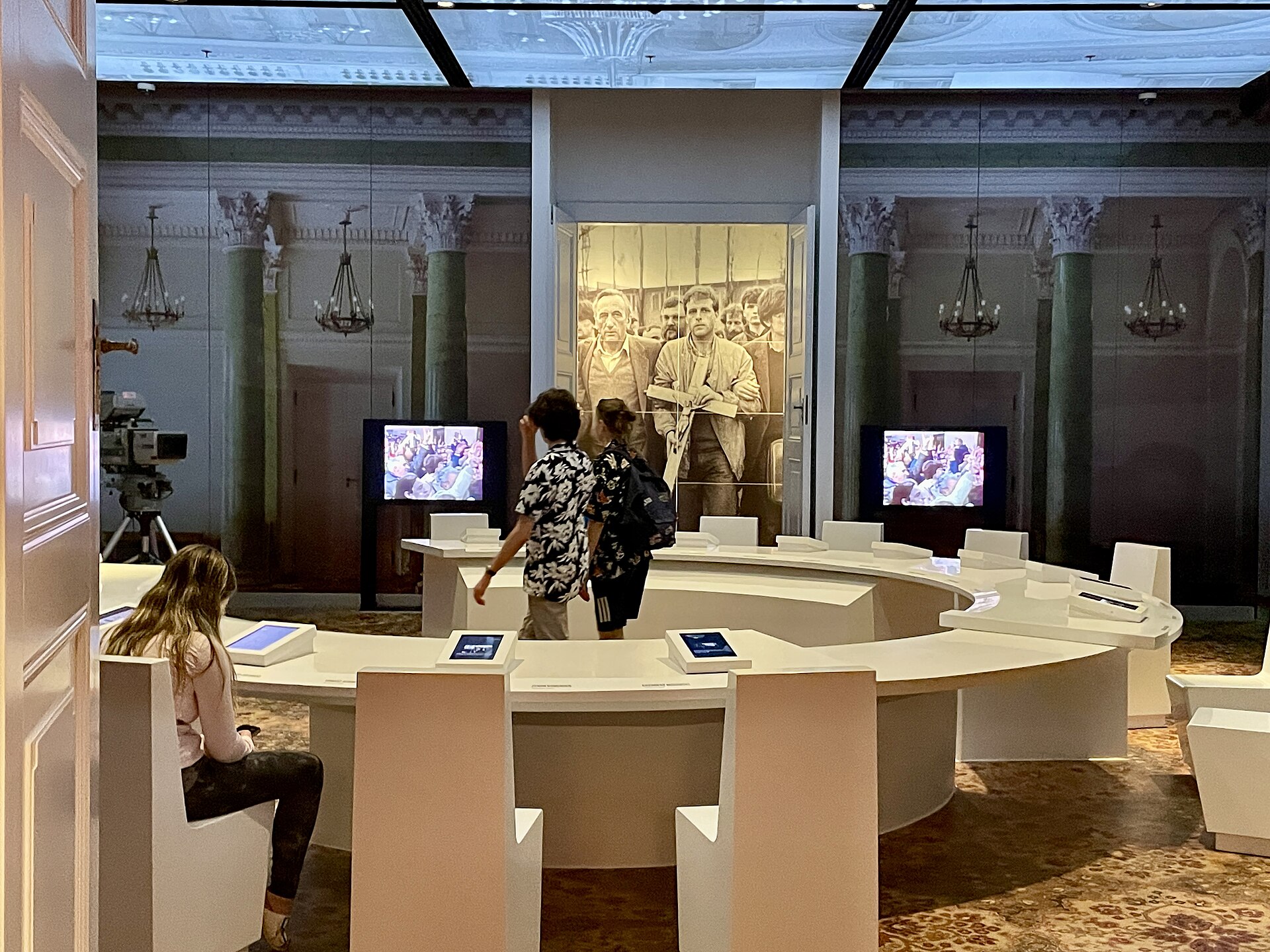
A highlight of the exhibition is the reconstruction of the Round Table, where negotiations between the government and opposition took place in 1989. More than just a replica, it symbolizes the transition from dictatorship to democracy, from censorship to free speech. Nearby, a section addresses contemporary challenges—human rights, civil society, migration—showing how the lessons of Solidarity remain relevant in a world where democracy is once again under threat. The centre doesn’t just preserve the past; it engages with the present, asking how those lessons can be applied today.
Outside, the surrounding park is a place of quiet reflection. Memorials and monuments honor the victims of communist rule, including the striking Monument to the Fallen Shipyard Workers of 1970. In summer, the park hosts concerts, film screenings, and discussions with those who lived through the events. Even in colder months, it draws visitors who come to lay flowers, sit in silence, or simply absorb the weight of history. The space feels meditative, a reminder of the cost of freedom.
Beyond its role as a museum, the European Solidarity Centre is a hub for research, education, and dialogue. It houses a library, hosts conferences, and runs educational programs for students, encouraging them to engage with history through discussion rather than passive observation. Collaborations with similar institutions worldwide ensure that the story of Solidarity continues to resonate beyond Poland. This is a place where history isn’t confined to exhibits—it’s alive, evolving, and still shaping conversations about freedom and resistance.
A visit here leaves a lingering impression. There’s pride in what was achieved, but also a sobering awareness of how fragile those achievements can be. The centre doesn’t rely on grand rhetoric; instead, it presents Solidarity as part of a broader European story, one that reminds us democracy isn’t a given but an ongoing effort. Sometimes, it takes just a few people willing to say no to change everything. That’s the lesson that stays with you long after you leave.