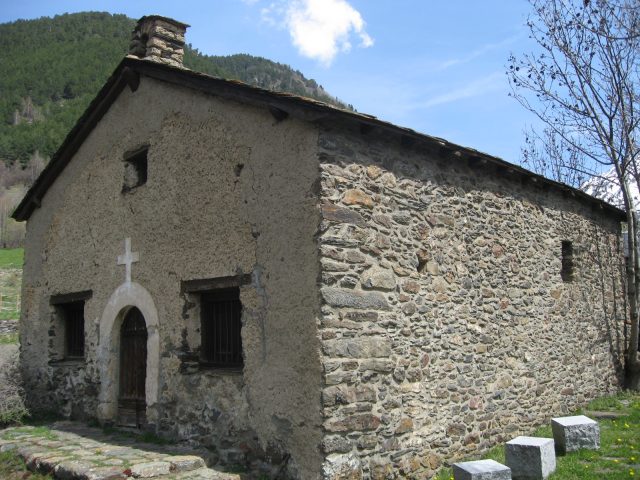
El Serrat is one of those quiet villages in the Andorran Pyrenees where time moves differently. Perched at over fifteen hundred meters above sea level, it sits among steep slopes and alpine meadows. Here, the Church of Sant Pere del Serrat stands as a modest yet enduring landmark, a building that carries the weight of history.
The church dates back to the 11th century, when this land was part of the shifting feudal territories of the Middle Ages. Built from rough local stone, its walls have endured centuries without losing their strength. Inside, faint traces of Romanesque frescoes remain, though time and damp have blurred their details. These murals are rare in Andorra, where most churches lost their original decorations long ago.
Its architecture is Romanesque—low vaults, small windows, thick walls—all designed to keep out the cold and wind. The bell tower, added later, doesn’t disrupt the sense of sturdy simplicity. The entrance is marked by a plain portal, once sheltered by a wooden awning that has since disappeared. Inside, the space is divided into a nave and an apse, where the altar once stood. Little has changed over the centuries, save for the modern wooden pews and electric lighting.
For the people of El Serrat, this church has always been more than just a building.
It was where baptisms, weddings, and funerals marked the passage of generations. On feast days, when the mountain roads were passable, villagers from nearby settlements gathered here. The feast of Saint Peter was especially important, celebrated with fairs, music, and shared meals of local cheese and wine.
Today, the village is quieter. Many houses stand empty. Yet the church still draws people on Sundays, a thread linking the present to the memories of elders who recall childhood services.
Surrounding the church is a small cemetery, where generations of villagers rest beneath simple stone markers. Some graves are well-tended, others overgrown. Nearby stands an ancient oak, said to be at least three hundred years old. In its shade, villagers once held meetings, and children sought refuge from the summer sun.
For travelers in Andorra, El Serrat offers a glimpse of the country without polish. There are no luxury resorts here, just mountains, forests, and a stillness broken only by the church bell or the cry of a bird. Sant Pere del Serrat sits at the edge of the village, as if welcoming those who make the climb up the narrow road. From its steps, the view stretches across the valley, where on clear days the snow-capped peaks of the French Pyrenees come into view.
In recent years, the church has been included in itineraries exploring Andorra’s Romanesque heritage. It’s part of tours of the mountain villages, where guides explain how such churches were built. But there’s no mass tourism here—the road is too steep for buses, and the village isn’t equipped for crowds.
This is a place for those who seek atmosphere over entertainment. Who are content to sit on a bench outside the church and listen to the wind rustling through the grass.
Sant Pere del Serrat isn’t a museum piece. It still serves its purpose, if less frequently than before. Occasionally, musicians perform classical concerts within its stone walls. In winter, when snow blankets the village, the church becomes one of the few places where warmth and company can be found. In summer, its doors are open to anyone who wishes to step inside.
Andorra has many churches, but this one feels different. Perhaps because it stands apart from the usual tourist routes, in a place where life moves at its own pace. Or because its walls have witnessed as many changes as the Pyrenees themselves. The Church of Sant Pere del Serrat doesn’t need to be advertised—it simply exists, as the mountains do. And that’s enough.