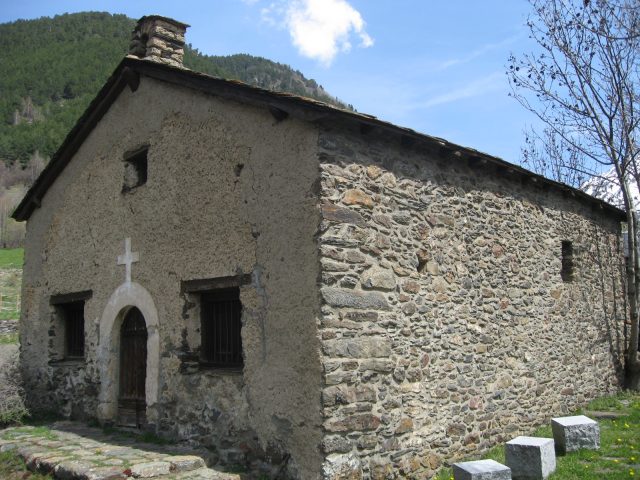
El Serrat is one of those quiet villages in the Andorran Pyrenees where time moves differently. The steep slopes and alpine meadows here feel untouched, and among them stands Sant Romà de Vila, a small church that seems to have grown from the landscape itself. Its stone walls, weathered by centuries, blend into the mountainside. There’s nothing grand about it—no spires or facades—but that’s what makes it stand out. In a world where so much is built to impress, this church offers stillness.
The origins of Sant Romà stretch back to the Middle Ages. Churches in these mountains were more than places of worship. They were the heart of community life, where people gathered for baptisms, weddings, and funerals. Historians place its construction between the 11th and 12th centuries, when Romanesque architecture was taking root in Andorra. Back then, El Serrat was just a handful of homes, and the church was the one constant in a life shaped by the Pyrenees.
The building is a perfect example of Andorran Romanesque design. The thick stone walls, roughly hewn, support a low ceiling that barely lets in light. Inside, there’s no gold leaf or carvings, just bare stone, wooden beams, a modest altar, and the scent of old wood. It’s a space built for purpose, not display. Even the bell tower, added later, is understated, as if it respects the mountains around it.
Sant Romà was never a wealthy parish. In medieval Andorra, most people lived on the edge of subsistence. The church was likely funded by farmers and shepherds who had little to spare. That might explain why it feels so rooted in the land—it wasn’t imposed by distant bishops or patrons, but built by those who lived here. Today, visitors come for views, but the church offers something more intimate: a quiet corner where you can listen to the wind.
The path to Sant Romà winds through El Serrat, a village that hasn’t changed much. There are no crowds, no shops, just a few old houses and the mountains. The church sits at the edge of meadows where cows graze in summer and snow drifts in winter. It’s a place shaped by the seasons.
Sant Romà is still an active church. Though it doesn’t have a resident priest, services are held on feast days. Locals come for baptisms, weddings, and funerals. In Andorra, where Catholicism is part of daily life, such churches are living links to the past. Even if you’re not religious, there’s something about Sant Romà that invites reflection. Generations before you stood in this same spot, looking at the same stone walls.
If you find yourself in El Serrat, step inside. Run your fingers over the cold stone. Look up at the simple wooden roof. Listen to the silence. There’s no grandeur here—just the quiet dignity of a place that has stood the test of time. Sant Romà de Vila isn’t just a church; it’s a piece of Andorra’s history, still here.