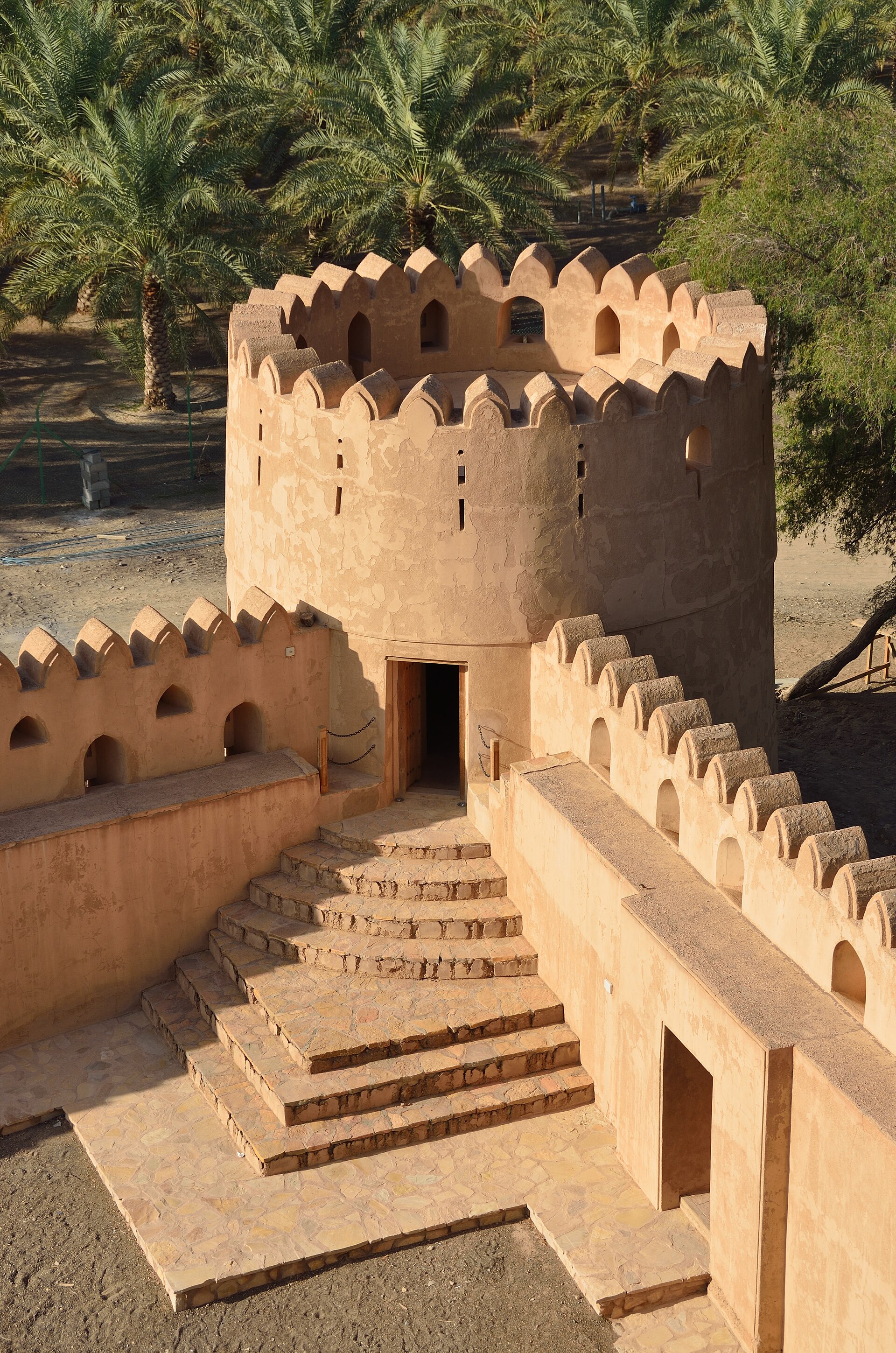
Jabrin Fort stands quietly in the heart of Oman, a short drive from the modern city of Nizwa. Unlike the imposing fortresses perched on rocky outcrops, this one sits on flat ground, its thick walls and towers rising unexpectedly from the surrounding date plantations. It doesn’t dominate the landscape so much as settle into it, as if it has always been part of the land. Built in the late 17th century, the fort was once the residence of Imam Bil’arab bin Sultan, a ruler of the Yaruba dynasty, and later became a center of learning, where scholars gathered to study Islamic law, astronomy, and medicine. Over time, it has seen battles, political intrigue, and the slow passage of generations, yet today it feels more like a well-preserved relic of a thoughtful era than a symbol of military might.
The architecture of Jabrin Fort is a blend of practicality and elegance, a rare combination in Omani fortifications. The outer walls, though sturdy, are not overly imposing, and the entrance is marked by a simple wooden door rather than an intimidating gate. Once inside, the layout unfolds like a carefully planned home rather than a defensive stronghold. The central courtyard, shaded by a single tall palm, serves as the heart of the fort, with rooms branching off in all directions. The ceilings are high, and the windows—some small and narrow, others wide and arched—allow light to filter in at different angles throughout the day. The most striking feature is the *majlis*, or reception hall, where the imam once received guests. Its ceiling is a masterpiece of Omani craftsmanship, covered in intricate geometric patterns and floral motifs painted in deep reds, blues, and golds. The woodwork, though centuries old, retains a warmth that makes the space feel lived-in rather than frozen in time.
What sets Jabrin apart from other forts in Oman is its role as a place of learning. While many fortifications were built for defense, Jabrin was designed with scholarship in mind. The upper floors house small, airy rooms that were once used as classrooms and libraries. Here, students would gather to study under the guidance of scholars, and manuscripts were carefully preserved in wooden chests. The fort’s location, away from the coast and major trade routes, made it a peaceful retreat for intellectual pursuits. Even today, the quiet of these rooms is palpable, as if the echoes of whispered discussions and the rustling of parchment still linger. The fort’s collection of old books and documents, though limited, offers a glimpse into the intellectual life of the time, with texts on theology, mathematics, and even early forms of medicine.
The fort’s design also reflects the social hierarchy of the period. The imam’s private quarters are tucked away on the upper levels, accessible only by narrow staircases, while the lower floors were reserved for servants, guards, and storage. The kitchen, with its large clay ovens and stone grinding wheels, gives a sense of the daily routines that once filled the space. Nearby, the *falaj*—a traditional Omani irrigation system—supplied water to the fort and the surrounding plantations, a reminder of how closely life here was tied to the land. The falaj still flows today, its gentle trickle adding to the fort’s serene atmosphere. In the evenings, when the heat of the day subsides, the sound of water mixing with the rustling of palm leaves creates a rhythm that feels timeless.
Jabrin Fort has survived not just as a monument but as a living piece of history. Unlike some of Oman’s other forts, which have been heavily restored or repurposed, Jabrin retains much of its original character. The wooden doors, though worn, are the same ones that would have creaked open centuries ago. The plasterwork on the walls bears the marks of time, with cracks and fading paint telling silent stories. Even the graffiti left by visitors over the years—some of it dating back decades—adds to the sense of continuity. There are no grand exhibits or interactive displays here; instead, the fort invites you to wander, to touch the cool stone walls, and to imagine the lives that unfolded within them.
The surrounding area adds to the fort’s appeal. The drive from Nizwa takes you through villages where life moves at a slower pace, past fields of date palms and small farms where goats graze. The landscape is dotted with watchtowers and old mud-brick houses, remnants of a time when every settlement needed to be prepared for conflict. Jabrin itself is set back from the road, its presence announced only by a simple sign. There’s no grand entrance or ticket booth—just a small parking area where a few local vendors sell dates and frankincense. The lack of crowds makes it easy to explore at your own pace, to sit in the courtyard and watch the light shift across the walls, or to climb to the rooftop for a view of the distant mountains.
Visiting Jabrin is less about ticking off a tourist attraction and more about stepping into a different rhythm. There’s no rush here, no need to follow a set path. You can linger in the *majlis*, tracing the patterns on the ceiling with your eyes, or stand in the doorway of a classroom and try to picture the students who once filled it. The fort doesn’t demand attention; it simply offers itself, a quiet witness to Oman’s past. In a country where so much has changed in recent decades, Jabrin feels like a bridge between the old world and the new—a place where the past isn’t just remembered but still feels alive.