Nizwa Fort
Nizwa Fort stands where the mountains meet the desert and the old trade routes once converged. Built in the mid-1600s under Imam Sultan bin Saif Al-Yarubi, its origins stretch further back. The circular tower, added in the 18th century, became the city’s symbol—proof of resilience in a region where power demanded endurance.
Nizwa was never only a military post. Caravans carrying frankincense, spices, and silver passed through here, bound for the coast or the interior. The fort’s thick walls were built to survive sieges, but its real strength lay in the details: hidden passages, deceptive staircases, wells dug deep into rock to outlast blockades.
Walk through the fort today, and you’ll see how its design still works. The architects didn’t just build a fortress; they shaped a self-sustaining world within its walls. Living quarters, storerooms, and a small mosque inside were arranged for practical use. Narrow windows doubled as lookouts and arrow slits. The central tower offers the same view traders and soldiers once saw—palm groves stretching toward the mountains. Climb its spiral staircase, and the past feels close: the creak of wood underfoot, the murmur of the market below.
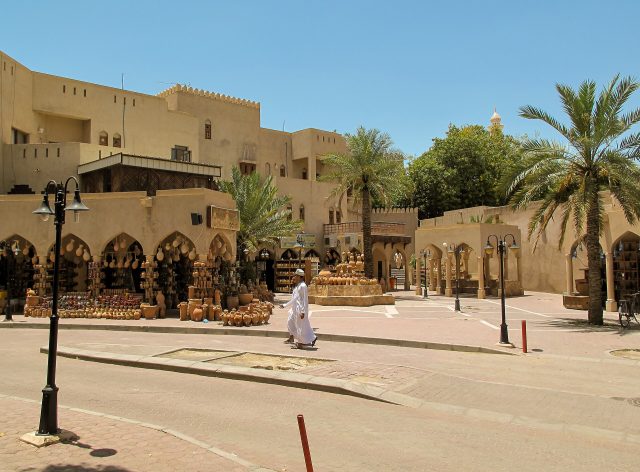
Nizwa sits between harsh desert and jagged peaks, yet life thrives in the shade of date palms and ancient aflaj channels. The fort guarded the routes connecting the Arabian Peninsula’s interior to the sea. The souq at its base was once one of the region’s most important, where silverwork, frankincense, and textiles from across the Indian Ocean were traded. Today, the market still hums—handmade khanjars, pottery, and dried limes share space with modern goods. The scent of cardamom coffee hasn’t faded.
Inside the fort, some rooms show how life looked in the 17th or 18th century. Low seating cushions, clay water jars, and displays of weaponry fill the spaces. Exhibits reveal how khanjars were forged or how silver filigree was shaped. Mannequins demonstrate pottery-making—motions passed down for generations. You can picture the fort as it was: a center of governance, trade, and daily life, where the ruler’s court, the garrison, and servants lived side by side.
The fort isn’t frozen in time. It’s part of Nizwa’s present. During Eid, courtyards fill with music, dance, and families. Traditional performances like the ardah—a sword dance with drumming—echo off the stone walls. On quiet days, locals and visitors sit in the shade, watching the light shift over the mountains. The pace is slow, as if the fort sets the rhythm.
The old souq, a short walk away, keeps the city’s craft traditions alive. Silver shops display khanjars with polished blades, while stalls overflow with dates—hundreds of varieties, from sweet khalas to firm fardh. A drive into the mountains leads to hot springs like Al Hammam, where warm mineral water bubbles up from the earth. Further out, petroglyphs and abandoned villages mark the lives of those who came before the fort.
Nizwa doesn’t erase its past. The fort’s weathered walls remind you of that. It’s not just a tourist stop; it’s a place where history feels real. You touch the same stones soldiers defended and merchants passed by. No grand spectacle—just a structure that has seen empires rise and fall, trade routes shift, and generations come and go.
Visit Nizwa Fort, and you step into a different pace. Wander the souq, haggle over a silver bracelet or a bag of dates, then sit in the fort’s shaded terraces with spiced coffee. The afternoon light softens, casting long shadows. The air carries the scent of grilled meat. No rush—the fort has stood here for centuries, and the timelessness in its walls isn’t going anywhere.