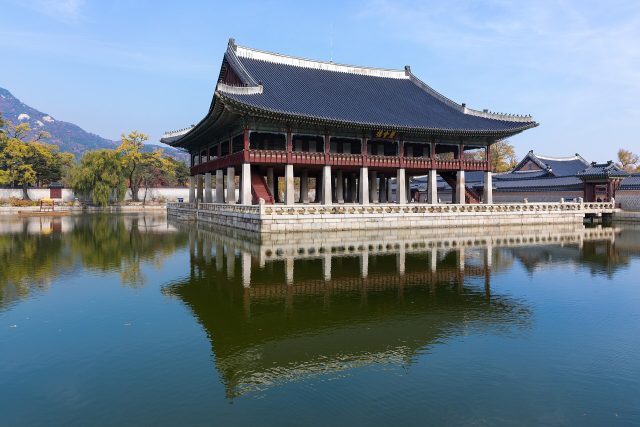
Changdeokgung Palace stands apart from Seoul’s other royal residences, not just in its age but in the way it settles into the land. Built in 1405 as a secondary palace, it became the primary home of the Joseon kings after the Japanese invasions of the late 16th century destroyed the capital’s main palaces. When reconstruction began, Changdeokgung was the first to rise again, and for the next 270 years, it served as the heart of the kingdom. Unlike the rigid, symmetrical layouts favored in Chinese palace design, this one was shaped by the natural contours of the land. Pavilions nestle into the hillsides, pathways curve along the slopes, and the entire complex feels less like an imposed structure and more like something that grew organically from the earth. That harmony with nature earned it a place on the UNESCO World Heritage list.
The palace’s most celebrated feature is Huwon, the Secret Garden, which sprawls across two-thirds of the grounds. Covering sixty hectares, it’s a quiet expanse of forest, ponds, and pavilions where kings once retreated to read, reflect, or simply escape the formality of court life. One of its traditions was the royal plowing ceremony, where the king himself would till a small field each spring, a symbolic gesture to honor agriculture. The garden isn’t open to casual strolls—visitors must join a guided tour, and spots are limited. Tickets sell out quickly, so booking in advance is wise. The tours run in small groups, offering a more intimate experience than the bustling palace grounds.
Inside the main palace complex, the architecture follows the traditional Joseon style, with wooden buildings raised on stone platforms and tiled roofs curving gently upward. The throne hall, where kings held court, is the most imposing structure, its raised dais and intricate woodwork designed to impress. Nearby, the royal living quarters and kitchens give a glimpse into daily life at court. One of the more unusual buildings is the residence where the last members of the royal family lived well into the 20th century, long after Korea’s monarchy had officially ended. Their presence adds a layer of continuity, bridging the gap between the palace’s past and its modern role as a historical site.
Visiting requires a bit of planning. Tickets are sold separately for the palace and the garden, and Mondays are closed. A full visit, including the garden tour, takes about three hours. Those who arrive in hanbok, the traditional Korean dress, get in for free—a popular option, as rental shops near the entrance offer a range of styles. The garden tours operate on a strict schedule, with no entry for latecomers, so punctuality is key. Inside the palace, shoes stay on, though visitors remove them before entering certain pavilions, a custom that dates back centuries.
Just beyond Changdeokgung’s walls lies another palace, and combined tickets are sometimes available for those who want to explore more of Seoul’s royal history. The guided garden tours are offered in several languages, with schedules posted at the entrance. Whether it’s the quiet elegance of the Secret Garden or the grandeur of the throne hall, the palace offers a rare chance to step into a world where Korea’s past feels almost tangible. There’s no rush here—just the slow unraveling of a place that has witnessed centuries of change.