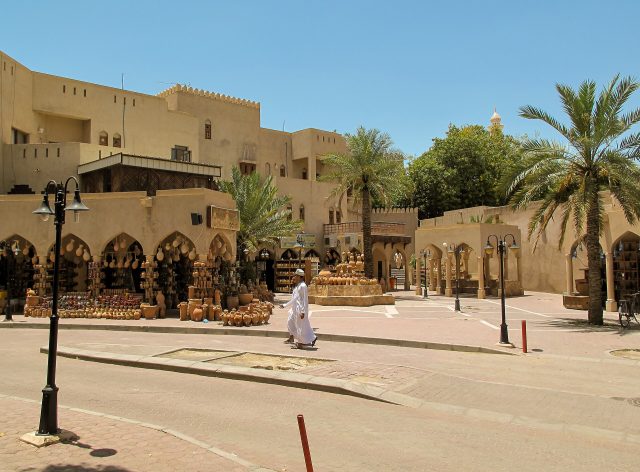
Al Hazm Palace sits quietly in the town of Nizwa, where the mountains soften into the horizon and palm groves sway in the breeze. Built in the early 1700s, it was once the seat of local rulers, a place where decisions shaped the fate of the region. Today, the palace remains open to visitors, its walls still holding the quiet dignity of a bygone era. There’s no grand spectacle here, no modern restoration that erases the passage of time—just the sense that the past lingers in the cool shade of its courtyards and the worn stone beneath your feet.
The architecture is a study in Omani tradition, where practicality meets subtle beauty. Thick clay and stone walls rise to shield against the desert heat, while narrow windows filter the sunlight into slanted patterns on the floors. Inside, wooden ceilings are carved with delicate geometric designs, their craftsmanship speaking of a time when artisans took pride in work meant to last. The rooms are furnished with simple pieces—low tables, woven mats, and chests—that hint at the daily lives of those who once lived here. It’s not a palace of opulence, but one of purpose, built to endure.
The central hall is where the palace’s history feels most alive. This was where rulers received dignitaries, where alliances were forged and disputes settled. Faded murals still cling to the walls, depicting scenes of royal life and the landscapes of old Oman. Some have faded beyond recognition, but others remain, their colors softened by centuries of sunlight. The restorers have been careful not to overpolish the past; the cracks in the plaster and the uneven floors are part of the story. It’s easy to imagine the murmur of voices here, the scent of frankincense lingering in the air long after the last guest departed.
Nizwa itself is a town where history runs deep. Once the capital of Oman, it was a crossroads of trade and culture, its influence stretching far beyond the mountains that surround it. The palace was more than a home for rulers—it was a symbol of authority, a place where the rhythms of the city pulsed strongest. Today, Nizwa retains that sense of timelessness. The old souq still bustles with activity, its stalls selling silver khanjars, pottery, and dates, while the narrow streets wind past houses built in the same style as the palace. To walk these lanes is to step into a world where the past isn’t just remembered; it’s still lived.
Visiting Al Hazm Palace is less about ticking off a landmark and more about slowing down. There are no crowds here, no guided tours rushing you from one room to the next. Instead, you can wander at your own pace, pausing in the courtyards where fountains once trickled and the scent of jasmine still hangs in the air. The locals, if you’re lucky enough to strike up a conversation, might share stories of the palace’s past—tales of diplomatic envoys arriving under the cover of night or of battles decided within these walls. It’s the kind of place where history isn’t just observed; it’s felt.
The palace’s location wasn’t chosen by accident. In the 18th century, control over water was as crucial as control over land. Nizwa sat at the convergence of ancient aflaj—underground channels that carried water from the mountains to the oases—and the palace was built to oversee this lifeline. The system still functions today, a testament to the ingenuity of those who designed it. From the palace’s terraces, you can see the green patches of date palms dotting the landscape, a reminder of how closely survival was tied to the land. The mountains in the distance, rugged and unyielding, frame the scene like a natural fortress.
For travelers, the palace is a gateway to understanding Oman’s past. From here, it’s easy to explore the rest of Nizwa—the imposing fort that looms over the town, the old souq where craftsmen still work with silver and leather, or the nearby villages where traditional falaj systems are still in use. There’s no pressure to rush; the palace invites you to linger, to sit in the shade of its walls and watch the light shift across the stone. It’s a place where the modern world feels distant, where the only sounds are the occasional call to prayer and the rustle of palm fronds in the wind.
Oman has a way of making history feel immediate, as if the past isn’t something to be studied but something to be experienced. Al Hazm Palace embodies that quality. It’s not a monument frozen in time, but a living piece of the country’s story. There’s no need for gilded halls or extravagant displays—what makes the palace special is its authenticity. The walls bear the marks of centuries, the air carries the scent of spices and earth, and the silence is thick with the weight of what has come before. To visit is to step into a quieter, slower rhythm, one that has shaped Oman for generations.