- Home
- Australia
- Port Campbell
- Twelve Apostles
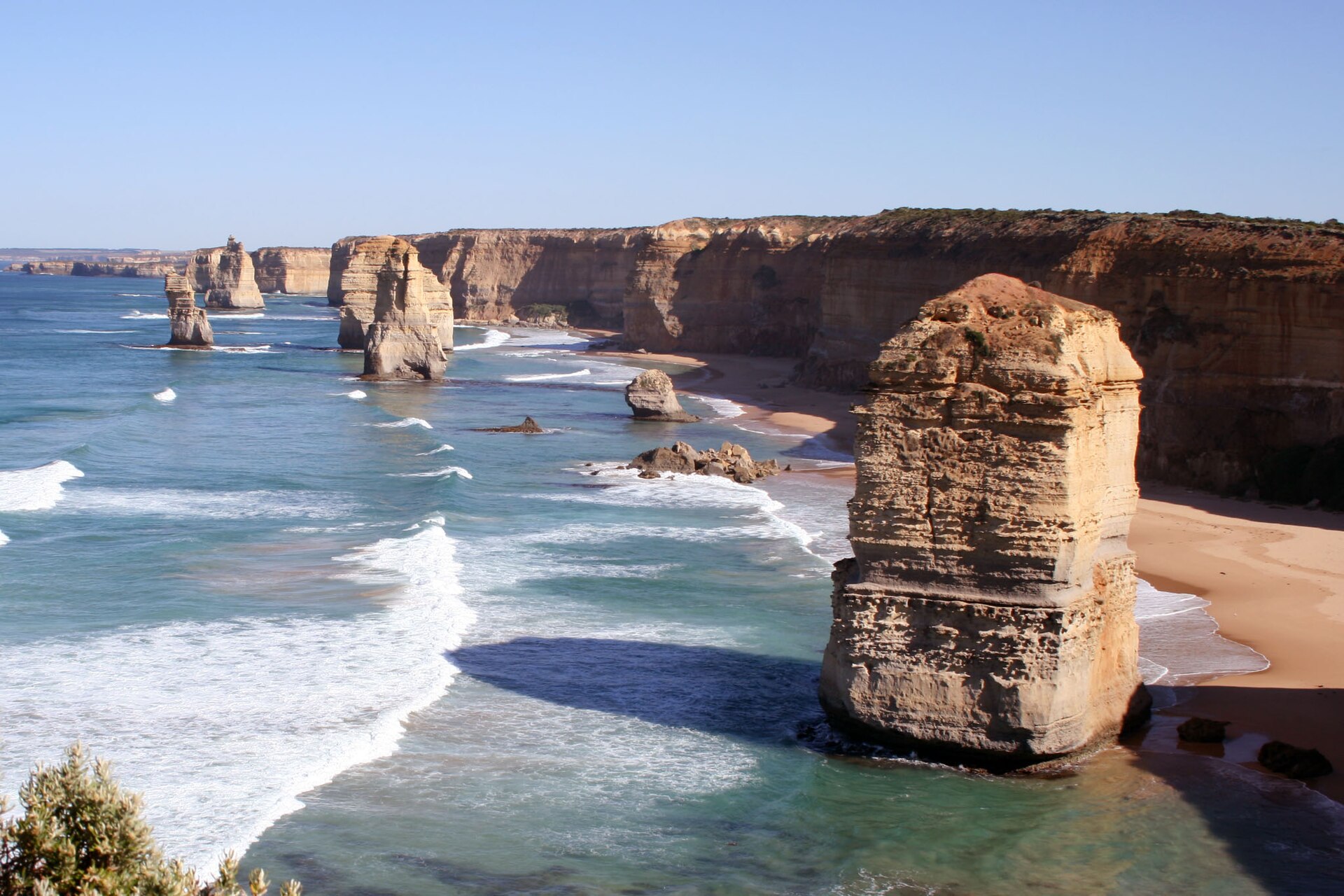
Photo: Mike Lehmann, Mike Switzerland, CC BY-SA 3.0
Twelve Apostles
out of 5 0 ratingsThe Twelve Apostles are one of those places that linger in your mind long after you’ve seen them—partly because they look too dramatic to be real, and partly because they’re always changing. These limestone stacks rise from the Southern Ocean along Victoria’s coastline, their jagged silhouettes instantly recognizable. The name is more poetic than accurate; there were never actually twelve of them, and today only eight remain. Even those are slowly being worn away by the relentless force of the waves, a reminder that this landscape is still very much in the making.
Their story began millions of years ago, when layers of marine sediment were compressed into limestone beneath the ocean floor. Over time, the elements took over. Wind, rain, and the ceaseless pounding of the sea carved away at the softer rock, sculpting arches, caves, and eventually the free-standing columns we see today. The process never stops. Each year, the stacks lose a few more centimeters to erosion, and occasionally, entire sections collapse without warning. In 2005, one of the tallest pillars suddenly crumbled into the ocean, a stark demonstration of nature’s unpredictability.
Long before they became a tourist attraction, the Twelve Apostles held significance for the Gunditjmara people, the traditional custodians of this land. To them, the stacks were sacred, tied to creation stories and ancestral spirits. The surrounding waters were considered a place of power, where the past and present intersected. European settlers who arrived in the 19th century saw the formations differently, naming them the Sow and Piglets after their resemblance to a mother pig with her offspring. The current name only took hold in the 1960s, when someone decided it sounded more evocative for visitors.
Today, the Twelve Apostles are part of Port Campbell National Park, and reaching them is easier than you might expect. The Great Ocean Road, one of the world’s most scenic drives, winds its way from Melbourne to this stretch of coastline, offering plenty of opportunities to pull over and take in the view. The best times to visit are at sunrise or sunset, when the light turns the limestone golden and pink. On stormy days, the scene is even more dramatic—the waves crash against the rocks with thunderous force, sending spray high into the air. It’s a place where the ocean’s raw power is impossible to ignore.
Despite their fame, the Apostles never feel overcrowded. There’s no jostling for space like at some other landmarks, and even in peak season, you can often find a quiet spot to stand and listen to the waves. Perhaps that’s because the place demands a certain stillness. It’s not just a photo opportunity; it’s a reminder of how small we are in the face of natural forces. You could spend hours watching the water shape the rock, or simply listening to the gulls wheeling overhead.
For those who want a different perspective, walking trails lead along the cliffs, offering new angles on the stacks. One path, Gibson Steps, descends to the beach below, where the Apostles loom overhead like ancient sentinels. On clear days, you can see the hollows left behind by collapsed arches, and if you’re lucky, you might spot dolphins playing in the surf nearby. The view from below is just as striking as the one from above, if not more so.
The Twelve Apostles are only one part of a much larger coastal landscape. Nearby formations like Loch Ard Gorge and London Arch (which partially collapsed in 1990) tell similar stories of erosion and change. The entire stretch of coastline is a geological wonder, with hidden coves, white sand beaches, and more limestone cliffs waiting to be explored. Together, they create a scene unlike anywhere else in Australia.
Visiting the Apostles isn’t just about ticking off a bucket-list sight. It’s a chance to witness a landscape in motion, where every wave and gust of wind leaves its mark. The stacks we see today are just a snapshot in time. In a few decades, they’ll look different; in a few centuries, they may be gone entirely. But for now, they stand as a quiet testament to the slow, relentless work of the natural world. And that’s reason enough to see them at least once.
Day around this place
Where else to go on the same day
Building the day…
Where it is
-38.66028, 143.09336