Franschhoek is a quiet town nestled in the folds of South Africa’s wine country, where the air carries the scent of ripening grapes and the hills roll like waves toward the distant mountains. It’s a place shaped by history, where French influences linger in the names of streets, the architecture, and the way the light falls on the vineyards at dusk. Among its unassuming landmarks stands the Dutch Reformed Church, a building that might not command attention at first glance but holds within its walls the echoes of a community that helped define this valley.
Built in the mid-1800s, the church arrived at a time when Franschhoek was still finding its identity. The first settlers, French Huguenots fleeing religious persecution, had arrived a century earlier, bringing with them not just their winemaking skills but also their faith. Though the Dutch Reformed Church later became the dominant religious institution in the region, its presence here reflects the blending of cultures that shaped the Cape. The building itself is a quiet testament to that evolution—less a grand statement of power than a practical gathering place for people who worked the land.
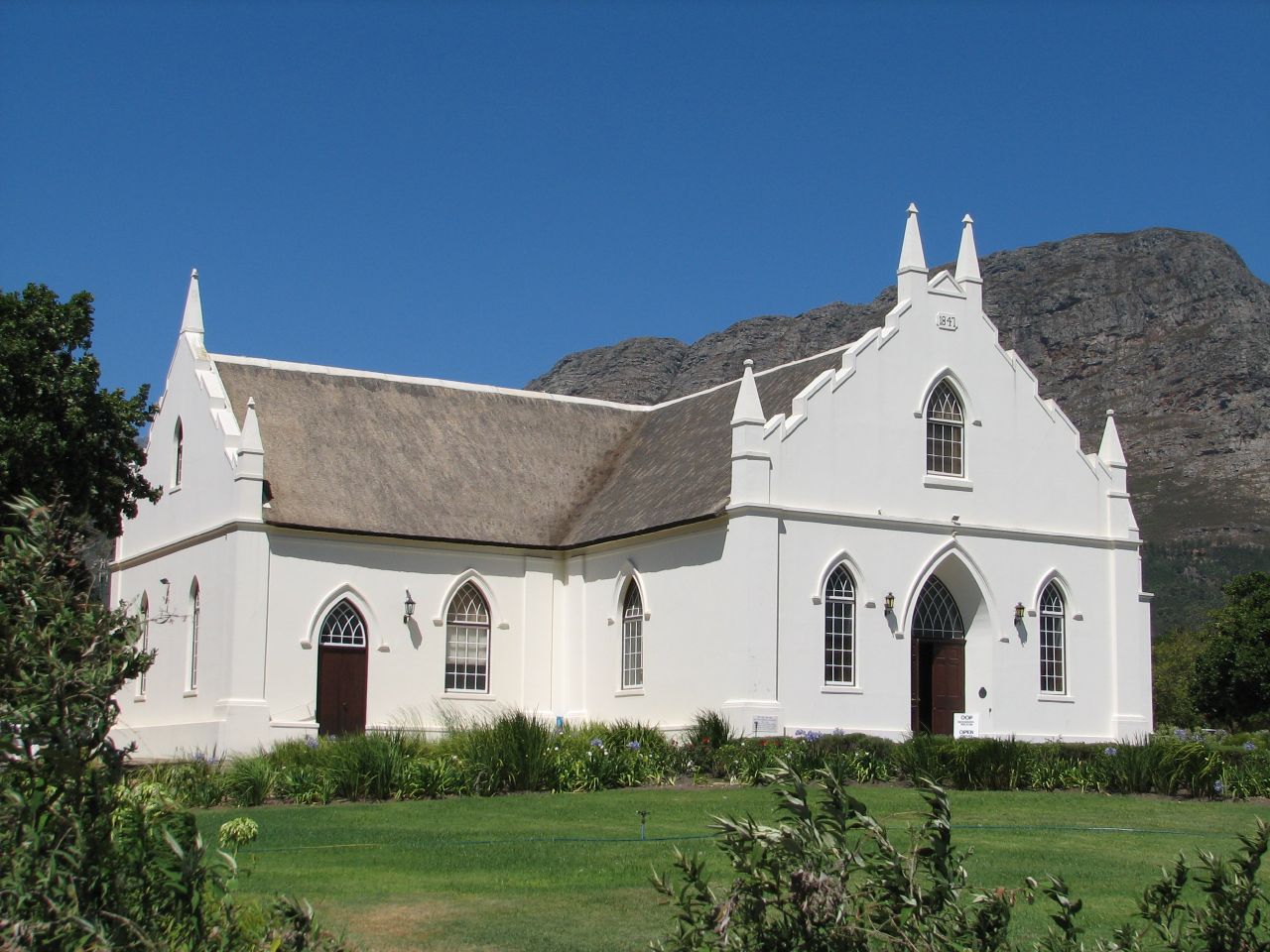
From the outside, the church is simple, almost understated. Its whitewashed walls and arched windows follow the neoclassical style that was common in colonial religious architecture, though adapted to the local climate and materials. There’s no soaring spire or ornate façade, just a clean, balanced structure that sits comfortably among the oak trees and vineyards. Inside, the space is equally unadorned: wooden pews, a modest pulpit, and the soft play of light through the windows. It’s the kind of place where the focus is on the words spoken rather than the surroundings, though the craftsmanship of the woodwork and the proportions of the room give it a quiet dignity.
For much of its history, the church was more than just a place of worship. In a small community like Franschhoek, it served as a social hub where people gathered not only for services but for weddings, funerals, and town meetings. The building witnessed the growth of the valley, from a scattering of farms to a settled town with its own rhythms. Over time, as the world outside changed, the church’s role shifted, but it never lost its connection to the people who built it. Even now, it stands as a reminder of the generations who have lived and worked here, their stories woven into the fabric of the place.
Visiting the church today feels like stepping into a slower, more deliberate pace of life. There are no crowds, no guided tours rushing you through—just the occasional creak of a floorboard or the distant sound of a tractor in the vineyards. On weekdays, the town is especially quiet, and the churchyard offers a peaceful spot to sit and take in the view. The surrounding hills, covered in vines and dotted with old farmhouses, stretch out in every direction, their colors shifting with the seasons. It’s easy to imagine the voices that once filled this space, first in French, then in Dutch, and later in Afrikaans, each language marking another layer of the valley’s history.
While Franschhoek is best known for its wine estates and gourmet restaurants, places like the Dutch Reformed Church offer a different kind of experience. Here, the focus isn’t on spectacle but on subtlety—the way the light slants through the windows in the afternoon, the worn edges of the pews, the sense of continuity that comes from a building that has stood here for nearly two centuries. It’s a place where the past feels tangible, not because of any grand displays but because of the quiet persistence of the everyday.
The church still serves its original purpose, with services held regularly, though its congregation is smaller now than in its early days. For locals, it remains a place of significance, a link to the families who have lived in the valley for generations. For visitors, it’s an opportunity to see Franschhoek beyond the wine routes and boutique hotels—to understand the town as a living community rather than just a picturesque stop. There’s no need to linger long; sometimes, a short visit is enough to feel the weight of the place, the way it holds the stories of those who came before.
In a region where so much is about indulgence—fine wine, rich food, luxury stays—the Dutch Reformed Church offers something simpler. It doesn’t ask for attention, nor does it promise grand revelations. Instead, it invites you to slow down, to notice the details that often go unremarked: the way the wood has darkened with age, the faint scent of old hymnals, the silence that settles in the late afternoon. It’s a reminder that history isn’t always about the dramatic or the extraordinary; sometimes, it’s found in the quiet, unchanging corners of the world.