Maria’s Dacha in Simeiz is one of those places that seems frozen in time, a quiet relic of the early 20th century when the Crimean coast was a playground for Russia’s elite. Built in 1908, it belonged to Nikolai Dmitrievich Stakheev, a Moscow industrialist and patron of the arts whose name carried weight in the circles of St. Petersburg and beyond. The house reflects the architectural tastes of its era—a blend of Art Nouveau elegance with subtle Crimean influences. Light balconies and intricate ironwork give it a fairy-tale quality, as if it were lifted from the pages of a storybook. Back then, Simeiz was more than just a resort; it was a retreat for aristocrats, artists, and intellectuals, and Maria’s Dacha was part of that world, a place where conversations flowed as freely as the wine.
The building itself is modest in size, but its proportions are carefully considered, designed to harmonize with the surrounding landscape. Tall windows flood the interior with light, while the spacious veranda, facing the sea, blurs the line between indoors and out. Though much of the original decor has been lost to time, descriptions from the period suggest a level of refinement typical of the era—plaster moldings, carved wood panels, stained glass—all executed with the kind of attention to detail that turned even a summer home into a statement of taste and status.
Like many grand estates along the Crimean coast, Maria’s Dacha had a turbulent history after the revolution. Nationalized in the Soviet era, it was repurposed over the decades, serving as a sanatorium, a guesthouse, and later an administrative building. Each new use left its mark on the interior, but the exterior remained largely unchanged. Today, the house bears the patina of age—peeling paint, weathered stone—but that only adds to its charm. It doesn’t feel like a museum exhibit; it feels like a living piece of history, one that has witnessed the transformations of an entire region.
Simeiz in the early 1900s was more than just a seaside escape; it was a cultural hub. Composers like Sergei Rachmaninoff, poets like Maximilian Voloshin, and painters like Konstantin Korovin spent time here, drawn by the same landscapes that had inspired generations before them. Maria’s Dacha wasn’t their primary residence, but it existed within that same atmosphere—a place where the sea, the mountains, and the Mediterranean light seemed to fuel creativity. For many, the southern coast of Crimea was a wellspring of inspiration, a place where the boundaries between art and life blurred.
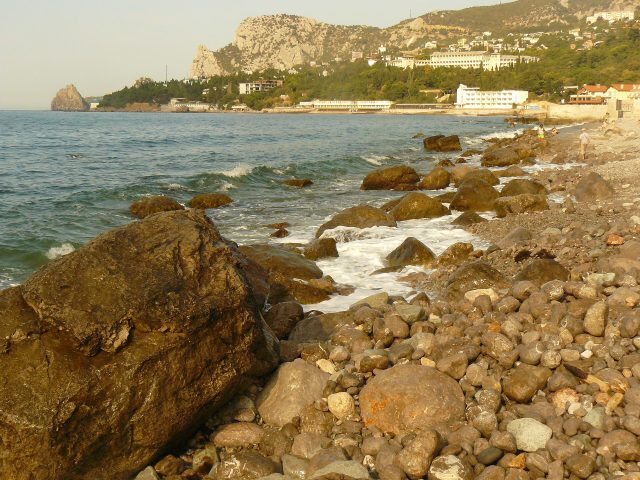
Nowadays, the dacha stands slightly apart from the main tourist routes, which makes it all the more intriguing for those who seek something beyond the usual beach holiday. It’s surrounded by an old park, where century-old pines and cypresses cast long shadows over winding paths. Simeiz itself has changed dramatically over the years—new hotels, cafes, and promenades have sprung up—but the older parts of town still retain a sense of the past. Maria’s Dacha is one of the few places where that past feels tangible, as if stepping into its orbit is stepping back in time.
The building is still in use today, though not as a private residence. Various organizations occupy its rooms, and access to the interior is limited. But even from the outside, it offers a glimpse into a different era. The facade, with its graceful lines and decorative flourishes, hints at a time when life moved at a slower pace, when summer evenings were spent on verandas listening to music and the sound of the waves. There’s something almost nostalgic about it, a quiet invitation to reflect on how ideas of beauty, leisure, and home have evolved over the decades.
For those with an interest in architecture, Maria’s Dacha is a small but fascinating discovery. It may not have the grandeur of the Livadia Palace or the opulence of the Vorontsov Palace in Alupka, but it has its own understated appeal. This was never a showpiece; it was a home, a place where people lived, entertained, and created. The walls may no longer echo with laughter or music, but they still carry the memory of those who once filled them with life.
Simeiz is the kind of place that rewards slow exploration. Its narrow streets, old villas, and hidden gardens make it perfect for unhurried walks. Maria’s Dacha is just a short stroll from the center of town, close enough to reach easily but far enough to feel removed from the bustle. The air here is thick with the scent of pine and salt, and the views of the sea and mountains are never far away. If you’re lucky, you might get a closer look at the house, noticing details in the woodwork or the iron railings that aren’t visible from a distance. If not, you can always sit on a nearby bench and imagine what it must have been like a century ago, when the dacha was alive with the sounds of conversation and the distant murmur of the Black Sea.
Many of Crimea’s old buildings have been lost to time, but Maria’s Dacha endures. Perhaps because it was never a palace, never a monument to excess, but simply a home—a place where people lived rather than performed their wealth. Today, it stands as a reminder that true value isn’t always found in grandeur. Sometimes, it’s in the quiet beauty of a house that has weathered the years, a place that doesn’t need pomp to leave a lasting impression.