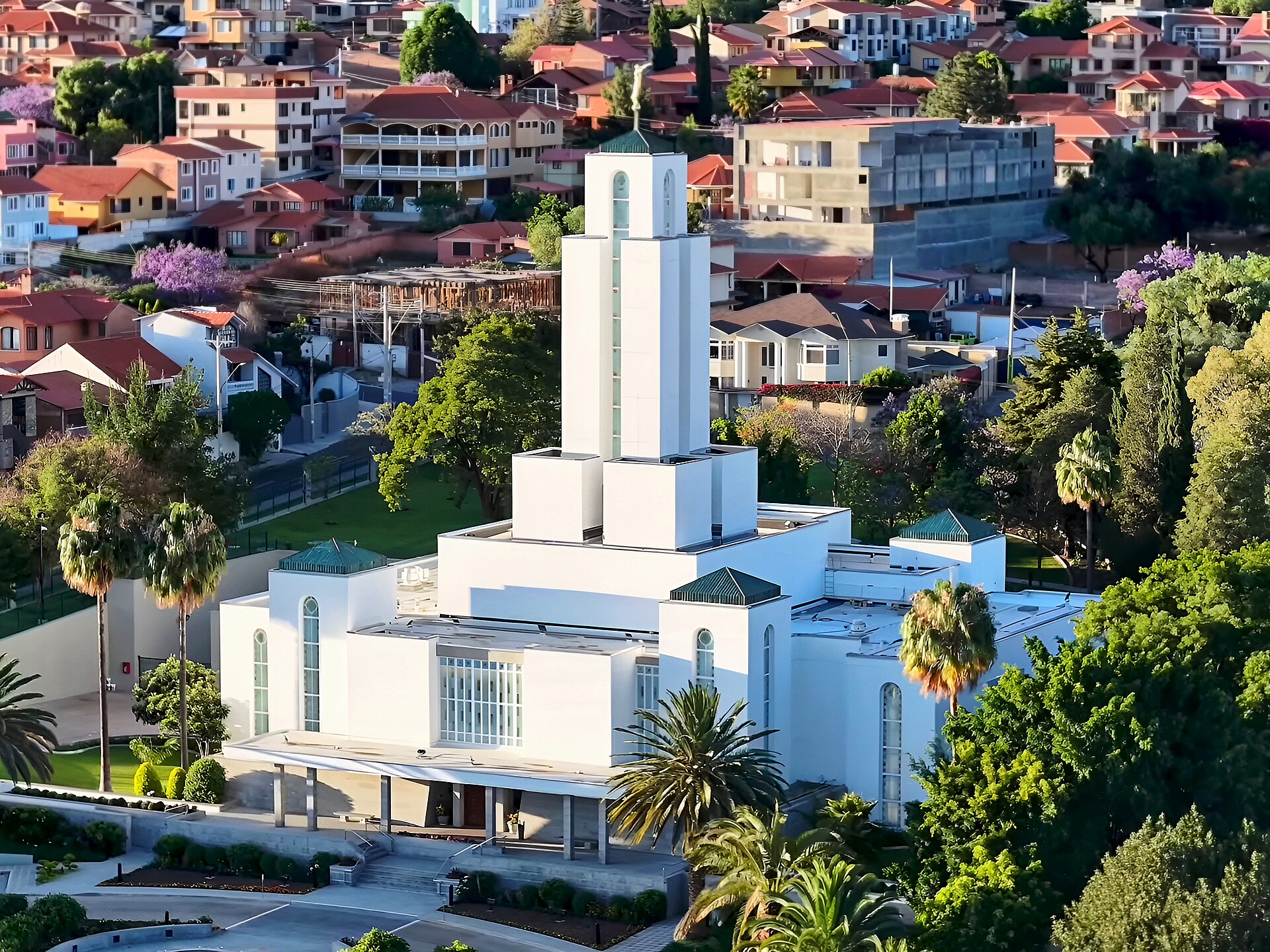
The Cochabamba Bolivia Temple sits quietly on the edge of the city, where the air carries the scent of dry earth and eucalyptus, and the distant Andes fade into a soft haze. Unlike the grand cathedrals or bustling tourist sites that demand attention, this place doesn’t try to impress. Its architecture is understated, almost humble, yet there’s a quiet harmony to it—reminiscent of old Spanish missions, but without the weight of history pressing down. The temple doesn’t shout; it simply exists, as if it has always been part of the landscape.
Built in the late 1990s, when the Church of Jesus Christ of Latter-day Saints was expanding its presence across Latin America, the temple follows the familiar design of Mormon houses of worship: white walls, pointed spires, and clean, symmetrical lines. But here, the effect is different. There’s no cold grandeur, no imposing monumentality. Instead, the building feels almost gentle, softened by the warm light of the Bolivian highlands and the gardens that surround it. Orange trees and bougainvillea spill over the grounds, adding a touch of color to the otherwise restrained palette. It’s the kind of place where time seems to slow down, where the outside world fades into the background.
For members of the church, this temple holds deep significance. It was the first of its kind in Bolivia, serving as a spiritual center not just for Cochabamba but for the entire country. Inside, the space is designed to evoke reverence—high ceilings, subtle stained glass, and an atmosphere of quiet reflection. Rituals like baptisms for the dead and temple marriages take place here, reserved exclusively for those who have undergone the necessary preparations. To outsiders, the interior remains a mystery, its sacredness preserved behind closed doors. But even from the outside, the temple carries a sense of purpose, a place where people come not just to worship, but to find peace.
Cochabamba itself is a city of layers. Founded by the Spanish in the 16th century, it was once a key agricultural hub, supplying the silver mines of Potosí. Over time, it absorbed the traditions of the Quechua people, the colonial legacy of its conquerors, and the rhythms of modern Bolivian life. The temple, though a recent addition, fits seamlessly into this mix. Locals, regardless of their faith, treat it with respect—perhaps because it doesn’t demand attention, but simply occupies its space in the city’s fabric. It’s not a landmark that dominates the skyline, but one that blends into the everyday.
One of the temple’s most intriguing aspects is its exclusivity. Unlike Catholic churches or public museums, where anyone can wander in, this place is accessible only to members of the faith who have completed specific religious requirements. The rules create an air of mystery around the building. Visitors can stroll through the gardens, take in the views of the city and the mountains beyond, but what happens inside remains unknown. Yet, this doesn’t make the temple feel distant. It’s often photographed, mentioned in travel guides, and even locals know it by heart, directing taxi drivers without needing an address. There’s something about it that draws curiosity, even if it keeps its secrets.
The architecture, while adhering to Mormon traditions, carries subtle local influences. The white stone used in its construction resembles the limestone found in the Bolivian Andes, grounding the building in its surroundings. The roof’s design, with its sharp angles, echoes the peaks of the nearby mountains, giving the structure a sense of lightness despite its solid form. The gardens around the temple shift with the seasons—dry and sparse one moment, bursting with color after the rains. It’s as if the place itself is in conversation with the land, a reminder of how human creations can coexist with nature.
For most travelers, the temple isn’t the main reason to visit Cochabamba. The city is better known for its eternal spring-like climate, its vibrant markets overflowing with exotic fruits, and the lively Plaza 14 de Septiembre, where cafés spill onto the sidewalks. But those who make the trip to the temple’s quiet corner often leave with a different kind of impression. There are no crowds, no guided tours, no pressure to perform the role of a tourist. Instead, there’s space to sit on a bench, listen to the birds, and watch the light change over the hills. It’s a rare kind of place where you can simply be, without expectation.
In the end, the Cochabamba Bolivia Temple is less about being a tourist attraction and more about the stories it holds. There’s the story of the Mormon faith taking root in Bolivia, seeking new followers in a land far from its origins. There’s the story of Cochabamba itself—a city that has weathered centuries of change yet retained its character. And then there are the personal stories of the people for whom this temple is a sacred space, a place of milestones and quiet reflection. Even if you don’t share their beliefs, there’s something honest about the temple. It doesn’t put on a show; it doesn’t need to. It’s just there, a quiet presence in a city that’s always moving.