All Saints Church in Nyeri is the kind of place that lingers in your memory long after you’ve left. It doesn’t demand attention with grand facades or towering spires, but rather settles into the landscape like something that has always been there. Perched on a hillside, surrounded by rolling green slopes, the church feels as much a part of the earth as the eucalyptus trees that scent the air after rain. There’s no pomp or spectacle here—just a quiet presence that grows on you, shaped by time, history, and the way it fits into the world around it.
Built in the early 1900s, the church stands as a quiet witness to Kenya’s colonial past. Nyeri was little more than a settlement then, a scattering of farms and tea plantations where British settlers sought both a new beginning and a familiar refuge. All Saints wasn’t meant to be anything more than a place of worship and gathering, but over the decades, it became something deeper—a bridge between worlds. Within its walls, Anglican hymns mingled with the voices of local communities, and the church slowly evolved into a space where different cultures and histories intersected.
The architecture is unassuming but carries a quiet dignity. The building is constructed from local stone, its warm, earthy tones blending seamlessly with the landscape. Tall, narrow windows filter soft light into the interior, while wooden beams overhead hint at the craftsmanship of the carpenters who worked here a century ago. Inside, there are no gilded icons or marble altars—just simple wooden pews, an unadorned altar, and stained-glass windows depicting biblical scenes. One of the most striking features is a window where the face of Christ seems to merge with the features of local people, as if faith here has taken on its own distinct form.
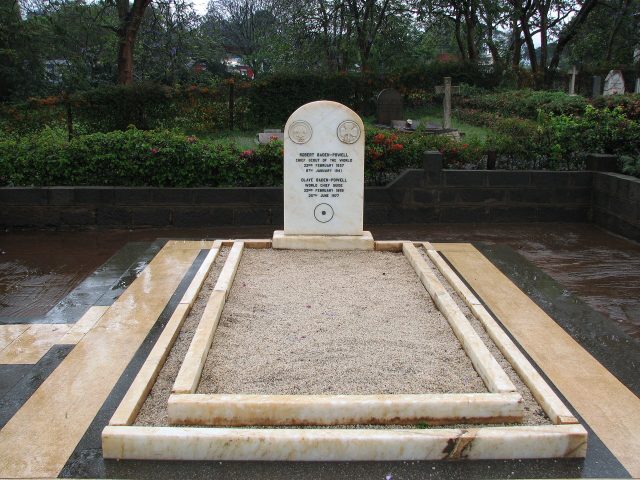
The church is closely tied to one of Nyeri’s most famous residents: Lord Baden-Powell, the founder of the Scout movement. He spent his final years in the area and was buried nearby, in a cemetery that has since become part of a memorial complex. His grave is marked by a modest stone, but for Scouts around the world, it holds deep significance. Every year, groups of young people visit to pay their respects, and the church itself bears a memorial plaque in his honor. Standing inside, it’s easy to imagine the early days of Scouting, when Baden-Powell’s ideas were still taking shape in this quiet corner of Kenya.
Today, All Saints continues its quiet existence. On Sundays, services draw a mix of descendants of settlers and local communities—Kikuyu, Maasai, and others—who have made the church their own. During the week, it’s often empty, save for the occasional visitor or pilgrim retracing Baden-Powell’s footsteps. When the church is quiet, the stillness feels almost tangible, as if the walls hold the echoes of prayers, conversations, and hopes from generations past.
Nyeri isn’t a place that reveals itself quickly. Unlike bustling Nairobi or tourist-heavy Mombasa, it moves at its own pace, and that’s part of its charm. All Saints Church is very much a part of this unhurried rhythm. It doesn’t try to impress or dazzle; instead, it offers something far more subtle—a sense of continuity, of history unfolding in small, unremarkable moments. There are no crowds here, no hustle, no polished tourist experience. Just the chance to pause, look around, and realize that some of the most meaningful stories aren’t written in grand monuments but in places like this, where time seems to move differently.
If you ever find yourself in Nyeri, it’s worth making the climb up the hill to the church. The best time to visit is early morning, when the sun is just beginning to warm the air and dew still glistens on the grass. You can sit on one of the benches outside, listen to the birds, and think about all the people who have come here over the years—some seeking solace, others reflecting on the past, and some simply wanting to feel connected to something larger than themselves. That’s the real draw of All Saints: not its size or splendor, but the quiet power it holds, the way it invites you to slow down and listen.