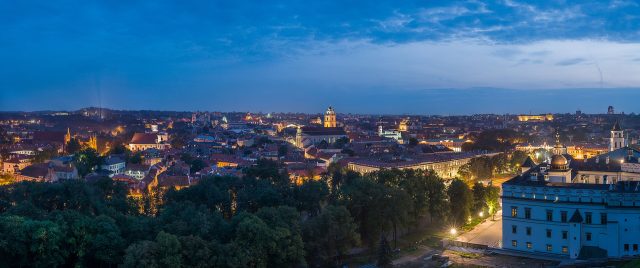
Nestled on a quiet side street in Vilnius’ Old Town, the Church of Saints Constantine and Michael is one of those places that doesn’t demand attention but lingers in memory long after you’ve left. Its unassuming white facade and modest proportions set it apart from the grand cathedrals and ornate Baroque churches that dominate the city’s skyline. There’s no fanfare here, no crowds of tourists snapping photos—just a sense of stillness, as if time moves at its own unhurried pace within these walls.
The church was built in the early 20th century as an Orthodox place of worship for Vilnius’ Russian community, a reflection of the city’s multicultural past. Designed by architect Mikhail Prozorov, its architecture blends Byzantine influences with local traditions, creating a structure that feels both rooted in history and distinctly of its time. The period of its construction was one of upheaval—Vilnius had recently shifted from Russian imperial rule to Lithuanian independence, and later, Polish control. For the Orthodox faithful, the church became a steady presence amid these changes, a place where continuity mattered more than grandeur.
Inside, the atmosphere is one of quiet reverence. The iconostasis is simple, the frescoes understated, and the light filtering through narrow windows casts a soft glow over the space. Unlike the lavish interiors of many Catholic churches in Lithuania, where every surface seems to tell a story, this church offers something different: a sense of space, of breath. It’s the kind of place where you might sit for a while, not because you’re dazzled by ornamentation, but because the simplicity itself feels restful.
The church’s history is deeply tied to the Russian community that once thrived in Vilnius. At the turn of the 20th century, the city was a mosaic of cultures—Lithuanians, Poles, Jews, Russians, and Belarusians all shaped its character. For Orthodox believers, the church was more than a place of worship; it was a cultural anchor. After World War I, when Vilnius became part of independent Lithuania, the community’s position shifted, but the church remained a vital spiritual center. Even during the Soviet era, when religious institutions faced pressure, it stayed open, though its congregation dwindled over time.
Today, the Church of Saints Constantine and Michael stands as a quiet testament to Vilnius’ layered past. It’s not a major tourist attraction, but those who seek it out often do so out of curiosity about the city’s multicultural history. The building itself is a reminder of how different communities coexisted here, each leaving their mark on the streets, the architecture, and the everyday rhythms of life. In a city known for its Gothic spires and Baroque flourishes, this modest church offers a glimpse of another side of Vilnius—one where Orthodox traditions, Russian heritage, and Lithuanian identity intersect.
Though its congregation is smaller now than it was a century ago, the church remains an active place of worship. Services, baptisms, and weddings still take place here, and for those who attend, it’s more than just a religious site. It’s a connection to the past, a place where the prayers of previous generations seem to echo in the quiet corners. The building has witnessed wars, political shifts, and social changes, yet it endures, a small but resilient part of the city’s fabric.
The surrounding streets of the Old Town add to the church’s charm. Vilnius’ historic center is a maze of cobblestone lanes, where every turn reveals something unexpected—a hidden courtyard, a crumbling fresco, a café tucked into a 16th-century building. Near the church, you’ll find small shops selling local crafts, cafés serving strong Lithuanian coffee, and houses with intricate wooden facades. It’s easy to wander here for hours, losing track of time as the city unfolds in layers of history.
What makes the Church of Saints Constantine and Michael special isn’t its size or its splendor, but the way it holds the past within its walls. It doesn’t shout its significance; it simply exists, a quiet witness to the people who have passed through its doors over the decades. In a city where Gothic and Baroque architecture often steal the spotlight, this unassuming church offers a different perspective—one that speaks to the diversity of Vilnius’ history and the many voices that have shaped it. If you take the time to step inside, you might just find that its stillness tells a story as rich as any grand cathedral.