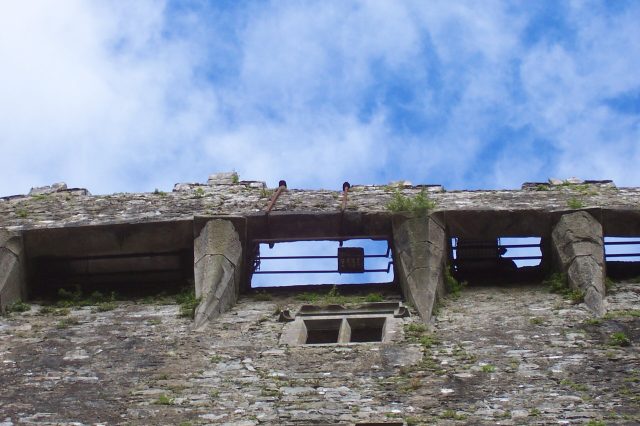
St. Finbarr’s Church of the Holy Trinity in Blarney is one of those quiet places that doesn’t demand attention but lingers in the mind long after you’ve left. Tucked away on the edge of the village, just beyond the well-trodden paths leading to the castle and its famous stone, it stands unassuming—a modest structure of grey stone, free of grand flourishes. There’s no attempt here to impress with scale or spectacle. Instead, the church offers something subtler: a pause, a moment to slow down and sense the unhurried rhythm of a small Irish community where time moves differently, and history is felt in the weight of every weathered stone.
Built in the mid-19th century, the church belongs to an era when Ireland was reshaping itself amid social and religious upheaval. Its architecture is a textbook example of Victorian Gothic revival—pointed arches, slender windows, and a modest spire reaching toward the sky. Inside, the space feels larger than it is, thanks to high ceilings and the soft glow of stained glass filtering through the windows. Those windows are the church’s most striking feature, though even they are understated, their colors muted and designs elegant without being ornate. They cast shifting patterns of light across the stone floor, a quiet reminder of the craftsmanship that went into something meant not for show, but for reflection.
The church’s history is woven into the fabric of Blarney itself. When it was built, Ireland was still reeling from the Great Famine, and many parishes struggled to survive. Yet despite hardship, the people of Blarney found a way to raise this place of worship, which became more than just a house of prayer. It was a gathering point for the community, a place where festivals were celebrated, decisions were made, and solace was found in difficult times. Today, while tourists flock to the castle for its legends, the Church of the Holy Trinity stands as a testament to the quieter, everyday stories that shape a place—the ones that don’t make it into guidebooks but endure in the lives of those who call it home.
Step inside, and the simplicity of the interior is immediately apparent. Wooden pews, a stone floor, a restrained altar—nothing here is meant to overwhelm. Yet there’s a warmth to the space, a sense of stillness that invites you to sit and listen. The carved wooden lectern, crafted by local hands, bears the marks of time, and the few plaques on the walls serve as quiet memorials to those who once knelt here in prayer. In one corner, a small brass plate honors parishioners lost in the world wars. These details don’t announce themselves, but they give the church its soul, bridging the gap between past and present.
Unlike the castle, which draws crowds year-round, the Church of the Holy Trinity rarely sees more than a handful of visitors at a time. Most days, the only sounds are the occasional footsteps of someone who wandered in by chance or the murmurs of a small congregation during service. It’s a place where the outside world’s noise fades, where you can sit on a pew and watch the light play across the stained glass or run your fingers along the cool stone walls. Time here doesn’t rush; it settles, allowing you to notice things you might otherwise miss—the way the wood creaks underfoot, the faint scent of old paper from hymnals, the way the air feels heavier near the altar.
Though unassuming, the church remains a vital part of Blarney’s life. It’s still an active parish, where locals gather on Sundays and traditional Irish hymns fill the air on feast days. In those moments, the building comes alive, its walls seeming to breathe with the voices of those inside. For many in the village, this isn’t just a church—it’s a chapter in their own stories. Baptisms, weddings, funerals—all the milestones of life have passed through these doors. That’s why the Church of the Holy Trinity isn’t just a landmark; it’s a living thing, tied to the people who have shaped it and been shaped by it in return.
If you find yourself in Blarney, it’s worth taking a detour here, not to check it off a list, but to experience something less tangible. Walk through the churchyard, where ivy climbs over old gravestones and wildflowers push through the cracks. Listen to the silence, broken only by birdsong, and let the place work its quiet magic. There’s no grandeur here, no postcard-perfect views—just the kind of authenticity that can’t be staged or sold. It’s the kind of place that reminds you why travel isn’t just about seeing, but about feeling the layers of time and human connection that make a place real.