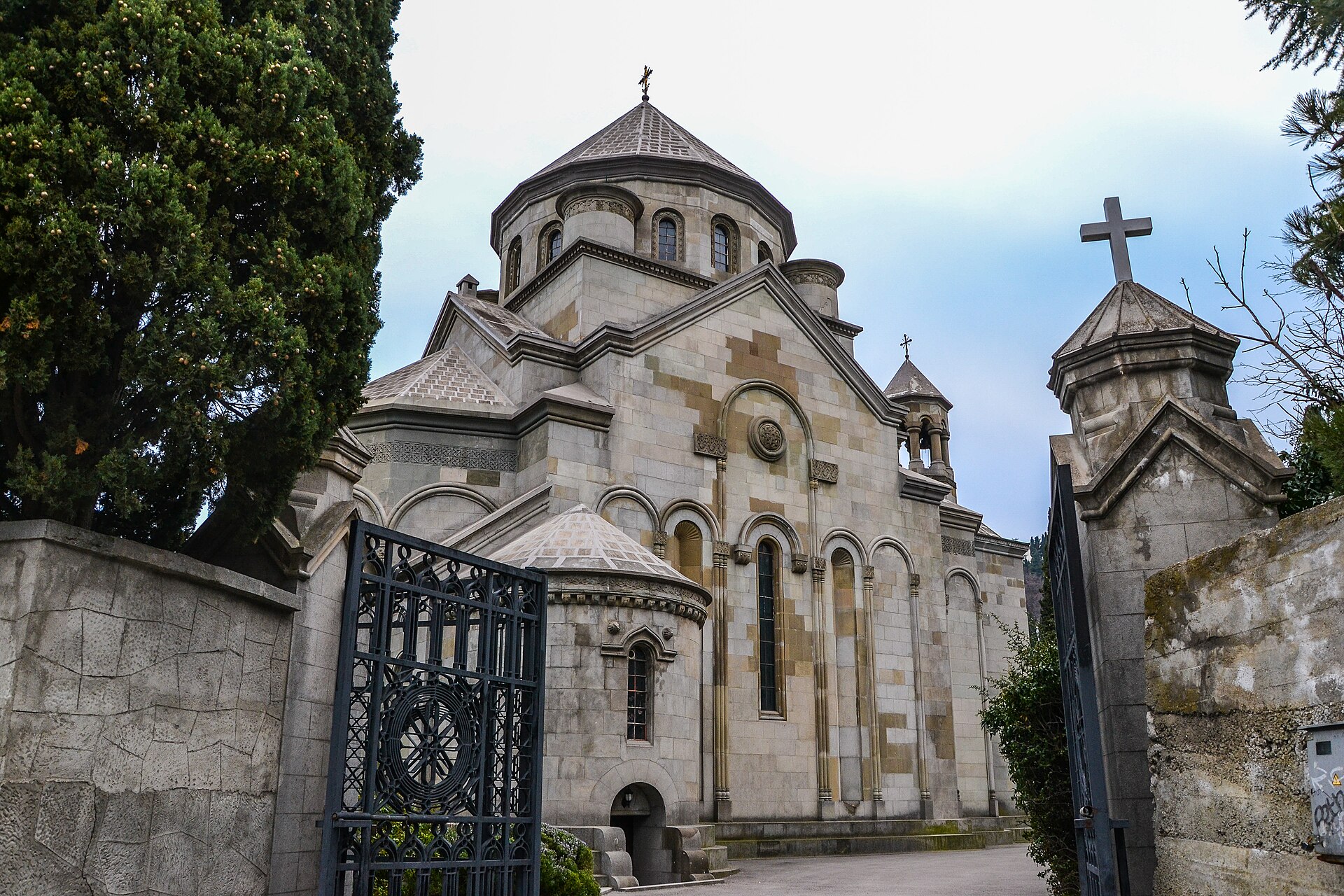
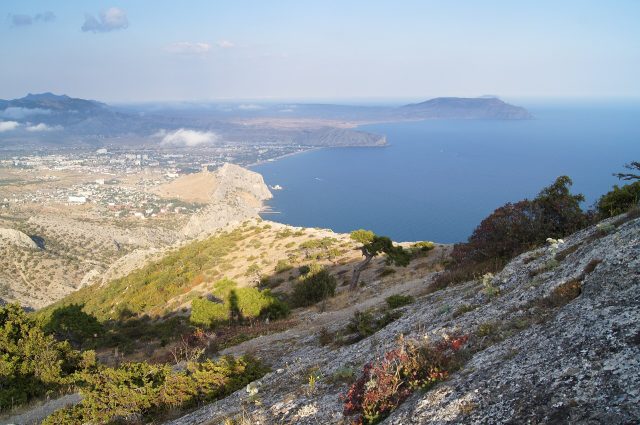
Perched on a quiet hillside above Yalta, the Church of Saint Hripsime feels like a place where time moves differently. Built in the late nineteenth century, it was conceived by the city’s Armenian community as a spiritual anchor for those who had settled in Crimea, far from their ancestral lands. The church stands modestly among the trees, its white stone walls and dark domes blending into the landscape as if they’ve always been there. From this vantage point, the view stretches over the rooftops of Yalta toward the sea, a quiet reminder of the distance between this place and the mountains of Armenia.
The architecture carries the unmistakable marks of Armenian tradition—clean lines, arched windows, and intricate carvings that soften the building’s otherwise austere silhouette. Inside, the space is intimate, with low vaulted ceilings and an iconostasis adorned with delicate paintings. Sunlight filters through stained glass, casting a warm glow over the wooden pews. There’s no grandeur here, no overwhelming opulence, just a sense of quiet reverence that lingers long after you step outside.
The church’s history is woven into the broader story of Yalta’s transformation in the late 1800s. By then, the city had become a fashionable retreat for Russia’s elite, drawing not only aristocrats but also merchants, artists, and immigrants from across the empire. The Armenian community, though small, was an active part of this cosmopolitan mix. For them, Saint Hripsime was more than a place of worship—it was a piece of home, a connection to a culture and faith that endured despite the miles between Crimea and the Caucasus.
Like many religious sites in the Soviet era, the church faced an uncertain future. It was closed, repurposed, and nearly forgotten, its interiors stripped of their original purpose. Yet it survived, and in the 1990s, it was returned to the faithful. Today, services are held in Armenian, and the church remains a gathering place for the local community. For visitors, it offers a glimpse into a lesser-known side of Yalta’s past, one that isn’t often highlighted in guidebooks.
The area around the church is just as understated as the building itself. Tucked away from the bustle of the waterfront, the neighborhood is a quiet maze of narrow streets lined with old trees and crumbling villas from Yalta’s early twentieth-century heyday. These were the homes of those who came not just for a holiday but to stay—writers, doctors, retired officers—each leaving their own mark on the city. A short walk uphill reveals the remnants of these grand houses, their faded facades hinting at stories that have long since faded from memory.
Saint Hripsime isn’t the kind of place that demands attention. There are no sweeping panoramas to photograph, no dramatic backdrops for selfies. Instead, it invites a slower kind of exploration. You might sit on one of the benches outside, listening to the rustle of leaves and the distant murmur of the sea, and think about the generations of people who have passed through its doors—some seeking solace, others a moment of reflection, all drawn by something intangible yet enduring.
Yalta is full of must-see sights, the kind that draw crowds and fill photo albums. But this church is different. It doesn’t clamor for recognition; it simply exists, a quiet presence in a city that has seen so much change. That’s perhaps why those who stumble upon it often find themselves returning—not for the sake of another visit, but for the rare sense of stillness it offers. In a place where history is often overshadowed by spectacle, Saint Hripsime reminds you that some of the most meaningful moments happen when you least expect them.