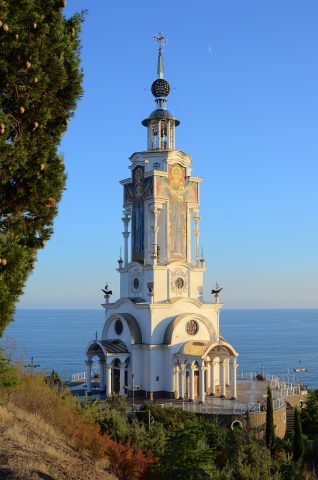
The Church of Saint Panteleimon in Malorechenskoye is one of those quiet places that doesn’t demand attention but lingers in the memory long after you’ve left. Tucked away on the edge of the village, almost at the water’s edge, it feels like a world apart from the bustle of Crimea’s more famous coastal resorts. Time moves differently here—slower, softer, without the urgency that defines so many tourist spots. The church itself is modest in size, its white walls and low bell tower standing out against the greenery and the low-slung houses of the village. When the sun rises over the sea, it catches the walls just right, highlighting the simplicity of the architecture, as if the building itself is breathing in the salt-tinged air.
The history of the church is woven into the story of Malorechenskoye, which began as a small fishing village long before it became a quiet retreat for travelers. By the late 19th century, as Crimea gradually transformed into a destination for rest and pilgrimage, coastal villages like this one needed their own places of worship. The Church of Saint Panteleimon was built in the early 20th century, though the exact date has faded into local lore rather than official records. What remains are the stories passed down through generations—how the church became the heart of the village’s spiritual life, how it weathered neglect during the Soviet era, and how it was carefully restored in the 1990s, returning to its role as a place of gathering and reflection.
The architecture is unassuming, reflecting the practical needs of a rural parish. A single dome rises above the simple structure, which includes a small refectory and a bell tower, all designed in the tradition of Russian Orthodox churches. The facades are adorned with understated details—arched windows, slender pilasters, a modest cornice—that give the building a sense of lightness and balance. Inside, there’s no opulence, just a quiet dignity. The iconostasis is low, the wooden benches worn smooth by time, and the narrow windows filter the sunlight into soft pools on the floor. The only sounds are the rustle of prayer books and, in the distance, the murmur of the sea.
For the people of Malorechenskoye, the church is more than a religious site; it’s where life’s most important moments unfold. Baptisms, weddings, and memorial services are held here, binding the community together. The church is also a focal point for the feast day of Saint Panteleimon, celebrated on August 9th, when pilgrims and worshippers from nearby villages and towns gather to honor the saint, revered as a healer and protector of physicians. The service is a reminder of the church’s enduring role in the spiritual life of the region, a thread connecting the past to the present.
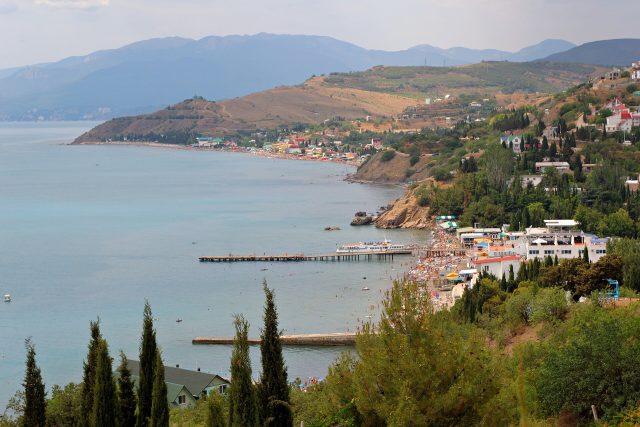
Malorechenskoye itself is an unassuming place, but that’s part of its charm. Stretching along the Black Sea coast between Alushta and Sudak, the village is a mix of forested hills and narrow beaches where pebbles give way to sand. There are no flashy resorts or crowded promenades here, just quiet streets lined with old houses, their shutters painted in faded blues and greens. The pace of life feels suspended, as if the village exists outside the rush of modern time. The Church of Saint Panteleimon fits seamlessly into this landscape, not dominating it but complementing it, its modest beauty echoing the unhurried rhythm of the place.
The best time to visit is in the summer or early autumn, when the sea is still warm and the air carries the scent of pine and wild herbs. Mornings here are especially peaceful, with the church bathed in the soft light of dawn. In the evenings, as the sun sets, the walls take on a golden hue, and the sound of the waves blends with the quiet of the surroundings. Visitors are welcome inside, but it’s worth remembering that this is an active place of worship. The atmosphere invites stillness—no loud conversations, no hurried steps, just the chance to sit, listen, and reflect.
This isn’t a church that draws crowds or becomes a backdrop for dramatic photographs. It doesn’t impress with grandeur or elaborate decoration, and that’s precisely what makes it special. There’s nothing excessive here—no gilded excess, no forced solemnity, just a sense of quiet rightness. The sea hums in the background, a reminder of something larger than the moment. For some, it’s just another church on Crimea’s map. For others, it’s a place to pause, to breathe, and to feel, if only for a little while, a connection to something beyond the everyday.