Perched on the slopes of Tara Mountain, the Church of Saint Sava in Bajina Bašta is one of those quiet places that feels older than it actually is. Built in the early 20th century, it stands as a testament to Serbia’s enduring spiritual traditions, though its story is woven into a much broader tapestry of history. The church was constructed between 1938 and 1940, a period when the region was still finding its footing after centuries of shifting borders and cultural influences. Its location, just outside the town center, gives it a sense of solitude, as if it were deliberately placed where the mountains begin to rise, offering a retreat from the noise of everyday life.
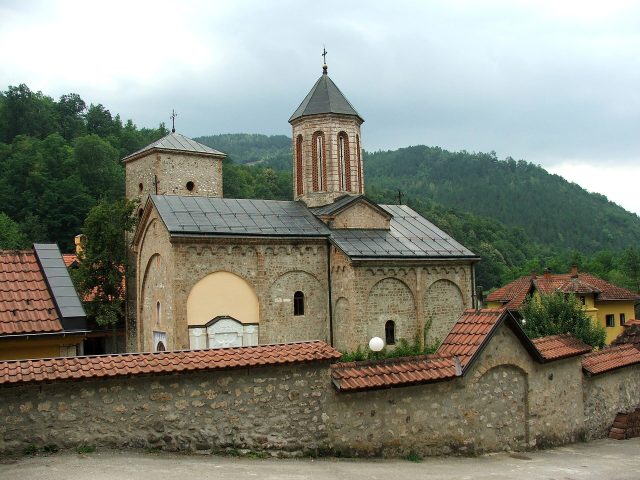
The architecture of the church is a blend of traditional Serbian Orthodox design and the practical considerations of its time. The exterior is modest, with whitewashed walls and a single dome that rises above the surrounding greenery. The simplicity of the structure is deceptive—inside, the space opens up into something far more intricate. The iconostasis, a wooden screen adorned with religious paintings, is the focal point, separating the nave from the altar. These icons, though not ancient, follow the centuries-old style of Serbian religious art, with their deep colors and solemn expressions. The craftsmanship reflects the skill of local artisans, who worked with what was available in an era before mass production.
What makes the Church of Saint Sava particularly interesting is its role in the community. Unlike grand cathedrals in major cities, this church was built for the people of Bajina Bašta and the surrounding villages. It has witnessed generations of baptisms, weddings, and funerals, serving as a constant in a region that has seen its share of upheaval. During World War II, the area was caught in the crossfire of conflict, and the church, like many others, became a refuge for those seeking solace. In the decades that followed, it remained a place where locals gathered not just for worship but for community events, festivals, and even quiet moments of reflection.
The church is dedicated to Saint Sava, the patron saint of Serbia and a figure who looms large in the country’s history. Born in the 12th century, Sava was the youngest son of Stefan Nemanja, the founder of the Nemanjić dynasty, which ruled Serbia during its medieval golden age. He renounced his royal inheritance to become a monk, eventually founding the Serbian Orthodox Church and securing its autocephaly—a move that shaped the nation’s identity. His legacy is deeply tied to the idea of Serbian statehood and faith, and churches like this one are a physical manifestation of that connection. For visitors, the dedication to Saint Sava offers a glimpse into how history and religion are intertwined in Serbia, where the past is never far from the present.
The setting of the church adds to its appeal. Tara Mountain, with its dense forests and dramatic viewpoints, has long been a place of natural beauty and legend. The church sits on a gentle slope, surrounded by trees that change with the seasons—lush green in summer, golden in autumn, and dusted with snow in winter. The air here is cooler than in the valley below, and the silence is broken only by the sound of birds or the occasional rustle of leaves. It’s easy to see why this spot was chosen; the landscape itself feels sacred, as if the land and the building were meant to exist in harmony.
For those who visit, the church offers more than just a historical or architectural experience. It’s a place where time seems to slow down. The interior is dimly lit, with sunlight filtering through small windows, casting soft shadows on the walls. The scent of incense lingers in the air, a reminder of the rituals that have taken place here for decades. There’s no grand tour or guided explanation—just the quiet hum of a place that has seen life unfold in all its complexity. Some visitors come to light a candle, others to sit on the wooden pews and listen to the silence. There’s no pressure to perform or understand; the church simply exists, as it has for nearly a century.
The Church of Saint Sava is also a reminder of how faith adapts to changing times. In the decades since its construction, Serbia has undergone dramatic transformations—from monarchy to socialism, from war to uneasy peace. Yet the church has remained a constant, a place where the rhythms of life continue unchanged. The frescoes on the walls, the flickering candles, the whispered prayers—all of these are part of a living tradition, one that doesn’t rely on grandeur or spectacle. It’s a place where the sacred and the ordinary coexist, where a farmer might stop by after work or a family might gather for a holiday service.
For travelers, the church is worth visiting not just for its historical significance but for the atmosphere it embodies. It’s a place that invites contemplation, whether you’re religious or not. The journey to Bajina Bašta itself is part of the experience—winding roads through the mountains, small villages where life moves at a slower pace, and the sense of stepping into a world that feels untouched by modernity. The church, with its unassuming presence, fits perfectly into this landscape. It doesn’t demand attention; it simply offers a space to pause, to reflect, and to appreciate the quiet beauty of a place where history, nature, and faith intersect.