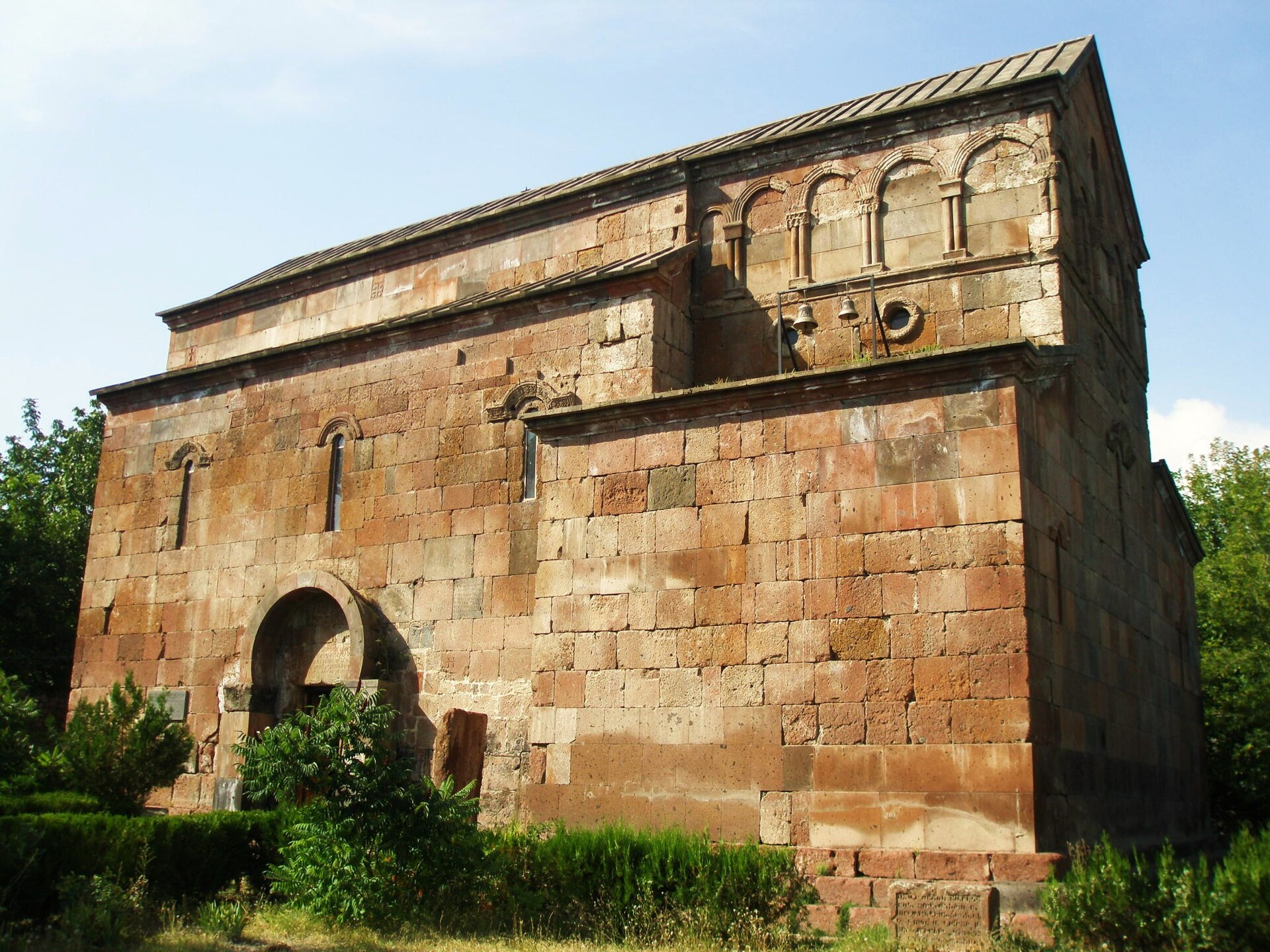
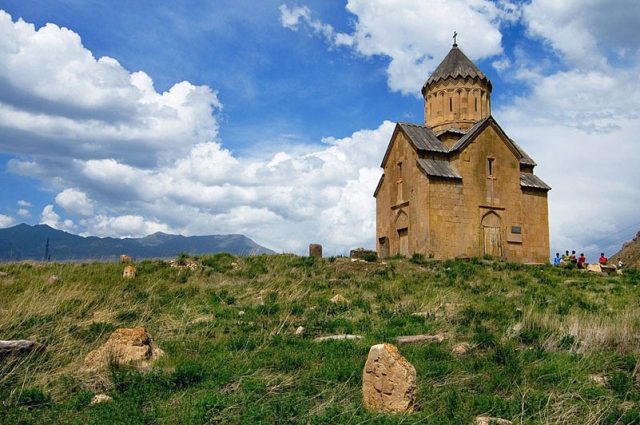
Perched on a gentle slope overlooking the village of Byurakan, the Church of Saint Hovhannes feels like a quiet guardian of time. Built in the 10th century, it stands as one of the lesser-known but deeply atmospheric examples of medieval Armenian architecture, a place where history lingers in the weathered stones and the soft light filtering through narrow windows. Unlike the more famous monastic complexes of Armenia, this church has never been overrun by tourists, and that sense of solitude only deepens its charm. The air here carries the scent of wild herbs and dry grass, and from the hillside, the view stretches across the Ararat plain, where Mount Ararat looms in the distance like a silent promise.
The church itself is modest in size but rich in detail. Constructed from local volcanic tuff, its warm, reddish-brown hues shift with the light of the day, turning golden at sunrise and deepening into rust as evening falls. The architecture follows the classic Armenian cruciform plan, with a central dome supported by four massive pillars. The exterior is adorned with simple yet elegant carvings—crosses, geometric patterns, and the occasional floral motif—hinting at the skilled craftsmanship of the era. Inside, the space is intimate, almost cave-like, with thick walls that seem to absorb sound, leaving only the faint echo of footsteps and the occasional rustle of wind through the open door.
What makes Saint Hovhannes particularly intriguing is its connection to Byurakan’s broader historical and cultural landscape. The village has long been a center of Armenian astronomy, home to the Byurakan Astrophysical Observatory, founded in the mid-20th century by the renowned scientist Viktor Ambartsumian. The contrast between the ancient church and the modern observatory—one rooted in faith, the other in science—creates a fascinating dialogue between past and present. It’s not uncommon to see astronomers from the observatory taking a break to wander up the hill, drawn by the same quiet that has attracted pilgrims and travelers for over a thousand years.
The church has seen its share of upheavals. Like much of Armenia, it endured invasions, earthquakes, and periods of neglect, yet it has survived with a surprising degree of integrity. The dome, though restored in places, retains its original form, and the interior frescoes, though faded, still offer glimpses of the vibrant colors that once covered the walls. These murals depict scenes from the life of Christ and the saints, their outlines softened by time but their presence still powerful. Standing beneath them, it’s easy to imagine the voices of medieval worshippers filling the space, their prayers rising toward the dome like incense.
Byurakan itself is a village that feels suspended between worlds. It’s neither a bustling town nor a forgotten backwater, but something in between—a place where life moves at its own unhurried pace. The locals are accustomed to visitors, though not overwhelmed by them, and there’s a warmth in the way they greet strangers, whether they’ve come to see the church, the stars, or simply to walk the quiet roads. The village is surrounded by rolling hills dotted with wildflowers in spring and golden wheat in summer, and the air is always crisp, carrying the faintest hint of pine from the nearby forests.
For those who make the journey, Saint Hovhannes offers more than just a glimpse into Armenia’s medieval past. It’s a place to sit for a while, to listen to the wind, and to think about the layers of history that have settled here like dust on an old book. The church doesn’t demand attention; it simply exists, as it has for centuries, a silent witness to the passage of time. And perhaps that’s its greatest gift—the chance to step away from the noise of the modern world and into a space where the past feels tangible, where every stone has a story, and where the view of Ararat in the distance serves as a reminder of something enduring.
Visiting the church doesn’t require much planning. There’s no ticket booth, no guided tour, no crowds to navigate. Just a short walk up the hill from the village, past a few scattered houses and grazing sheep, until the church comes into view. The door is usually open, inviting visitors to step inside and take their time. Outside, the hillside is a perfect spot to spread out a blanket, unpack a simple meal of local bread and cheese, and watch the light change over the landscape. It’s the kind of place that stays with you long after you’ve left, not because it’s grand or dramatic, but because it feels honest—unpolished, unpretentious, and deeply real.