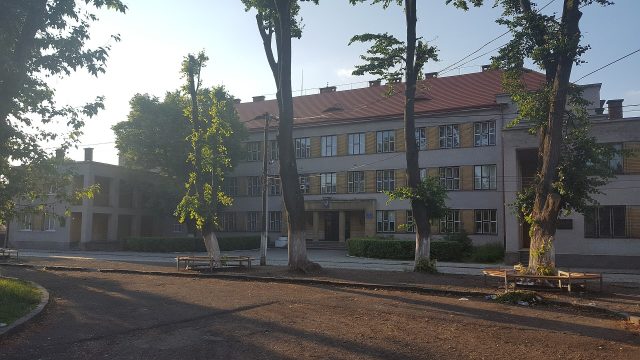
Perched on a gentle hill in the heart of Khust, St. Nicholas Church feels like a quiet guardian of time. From its modest elevation, the wooden structure overlooks the rolling foothills of the Carpathians, its steep shingle roof and unassuming silhouette blending naturally with the landscape. There’s no grandeur here—no towering stone facades or gilded domes—just the warm, weathered wood of a building that has stood through centuries, shaped by the hands of local craftsmen and the rhythms of rural life. The church doesn’t demand attention; it simply exists, as it always has, a testament to the enduring spirit of the region.
The origins of St. Nicholas Church stretch back to the early 17th century, a time when Khust was a bustling hub on the trade routes between Hungary and Galicia. The first written records date to 1616, though some historians suggest an even older structure may have preceded it. In those days, wooden churches were more than places of worship—they were communal anchors, offering shelter during raids, hosting festivals, and serving as the emotional core of village life. The church has survived fires, invasions, and wars, each time rebuilt with care to preserve its original character. The fact that it still stands today is less a miracle than a reflection of the determination of those who refused to let it disappear.
The architecture is a fine example of Transcarpathian wooden craftsmanship, a style that prioritizes harmony with the surroundings over ornate decoration. The church follows a traditional three-part design: a tall central nave topped with a steep, shingled roof, flanked by a smaller narthex and an altar. The shingles, silvered by time, seem to shift in color with the seasons—soft gray in winter, muted gold in autumn. Inside, the space feels surprisingly airy, with light filtering through narrow windows to illuminate the simple, hand-carved iconostasis. The icons themselves are striking in their understated beauty, their figures rendered with a warmth that feels almost intimate, as if the saints were neighbors rather than distant holy figures.
For generations, St. Nicholas Church has been woven into the fabric of Khust’s daily life. It has witnessed countless baptisms, weddings, and funerals, its walls absorbing the joys and sorrows of the community. During the Soviet era, when many religious sites were destroyed or repurposed, the church narrowly escaped demolition, though it was closed to worshippers for decades. Locals kept its memory alive, passing down stories of how it sheltered families during wartime, how carols echoed through its rafters at Christmas, and how its doors remained a place of solace in times of grief. Today, it has been restored to its original purpose, with services held regularly, drawing both parishioners and visitors curious about the region’s past.
The hill where the church stands is surrounded by old trees, their branches forming a natural canopy over winding paths that lead to small springs. In summer, the air is thick with the scent of wildflowers and damp earth, while winter transforms the scene into something almost fairy-tale-like—the church a snowy silhouette against a pale sky, smoke curling from chimneys in nearby houses. Just beyond the churchyard lies an old cemetery, its weathered headstones etched with crosses and inscriptions in Old Slavonic and Hungarian, a quiet reminder of the many cultures that have shaped this land.
What makes St. Nicholas Church special isn’t its size or opulence, but its authenticity. It doesn’t try to impress; it simply endures, carrying within its wooden beams the stories of those who built it, prayed in it, and fought to preserve it. There’s a humility to the place, a sense that it has always been exactly what it needed to be—a refuge, a gathering point, a silent witness to the passage of time. Visiting it feels less like stepping into a museum and more like being allowed into a living space, one that has seen centuries of human experience unfold.
The church also offers a glimpse into the broader history of Transcarpathia, a region where borders and allegiances have shifted countless times. Khust itself has been part of Hungary, Czechoslovakia, the Soviet Union, and now Ukraine, and the church stands as a rare constant in that ever-changing landscape. Its very existence is a testament to the resilience of local traditions, even as the world around it transformed. The fact that it remains an active place of worship, rather than a relic, speaks to the deep roots of faith in this corner of the Carpathians.
For those who take the time to visit, St. Nicholas Church offers more than just a photo opportunity. It invites reflection on the quiet strength of ordinary people—the craftsmen who built it, the families who maintained it, and the generations who found meaning within its walls. There’s no fanfare here, no grand narrative of conquest or revolution. Instead, there’s the quiet persistence of a community that refused to let its past fade away. In an age where so much is disposable, the church stands as a reminder of what endures.