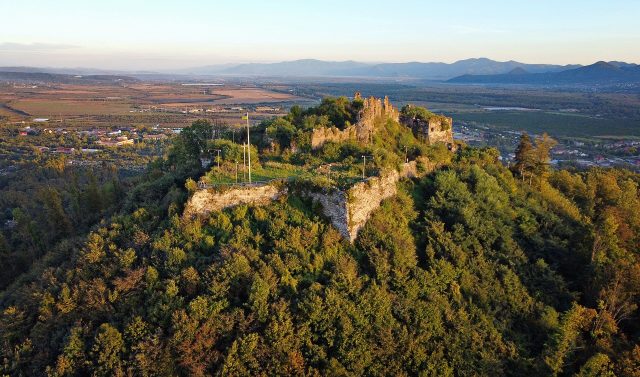
Perched on a steep hill overlooking the town of Khust, the ruins of Khust Castle offer more than just a glimpse into the past—they invite you to step into it. From this vantage point, the Tysa River valley unfolds below, framed by the gentle rise of the Carpathian foothills. The castle isn’t grand like some of Europe’s more famous fortresses, nor does it overwhelm with its scale. Instead, its weathered stones carry the quiet weight of centuries, bearing witness to battles, neglect, and the slow reclaiming of the land by nature. There’s something enduring about this place, as if the very air hums with the echoes of those who once walked these walls.
The first fortifications here date back to the 11th century, when the region was part of the Kingdom of Hungary. A wooden stronghold initially stood guard over trade routes and river crossings, a strategic outpost in a contested land. The stone castle began to take shape in the 13th century, as Hungarian kings recognized Khust’s importance as a border stronghold. It was meant to hold the line against the Principality of Galicia-Volhynia and later the Moldavian Voivodeship. More than just a military installation, the castle became a symbol of authority, its presence shaping the growth of the town below. Life within its walls was far from luxurious—this was a place built for survival, not comfort.
The architecture of Khust Castle reflects its purpose. The central keep, or donjon, towered over the rest of the structure, serving as the last line of defense. Thick walls with arrow slits encircled the inner courtyard, where living quarters, storage rooms, and a well were tucked away. Everything was designed to withstand a siege: supplies of food and water, defensive positions, and the ability to hold out against attackers. Even now, the remnants of the walls hint at the fortress’s former life—imagine the clamor of battle, the shouts of soldiers, the smoke rising from watchfires into the night sky. This was never a palace for feasts, but a fortress for war.
The castle’s history is one of resilience and decline. In the 14th century, it withstood multiple sieges, and in 1514, it fell briefly to peasant rebels led by György Dózsa. By the 17th century, it became a pawn in the power struggles between Transylvanian princes and the Habsburgs. The final blow came in 1709 during Ferenc Rákóczi’s uprising, when the fortress was partially destroyed. Abandoned by its last defenders, it slowly succumbed to time. Ivy crept over the stones, locals repurposed them for building materials, and by the 19th century, only ruins remained. Yet even in decay, the castle drew travelers and historians, its crumbling walls still holding stories untold.
Today, Khust Castle feels like a secret kept from the crowds. Unlike more famous ruins, it doesn’t attract hordes of tourists, which only adds to its charm. The climb up the hill is steep, but the reward is worth it: a quiet encounter with history, unfiltered and unpolished. Fragments of walls still stand, along with the remnants of arches and towers. The view from the highest point is particularly striking—the town sprawls below, the river winds through the valley, and the Carpathians loom in the distance. In summer, the grass whispers in the wind; in winter, snow blankets the ruins, turning them into a frozen memory of the past.
This isn’t just a tourist attraction; it’s a living piece of the region’s history. The castle stands as a reminder of shifting borders, of empires rising and falling, of people who lived, fought, and built here long before the modern world took shape. Legends have grown around it, as they often do with places steeped in time. Some say hidden treasures lie buried beneath the hill, never found. Others claim the spirits of the castle’s defenders still wander the ruins. Whether or not these stories hold any truth, they add a layer of mystery to the place, making it feel even more alive.
For history enthusiasts, the castle is a treasure trove. Here, you can see firsthand how medieval fortifications were constructed, how they functioned, and why they eventually lost their strategic importance. Unlike reconstructed fortresses, where everything looks too pristine, Khust Castle retains its authenticity. The stones are real, worn by time, and that makes them all the more compelling. Even if you’re not a historian, the ruins offer a chance to sit quietly, gaze out at the landscape, and feel the weight of centuries settling around you.
Khust is a small town, and the castle isn’t just a landmark—it’s part of its identity. Locals treat it with a kind of quiet reverence, as if it were an elderly relative who has seen it all. Occasionally, the castle becomes the backdrop for medieval festivals, where people in armor gather, music fills the air, and markets spring up around the ruins. But even without such events, the castle has a life of its own. Couples come here for quiet moments, photographers capture its moods, and history buffs wander the grounds, piecing together the past.
If you find yourself in Khust, don’t miss the chance to visit the castle. The best time to go is in the late afternoon, when the sun casts long shadows and the ruins take on a golden hue. Bring a thermos of tea or coffee, find a spot on one of the stones, and watch as the day fades into evening. In moments like these, it’s easy to understand why people have fought to preserve this place. It offers something rare in the modern world—a tangible connection to the past, a quiet reminder that history isn’t just something we read about, but something we can still touch.