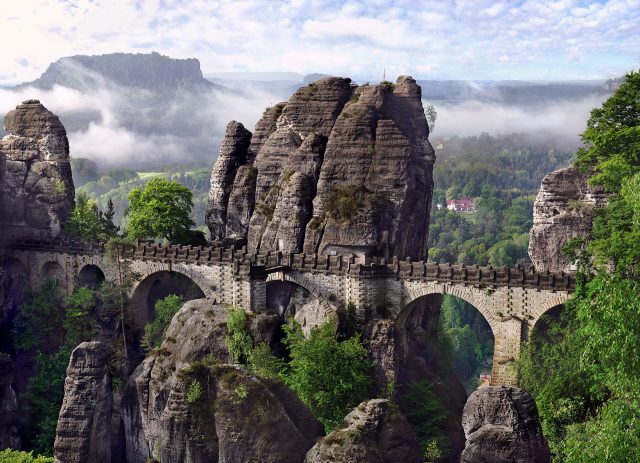
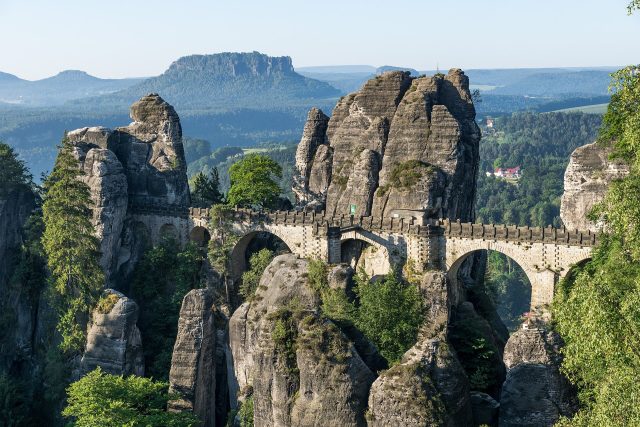
St. Michael’s Church in Rathen is one of those rare places where time seems to stand still, preserving the quiet dignity of medieval Germany. Nestled in a small town along the Elbe River, it feels like a natural extension of the landscape—its stone walls blending seamlessly with the rolling hills of Saxon Switzerland, its spire rising above the red-tiled roofs of the houses below. The church has witnessed centuries of change, its origins tracing back to the 12th century, when Rathen was a strategic trading and defensive post within the Holy Roman Empire. The first recorded mention of the church dates to 1160, though little remains of that original structure. Over the years, it has been rebuilt, expanded, and restored after fires and wars, each era leaving its mark on the building.
The architecture of St. Michael’s is a layered story of different periods. The oldest surviving part is the Romanesque portal, with its rounded arches and rough-hewn stone carvings—a remnant of the time when the church was part of a monastic complex, where Benedictine monks not only held services but also chronicled the life of the region. Later, during the Gothic era, the church gained its soaring pointed windows and vaulted ceilings, lending it an air of lightness and upward aspiration. Inside, the decor is understated yet evocative: wooden pews with intricately carved armrests, an altar depicting St. Michael triumphing over the dragon, and faded frescoes on the walls. The 17th-century pulpit, adorned with figures of the Evangelists, feels like a relic of the Reformation, when Rathen embraced Protestantism.
Beyond its religious significance, the church has long been a cornerstone of the community. In the Middle Ages, it served as more than just a place of worship—it was a gathering spot where townspeople made decisions that shaped their lives. During the Thirty Years’ War, Rathen, like much of Germany, suffered destruction, and the church often provided refuge. By the 19th century, when Saxon Switzerland became a magnet for artists and travelers, the church became part of the region’s romantic allure. It appeared in engravings and paintings, and later in photographs, admired for the way it harmonized with the rugged natural beauty around it. Today, it remains an active place of worship, where the sound of the organ fills the space on Sundays, echoing through the centuries.
The surroundings of Rathen are just as compelling as the church itself. The town moves at a slower pace, its main attractions within easy reach. From the church, a short walk leads to the Elbe’s riverbank, where old ferries still shuttle people and bicycles across the water. Nearby, narrow streets wind up to the ruins of Neurathen Fortress, offering sweeping views of the river’s bend and the rocky peaks beyond. In summer, the area buzzes with hikers exploring the national park, while locals host open-air markets and festivals. Winter brings a hush over the town, and St. Michael’s stands as one of the few places where history feels tangible, unburdened by crowds.
Inside the church, the atmosphere is quiet and almost reverent. Light filters through the stained glass, casting soft hues across the stone floor, while the scent of aged wood and candle wax lingers in the air. An ancient baptismal font, carved from a single block of stone, sits in one corner, and the walls bear faint inscriptions left by parishioners over the centuries—some barely legible, but all whispering of the past. Occasionally, the church hosts chamber music concerts, the sound of the organ or strings resonating through the vaulted ceilings, highlighting the space’s natural acoustics.
St. Michael’s is more than just an architectural landmark; it’s a living piece of history that continues to evolve. It has endured wars, religious shifts, economic hardships, and the ebb and flow of tourism, yet it remains a place where people still seek solace, inspiration, or simply a moment of quiet. For some, it’s a stop on the way to the Bastei Bridge or Königstein Fortress. For others, it’s a reason to linger in Rathen a little longer. For the locals, it’s woven into the fabric of their lives—a place where generations have been baptized, married, and remembered. That, perhaps, is its greatest value: it isn’t a museum, but a part of the town’s living story.
The church is open year-round, but it’s especially memorable in the off-season, when the light falls at just the right angle, making time feel suspended. If you’re lucky, you might catch the organist practicing, the music drifting through the open doors like a bridge to another era. In the evening, as the lanterns along the riverbank flicker to life, the church’s reflection shimmers in the dark waters of the Elbe, as if it’s still watching over the town, just as it has for centuries. Rathen doesn’t have the hustle of a big city, and that’s why it’s so easy to feel a connection to the past here—not through guided tours or plaques, but through the quiet, the light, and the stone that remembers.