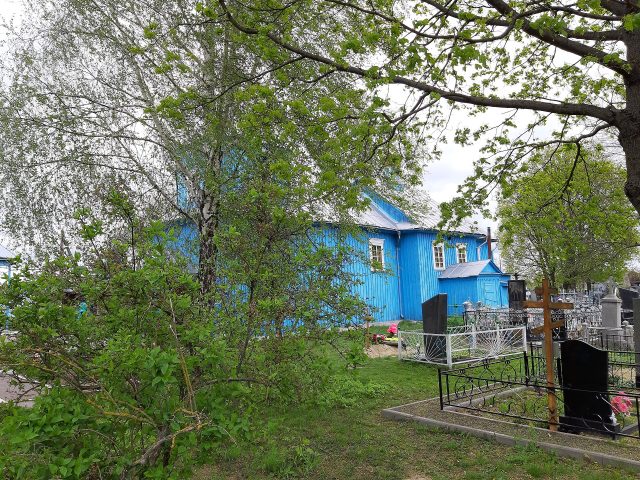
Turov is one of Belarus’s oldest towns, a place where history feels alive in the quiet rhythm of daily life. Perched on the banks of the Pripyat River, it was once a center of medieval trade and governance, where veche assemblies once gathered and later, churches rose to mark the passage of centuries. Among them, the Church of St. Michael the Archangel stands as a quiet witness to time, its presence unassuming yet deeply rooted in the landscape. From its slight hill, the view stretches over the river and the surrounding fields, as if the past lingers here, untouched by the rush of the modern world.
Built in the early 20th century, the church carries the spirit of an earlier era. Its brick walls and clean lines reflect the retrospective style common in ecclesiastical architecture of the time, a nod to tradition without excessive ornamentation. Inside, the space feels open and luminous—high vaulted ceilings, large windows, and a modest yet striking iconostasis create an atmosphere of quiet reverence. There is no grandeur here, only a sense of authenticity, the kind that feels rare in more recent constructions.
Local lore speaks of an older wooden church that once stood on this site, lost to fire before the current structure was built. The decision to use brick was practical, a way to ensure the building would endure. Like many places of worship in the region, the church faced closure during the Soviet era, only to be restored later as a functioning parish. Today, it serves not just as a place of prayer but as a destination for those drawn to the history of the Pripyat basin, where the past is never far from the surface.
The architecture is simple, almost austere, yet there is strength in its restraint. The facade is marked by narrow arched windows, a small pediment, and a bell tower rising above the entrance. Inside, the layout guides the eye toward the altar, where wooden pews, aged icons, and soft natural light foster a sense of stillness. Services here are not loud or ostentatious, but each one carries a quiet solemnity, as if time moves differently within these walls.
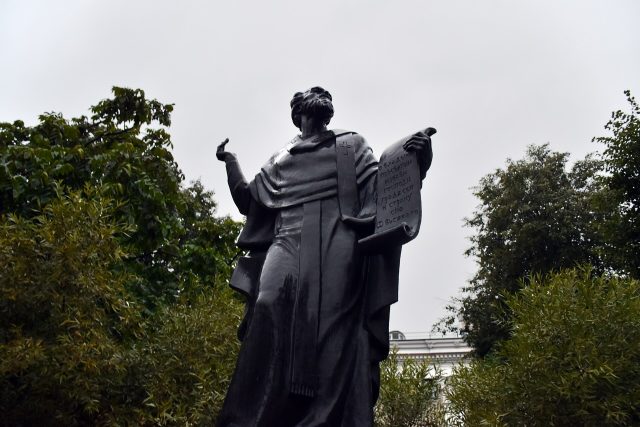
Turov has long been considered a spiritual heartland of the Polesia region. In the Middle Ages, it was one of the largest cities of Kievan Rus, later becoming the center of the Turov Principality. It was home to saints, including the renowned Cyril of Turov, whose sermons still resonate in Orthodox tradition. The Church of St. Michael the Archangel is just one of the town’s landmarks, yet it embodies the continuity of generations. Within its walls, the echoes of the past feel tangible—the murmur of prayers, the tolling of bells, the wind rustling over the Pripyat.
Visiting the church is as much about the atmosphere as it is about history. Turov doesn’t offer the kind of spectacle that draws crowds; instead, it offers silence and a chance to step away from the noise of everyday life. There are no throngs of tourists here, and the locals greet visitors with quiet warmth. If you’re fortunate, you might arrive during a service or simply find a moment to sit on a bench in the shade, watching the river and listening to the distant call of birds. In these moments, it’s easy to understand why this place holds such a pull for those seeking respite from the pace of modern life.
The Church of St. Michael the Archangel is not a museum piece but a living part of Turov’s daily rhythm. It doesn’t dazzle with opulence, and that is precisely its charm. Everything here feels genuine—the walls, worn smooth by time and touch, the air thick with the scent of incense and candle wax. Around the church, an old park offers a place to wander after a service, while the hill behind it provides a sweeping view of the Pripyat. From this vantage point, it’s clear why people have long sought solace and hope in this very spot.
Turov is a town that reveals itself slowly. To truly understand it, you need more than a passing visit—you need to linger, to walk its narrow streets, to browse the small shops selling local crafts, and, of course, to spend time in the church. It doesn’t announce its significance with fanfare, but if you listen closely, you can hear its story—a quiet one, as deep and enduring as the Polesian land itself.