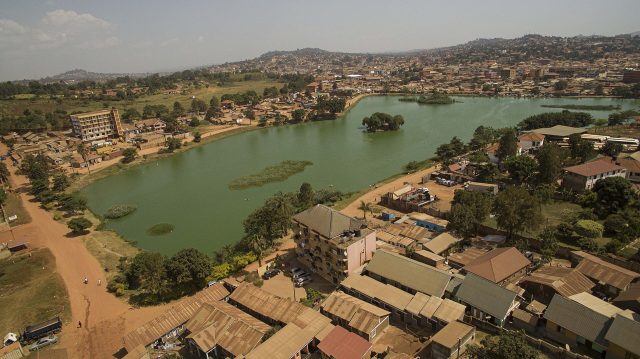
Perched on Lubaga Hill in Kampala, St. Matia Mulumba Church occupies a quiet space where Uganda’s past and present coexist without fanfare. The hill itself is unassuming, covered in greenery and dotted with the modest homes of a city that has grown around it. Yet this place carries the weight of history—one that stretches back over a century, long before the church bearing Matia Mulumba’s name was built. He was one of twenty-two Ugandan Christians executed in the late 1800s under the orders of Kabaka Mwanga II, their refusal to renounce their faith turning them into symbols of resilience. The church now stands as both a tribute to their memory and a living part of a story that reshaped the country’s religious landscape.
The building itself is unpretentious, designed with a quiet dignity that suits its surroundings. Constructed from local stone and brick, its high arched windows filter soft light into the interior, where the air feels still and cool. The red-tiled roof has weathered over time, its color deepening to blend with the earthy tones of the hill. Inside, the space is simple: wooden pews, an unadorned altar, and a handful of stained-glass windows depicting saints. There is no gilded opulence here, no marble grandeur—just the kind of understated solidity that makes a place feel real, as if the walls themselves have absorbed decades of whispered prayers.
Lubaga Hill is more than just another neighborhood in Kampala; it is a place deeply entwined with the history of Catholicism in Uganda. In the late 19th century, French missionaries established the first permanent Catholic mission here, on land that belonged to the kingdom of Buganda. Their arrival was met with cautious curiosity by Kabaka Muteesa I, but his successor, Mwanga II, saw the new faith as a threat to his authority. In 1886, he ordered the execution of a group of young Christians, including Matia Mulumba. Far from crushing the fledgling community, their deaths only strengthened the resolve of those who remained, turning martyrdom into a foundation for the church’s growth.
Today, St. Matia Mulumba Church serves as both a place of worship and a quiet monument to that history. From the hill, Kampala sprawls below—a mix of modern buildings and traditional homes, the city’s hum drifting upward like a distant murmur. Around the church, a small garden offers shade and a place to sit, where locals sometimes gather for picnics or moments of rest. There are no crowds here, no tour groups snapping photos. This is a church where people come not for spectacle, but for stillness, for the chance to step away from the noise of daily life.
Inside, time moves differently. On Sundays, the congregation fills the pews—men, women, and children dressed in modest, well-kept clothes. Services are held in English and Luganda, and though the singing may not always be perfectly in tune, it carries a sincerity that polished choirs sometimes lack. After mass, many linger, chatting with neighbors or simply sitting in the cool quiet. For some, this is a routine part of life; for others, it’s a connection to something deeper, a reminder of the faith that took root here long before they were born.
St. Matia Mulumba Church isn’t the kind of place that demands attention. It doesn’t feature in glossy travel brochures or top-ten lists, and most visitors to Kampala will never hear of it. That’s part of what makes it special. There’s no rush here, no pressure to perform or impress. Just a hill, a church, and people who come because they want to—not because they feel they should. In a world that often equates value with volume, places like this offer a different kind of richness: one found in simplicity, in the quiet persistence of history, and in the unspoken understanding that some things don’t need to be loud to matter.