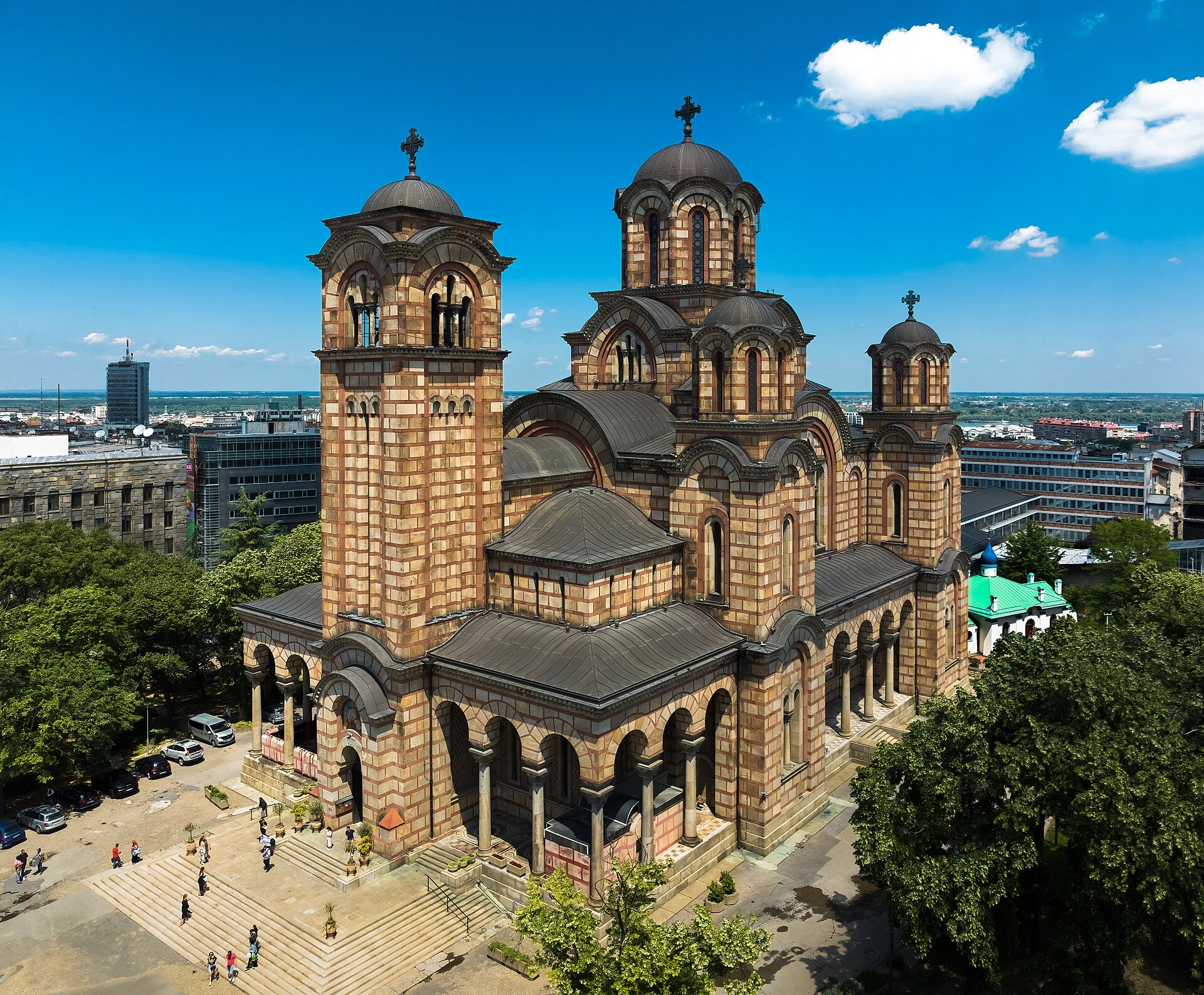
St. Mark’s Church doesn’t announce itself with grandeur but lingers in memory. Tucked away in Tašmajdan, it doesn’t command attention like St. Sava’s Cathedral, yet there’s a quiet strength to it. This church isn’t just a building—it’s a piece of history that has weathered wars, political shifts, and time while retaining the spirit of the era in which it was built.
Construction began in the 1930s, when Belgrade was evolving into a modern European capital but still carried echoes of centuries under Ottoman rule. Architects Petar and Branko Krstić chose a Serbian-Byzantine style, a revivalist movement that flourished in the early 20th century as a symbol of national identity. Inspired by medieval Serbian monasteries, particularly those of the Raška school, the design balances monumentality with lightness. The façade, with its alternating bands of red brick and white stone, gives the structure a rhythmic quality. The domes convey steadiness.
Inside, St. Mark’s impresses with its use of space. Light filters through narrow windows, illuminating frescoes painted in the mid-20th century. These murals follow traditional techniques. The wooden iconostasis is simple. People come here for services, to sit in silence, reflect, or talk with others. St. Mark’s exists as part of the city’s daily rhythm.
The history of this site stretches beyond the church itself. Tašmajdan, where it stands, was an Ottoman quarry—its name means "stone yard." Later, it became a cemetery. In the 19th century, after Belgrade’s liberation from Turkish rule, the area developed. The current church replaced a small wooden one built in the early 1800s, which was meaningful to locals. Generations were baptized, married, and laid to rest here. When the new church was built in the 1930s, the old one was demolished, but its legacy remained.
St. Mark’s endured World War II and the Allied bombings of Belgrade in 1944. Though damaged, it survived. In the postwar socialist era, when religion was sidelined, the church wasn’t shut down. Baptisms, weddings, and funerals continued.
Today, the church remains active. Some light candles, others sit on the wooden benches, and a few talk with the priest. On weekdays, the atmosphere is intimate—the rustle of prayer books, the creak of floorboards. Sundays bring more activity, but the church never feels crowded.
Beyond its religious role, St. Mark’s hosts concerts of sacred music, iconography exhibitions, and theological discussions. These events attract the devout and the curious alike.
If you’re in Belgrade, stop by. You don’t need to be religious to sense this place is part of the city’s soul. There’s no extravagance, just authenticity. You might stand at the entrance, looking at old photographs of parishioners, or wander the paths of Tašmajdan. Often, the unassuming places are the most meaningful.